
Weight Loss Education, Weight Loss Medication
SS-31 Peptide: 9 Essential Mitochondrial Research Facts
Sep
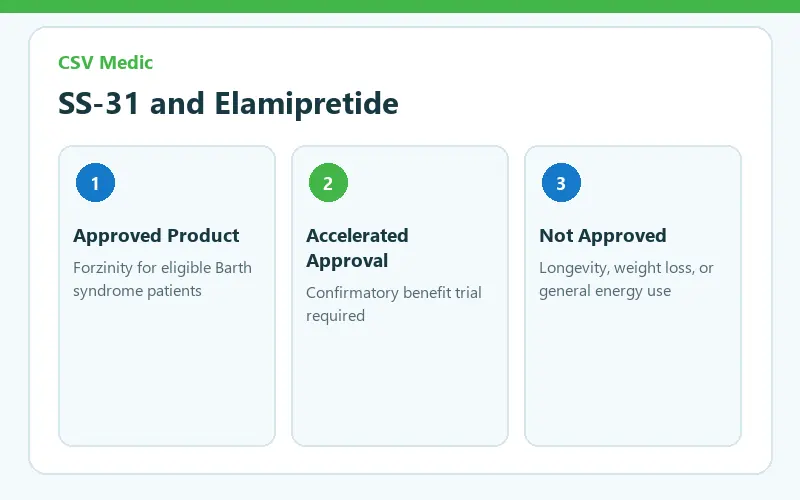
SS31 peptide is another name used for elamipretide, a mitochondria-targeting tetrapeptide. The regulatory story changed in September 2025: FDA granted accelerated approval to the specific prescription product Forzinity (elamipretide) for improving muscle strength in adults and children with Barth syndrome who weigh at least 30 kilograms.
That narrow approval does not mean every “SS-31” vial sold online is FDA approved. It does not approve elamipretide for fatigue, longevity, athletic performance, weight loss, long COVID, general mitochondrial support, or anti-aging. FDA approval applies to a specific product, manufacturer, formulation, indication, population, label, and quality system.
This distinction is the central safety message. SS-31 has substantial scientific interest and a legitimate approved use, but consumer peptide marketing often stretches rare-disease evidence far beyond the patients and outcomes studied.
Key Takeaways
- SS-31, elamipretide, MTP-131, and Bendavia are names associated with the same investigational history, but products may not be interchangeable.
- Forzinity is FDA approved under accelerated approval for a specific Barth syndrome indication.
- The approved population includes adults and pediatric patients with Barth syndrome who weigh at least 30 kg.
- Approval was based on an intermediate endpoint involving knee extensor muscle strength.
- Continued approval may depend on a confirmatory trial demonstrating clinical benefit.
- Approval does not cover weight loss, energy enhancement, longevity, recovery, or general mitochondrial wellness.
- The FDA-approved label, not an online SS-31 peptide dosage chart, governs use of Forzinity.
- Serious hypersensitivity and injection-site reactions are relevant safety concerns.
- Unapproved online or compounded vials are not automatically equivalent to Forzinity.
What Is SS31 Peptide?
SS-31 is a small synthetic peptide consisting of four amino acids. Its generic drug name is elamipretide. Researchers designed it to interact with cardiolipin, an important phospholipid in the inner mitochondrial membrane.
Mitochondria help cells produce energy. Cardiolipin contributes to mitochondrial membrane structure and the organization of proteins involved in energy production. Elamipretide has therefore been investigated across multiple mitochondrial and degenerative conditions.
The phrase peptide SS31 may appear on research-vial labels, while regulated clinical literature generally uses elamipretide. A name match alone does not establish pharmaceutical equivalence. Concentration, purity, excipients, manufacturing controls, storage, sterility, delivery device, and clinical indication all matter.
CSV Medic’s MOTS-C review explains a different mitochondrial peptide, while Is NAD a Peptide? addresses another frequently confused metabolic product.
What Is Barth Syndrome?
Barth syndrome is a rare, serious, X-linked genetic condition caused by pathogenic variants involving the TAFAZZIN gene. It primarily affects males and can involve cardiomyopathy, skeletal muscle weakness, exercise intolerance, neutropenia, growth problems, and metabolic abnormalities.
This is not ordinary tiredness or reduced gym performance. Diagnosis requires specialist evaluation and genetic confirmation. Patients often need coordinated cardiology, metabolic, hematology, nutrition, rehabilitation, and genetic care.
FDA’s Forzinity approval announcement describes the disease and the approved population.
Is SS-31 Peptide FDA Approved?
The accurate answer requires precision.
Yes, FDA approved Forzinity, whose active ingredient is elamipretide, in September 2025. It is indicated to improve muscle strength in adults and children with Barth syndrome weighing at least 30 kg.
No, that approval does not apply to every SS31 peptide product, every compounded vial, or every proposed use. There is no broad FDA approval for “mitochondrial repair,” fatigue, weight loss, anti-aging, exercise enhancement, neuropathy, or general wellness.
The FDA prescribing information is the authoritative source for the approved formulation, indication, dosing, warnings, and administration. FDA’s Drug Trials Snapshot explains the evidence in patient-friendly language.
What Does Accelerated Approval Mean?
Accelerated approval allows FDA to approve a drug for a serious condition based on a measure considered reasonably likely to predict clinical benefit. It can provide earlier access where there is an unmet medical need, while requiring further study.
For Forzinity, FDA based accelerated approval on improvement in knee extensor muscle strength. The agency requires a randomized, double-blind, placebo-controlled post-approval trial to confirm that this change translates into patient benefit, such as improved standing or walking function.
Accelerated approval is real FDA approval. It is not a provisional social-media endorsement. At the same time, the confirmatory requirement is important and should not be omitted from marketing summaries.
| Regulatory statement | Accurate interpretation |
|---|---|
| Forzinity is FDA approved | Correct for the labeled Barth syndrome population and use |
| SS-31 is approved for mitochondrial health | Too broad and misleading |
| FDA proved SS-31 reverses aging | False |
| Approval covers research vials | False; approval is product-specific |
| More research is required | Correct; confirmatory clinical benefit must be evaluated |
SS31 Peptide Benefits: What Is Established?

Searches for SS31 peptide benefits and SS-31 peptide benefits often list energy, endurance, reduced fatigue, cardiac support, neuroprotection, kidney support, muscle recovery, or longevity.
The established claim is narrower: Forzinity is indicated to improve muscle strength in eligible patients with Barth syndrome. Other conditions remain investigational unless separately approved in the future.
The pivotal evidence came from a small rare-disease program. FDA’s trial snapshot notes that the controlled study enrolled 12 patients at one U.S. site. Rare-disease trials often face unavoidable recruitment challenges, but the small and demographically limited sample affects how confidently findings can be generalized.
A published phase 2/3 Barth syndrome trial did not meet its primary endpoints during the randomized crossover period. Improvements were reported during the open-label extension, including knee extensor strength, which later contributed to the accelerated-approval evidence package. Open-label findings can be informative, but they are more vulnerable to bias than blinded placebo comparisons.
SS-31 Research Beyond Barth Syndrome
Elamipretide has been investigated in primary mitochondrial myopathy, heart failure, kidney disease, ophthalmic conditions, Friedreich ataxia, and other disorders. A listing on ClinicalTrials.gov means a study exists; it does not mean the intervention was effective or approved.
For example, the ELViS-FA trial listing concerns Friedreich ataxia. Patients should review the study status and results rather than treating enrollment or a protocol as proof.
Research into a shared pathway does not make all mitochondrial diseases equivalent. Genetic cause, tissue involvement, disease stage, outcome measures, formulation, and dose may differ substantially.
SS-31 Peptide Dosage: Approved Label Versus Online Protocols
Forzinity has an FDA-approved label for eligible Barth syndrome patients. That label contains a product-specific regimen and an adjustment for adults with severe renal impairment. Only the treating specialist should apply it to a patient.
An online SS-31 peptide dosage or SS31 peptide dosage is not a substitute for that label. Research-vial schedules marketed for energy or longevity are not approved protocols. They may use different concentrations, excipients, manufacturing methods, or chemical forms.
The search phrase SS-31 peptide dosage also risks a dangerous shortcut: copying a number from a rare-disease study into self-treatment. A dose is inseparable from diagnosis, product identity, route, renal function, monitoring, storage, injection training, and adverse-event planning.
CSV Medic does not provide self-dosing instructions for unapproved SS-31 products. General injection risks are reviewed in Peptide Injections: Safety and Cancer Facts.
Forzinity and SS-31 Side Effects
The approved label reports injection-site reactions as the most common adverse reactions. FDA also identifies serious hypersensitivity reactions and lists hypersensitivity as a contraindication.
Relevant concerns include:
- injection-site redness, pain, swelling, or other local reactions;
- allergic and hypersensitivity reactions;
- infection or technique-related injury;
- benzyl alcohol exposure considerations in the approved formulation;
- dosing considerations in severe renal impairment;
- uncertainty when an unapproved product differs from the approved formulation;
- contamination, incorrect strength, or storage failure in unauthorized products.
Patients using the approved drug should follow the current prescribing information and contact their care team about reactions. Trouble breathing, throat swelling, fainting, or rapidly worsening systemic symptoms require emergency evaluation.
SS-31 Versus MOTS-C

| Feature | SS-31/elamipretide | MOTS-C |
|---|---|---|
| Type | Synthetic mitochondria-targeting tetrapeptide | Mitochondrial-derived peptide studied in metabolism |
| FDA-approved product | Forzinity for a narrow Barth syndrome indication | None |
| Approved wellness or longevity use | No | No |
| Human evidence | Product-specific rare-disease clinical program | Limited and no approved therapeutic indication |
| Key risk in comparisons | Extending Barth syndrome approval to unrelated uses | Turning early metabolic research into treatment claims |
Combining the products in a “mitochondrial stack” has not been validated by controlled clinical trials. More ingredients create more uncertainty about product quality, interactions, and the cause of adverse effects.
Who Should Not Self-Treat With SS-31 Products?
No one should use an online research vial as a substitute for the approved prescription product or specialist care. Particular caution applies to:
- people without a confirmed Barth syndrome diagnosis who are seeking energy or longevity effects;
- pregnant or breastfeeding people;
- children outside a specialist rare-disease program;
- people with severe kidney disease;
- anyone with a history of serious drug hypersensitivity;
- people combining several injectable peptides;
- patients who cannot verify the licensed prescriber, pharmacy, manufacturer, and lot;
- competitive athletes subject to anti-doping rules.
Fatigue can result from anemia, sleep apnea, thyroid disease, heart disease, depression, infection, medication effects, undernutrition, diabetes, or many other causes. Diagnosis should precede treatment.
How to Evaluate an SS31 Product Claim

Ask:
- Does the page name Forzinity and state the exact approved indication?
- Does it explain accelerated approval and the confirmatory trial requirement?
- Is the product an FDA-approved Forzinity package or an unrelated vial?
- Is a Barth syndrome specialist involved?
- Does the page avoid longevity, weight-loss, and anti-aging promises?
- Are hypersensitivity and injection-site reactions disclosed?
- Is the manufacturer, pharmacy, lot, storage, and adverse-event process verifiable?
- Is the seller confusing “same peptide” with “same approved drug”?
Patient Discussions Are Anecdotal
A Reddit thread requesting SS-31 dosing and results shows why patients encounter conflicting schedules and highly variable experiences. Such posts are not clinical evidence. Users may receive different substances, use multiple products, report selectively, or attribute unrelated changes to an injection.
The correct comparison is not between the most enthusiastic posts. It is between claims and the FDA label, controlled trials, complete safety reporting, and the patient’s actual diagnosis.
Myths Versus Facts About SS-31
Myth: FDA approval means every SS-31 vial is approved
Fact: FDA approved Forzinity, a specific elamipretide product made under an approved application. A research vial, compounded preparation, or foreign product does not inherit that approval because its label uses the same development name.
Myth: Mitochondrial targeting proves an anti-aging effect
Fact: A mechanism can support research without establishing longevity, cognitive, weight-loss, or performance benefits. Human aging involves many pathways and cannot be reduced to one mitochondrial interaction.
Myth: Rare-disease evidence applies to healthy adults
Fact: Barth syndrome is a defined genetic disease with abnormal cardiolipin biology. Results in that population cannot automatically predict outcomes in people seeking general energy or recovery support.
Myth: Accelerated approval means FDA skipped safety review
Fact: Accelerated approval is an established regulatory pathway. FDA reviews a product’s evidence and manufacturing information, while requiring confirmation of clinical benefit after approval when an intermediate endpoint supports the decision.
Product Selection and Pharmacy Questions
A patient with confirmed Barth syndrome should receive the FDA-approved product through the prescription and specialty-pharmacy pathway arranged by the treating team. Questions should include insurance authorization, refrigeration or storage, injection training, missed-dose instructions, renal function, management of site reactions, and access to emergency support for hypersensitivity.
Patients should be wary when a seller uses the Forzinity approval to promote a different SS-31 product. Ask for the National Drug Code, manufacturer, original packaging, prescribing information, and dispensing-pharmacy details. A certificate of analysis for bulk powder is not equivalent to an approved finished-drug application.
FDA’s compounding questions and answers explains that compounded drugs do not undergo FDA premarket review for safety, effectiveness, or quality. Compounding cannot be described as an FDA-approved shortcut to uses outside the Forzinity label.
What Future SS-31 Research Should Answer
The confirmatory Barth syndrome trial must test whether the intermediate muscle-strength finding translates into meaningful function. Other research programs need condition-specific endpoints, adequate controls, diverse enrollment, transparent adverse-event reporting, and product-standardization details.
Future studies may clarify whether elamipretide has value in other mitochondrial diseases. Until those studies produce persuasive results and regulators review a specific application, investigational uses should remain investigational. Scientific potential and commercial availability are not the same thing.
Researchers should also report outcomes that patients can feel and use in daily life, not only laboratory or imaging changes. Walking ability, fatigue, participation, hospitalization, symptom burden, and quality of life may all matter, depending on the disease. Long-term follow-up is especially important when treatment begins in childhood or continues for years.
Broader and more diverse enrollment would improve understanding of how benefits and reactions vary. Transparent publication of negative and neutral findings is equally important because selective success stories can exaggerate confidence in a developing therapy.
Frequently Asked Questions
Is SS31 peptide the same as elamipretide?
SS-31 is a development name for elamipretide. However, products using the SS-31 name are not automatically equivalent to the FDA-approved product Forzinity.
Is SS-31 FDA approved?
Forzinity (elamipretide) is FDA approved under accelerated approval for eligible patients with Barth syndrome. Other products and uses are not covered by that approval.
Is SS-31 approved for fatigue or longevity?
No. General fatigue, longevity, athletic performance, and anti-aging are not approved indications.
What are the proven SS31 peptide benefits?
The approved indication is improvement of muscle strength in adults and children with Barth syndrome weighing at least 30 kg. Broader online benefit lists are not established indications.
Does SS-31 cause weight loss?
It is not an FDA-approved weight-loss medication, and rare-disease muscle-strength evidence should not be converted into a weight-loss claim.
Can patients use an online SS-31 peptide dosage chart?
No. The approved product has prescribing information for a specific disease and patient population. Research-vial charts are not validated substitutes.
What does accelerated approval mean for patients?
The drug is approved, while continued approval may depend on confirmation that the intermediate endpoint predicts meaningful clinical benefit.
Is compounded SS-31 the same as Forzinity?
No. Compounded drugs are not FDA approved, and a compounded or research product should not be represented as equivalent to the approved formulation.
Where can readers verify current information?
Use the FDA approval announcement, current prescribing information, Drugs@FDA, PubMed, ClinicalTrials.gov, and a Barth syndrome specialist.
Selected Medical Sources
- FDA accelerated-approval announcement for Forzinity
- Current Forzinity prescribing information
- FDA Drug Trials Snapshot for Forzinity
- FDA ongoing accelerated-approval requirements
- FDA orphan-drug designation and approval record
- PubMed: randomized Barth syndrome trial
- PubMed: 168-week open-label extension
- ClinicalTrials.gov: confirmatory Forzinity study
These sources support a product-specific conclusion. Forzinity’s indication cannot be extended to generic SS-31 products or unrelated wellness uses. CSV Medic’s How It Works page explains how to ask about legally available services without assuming that an experimental product is offered.
Conclusion
SS31 peptide has moved from experimental mitochondrial research to a specific FDA-approved rare-disease product. That is meaningful progress, but it demands more precise communication, not broader marketing.
Forzinity’s approval applies to eligible patients with Barth syndrome and includes a confirmatory evidence requirement. It does not validate online SS-31 products for energy, longevity, weight loss, or recovery. Readers can continue with CSV Medic’s peptide education and medical disclaimer.
Editorial and Medical Review Status
This educational draft was prepared from FDA materials, the current prescribing information, peer-reviewed literature and clinical-trial records available on September 1, 2026. It is saved for medical and editorial review by Dr Spencer before publication. The Forzinity label, confirmatory-study status and related regulatory information should be checked again on the publication date.
Medical disclaimer: This article is educational and is not medical advice, a diagnosis, or a prescribing guide. Patients with Barth syndrome or suspected mitochondrial disease require specialist care. Use only an FDA-approved prescription product exactly as directed by the treating clinician.
