
Weight Loss Education, Weight Loss Medication
Is There a Generic Ozempic? 9 Essential Facts
Sep
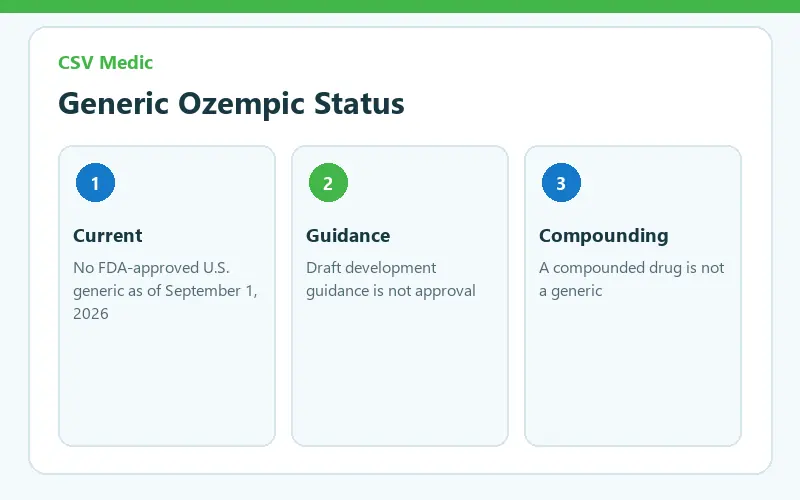
There is no FDA-approved generic Ozempic listed for U.S. patients as of September 1, 2026. Ozempic is a branded semaglutide injection. FDA has published draft guidance intended to help companies develop proposed generic semaglutide products, but guidance is not approval and does not make a product available at pharmacies.
Compounded semaglutide is also not generic Ozempic. Compounded drugs are not FDA approved, are not automatically bioequivalent to Ozempic, and cannot legally be marketed as “the same as” or a generic version of an approved drug. An Ozempic pill or Ozempic tablet is a separate question: oral semaglutide products and Wegovy tablets have their own brands, formulations, indications, and instructions.
This guide explains the generic approval process, patent and device complexity, current oral options, cost strategies, and how to recognize misleading “generic Ozempic” advertising.
Key Takeaways
- No FDA-approved generic Ozempic is available in the United States as of September 1, 2026.
- FDA’s 2026 draft product-specific guidance supports generic development but does not approve a medicine.
- A true generic must receive FDA approval through an Abbreviated New Drug Application.
- Generic applicants must address the drug substance, formulation, delivery device, quality, and bioequivalence requirements.
- Compounded semaglutide is not a generic and is not FDA approved.
- Semaglutide salts should not be assumed equivalent to the semaglutide base used in approved products.
- Ozempic is an injection; “Ozempic pill” usually refers incorrectly to a different semaglutide product.
- Rybelsus and Wegovy tablets are not generic Ozempic.
- Patients can explore coverage, assistance, and approved alternatives without purchasing an unverified product.
What Is a Generic Drug?
An FDA-approved generic contains the same active ingredient as the reference listed drug and must meet regulatory requirements for strength, dosage form, route of administration, quality, performance characteristics, and intended use, subject to permitted labeling differences.
Manufacturers generally submit an Abbreviated New Drug Application, or ANDA. They do not repeat every clinical trial performed for the brand, but they must demonstrate that the proposed product meets FDA standards, including bioequivalence where applicable.
FDA’s generic-drug facts explain that generic approval is a formal review, not a marketing description. A seller cannot turn an unapproved product into a generic by using the active ingredient’s name.
Is There a Generic Ozempic in 2026?
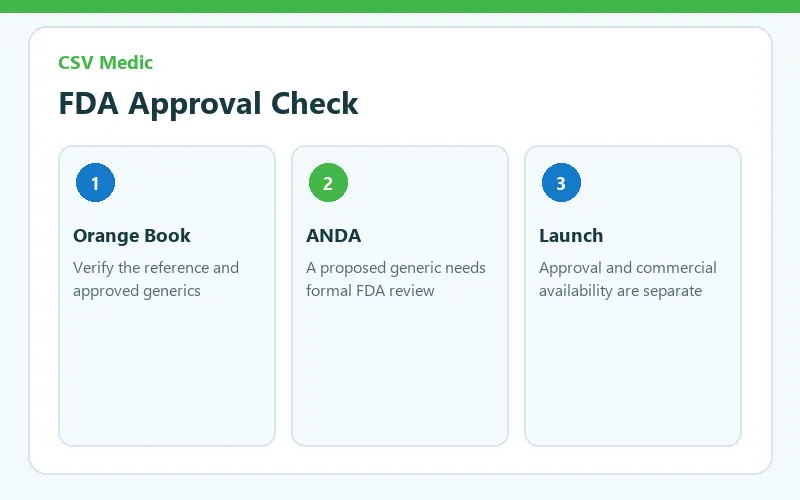
No FDA-approved Ozempic generic is available in the United States as of the date of this review. Patients should verify current approvals using the FDA Orange Book or Drugs@FDA rather than relying on a marketplace listing.
Search results may show semaglutide vials, “generic GLP-1,” compounded injections, salt forms, imported products, or research-use products. None should be assumed to be an FDA-approved generic Ozempic.
CSV Medic’s Ozempic cost guide describes branded access questions without representing compounded products as generics.
What Did FDA Publish in July 2026?
On July 28, 2026, FDA announced revised draft product-specific guidance for certain generic peptide products, including semaglutide. The agency said the guidance could help generic drug development and improve the efficiency of review.
The FDA generic peptide guidance announcement is important, but its meaning is narrow:
- it describes FDA’s current recommendations for proposed development;
- it does not announce an approved generic;
- it does not confirm that a particular company has submitted a complete ANDA;
- it does not set a guaranteed pharmacy launch date;
- it does not override patents, exclusivities, litigation, manufacturing review, or device requirements.
Draft guidance is part of a regulatory pathway, not the end of it.
Why Is Generic Ozempic Complex?
Ozempic is more than a powdered ingredient. A proposed generic must address the semaglutide drug substance, formulation, stability, impurities, manufacturing controls, container-closure system, injection device, dosing performance, and human-factors considerations where required.
Peptide products can be challenging because small differences in synthesis, impurities, aggregation, or degradation may affect quality or immune response. The pen is also part of safe delivery. Dose accuracy, needle compatibility, instructions, storage, and usability matter.
| Development area | Why it matters |
|---|---|
| Active ingredient | Identity and structural sameness must be established |
| Impurities | Peptide-related variants and contaminants require control |
| Formulation | Excipients and concentration affect stability and delivery |
| Bioequivalence | Exposure must meet FDA requirements |
| Device | Dose accuracy and safe use must be demonstrated |
| Manufacturing | Facilities and controls must meet quality standards |
| Labeling | Approved uses, warnings, and instructions must align legally |
An inexpensive vial sold without a reviewed pen or approved labeling has not demonstrated this package.
Patent and Exclusivity Questions
FDA approval and commercial launch are different events. A generic application can involve patents listed for the reference product, statutory exclusivities, certifications, litigation, settlement, and manufacturing readiness.
Patients often ask for an exact generic launch date. Public patent estimates can change, and a court, settlement, new patent listing, approval scope, or supply decision can affect timing. A responsible article should not promise a date that FDA has not announced.
The Orange Book provides patent and exclusivity information associated with approved drug products. It is more reliable than a countdown website, though it still does not guarantee launch.
Is Compounded Semaglutide Generic Ozempic?
No. Compounded semaglutide is not an FDA-approved generic Ozempic. Compounding can address an identified clinical need when federal and state requirements are satisfied, but compounded drugs do not undergo FDA premarket review for safety, effectiveness, or quality.
In February 2026, FDA announced enforcement intentions involving mass-marketed non-approved GLP-1 products and emphasized that compounded products cannot be advertised as generic versions or the same as approved drugs. See the FDA GLP-1 enforcement announcement.
FDA has also described concerns involving:
- dosing errors caused by varying concentrations and syringe units;
- fraudulent labels and nonexistent pharmacies;
- semaglutide salt forms that differ from the active ingredient in approved products;
- adverse events, some requiring hospitalization;
- shipping, storage, sterility, and quality failures;
- marketing that falsely implies FDA approval or equivalence.
The agency’s unapproved GLP-1 safety page should be part of any buying decision.
Semaglutide Base Versus Salt Forms
Approved Ozempic contains semaglutide base in a specific finished formulation. Some compounders or sellers have used semaglutide sodium or semaglutide acetate. FDA has stated that these are different active ingredients and has questioned whether the federal conditions for their use in compounding are met.
A salt name on a certificate of analysis does not prove sameness, bioequivalence, clinical effectiveness, or legal compliance. Patients should ask the prescriber and pharmacy for the exact ingredient form and reason it is being used.
CSV Medic’s peptide safety guide explains why chemical identity matters.
Is There an Ozempic Pill?
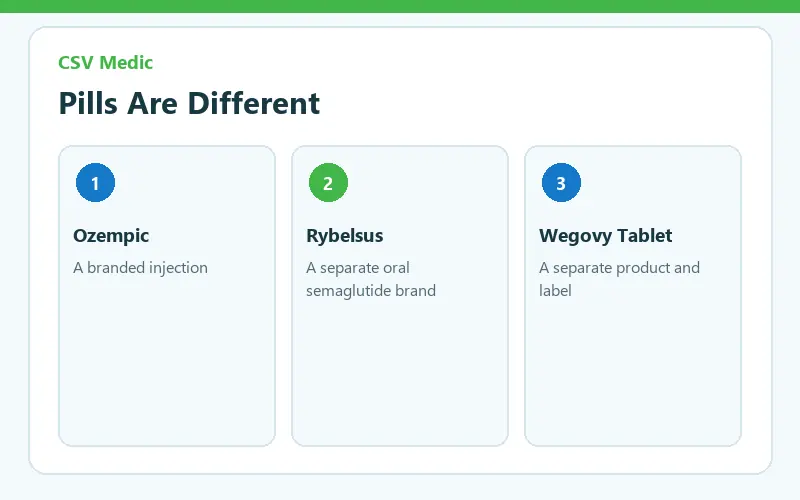
Ozempic is an injection brand. Searches for Ozempic pill, Ozempic pills, or Ozempic tablets often refer to one of several different things:
- Rybelsus, an oral semaglutide product for type 2 diabetes;
- Wegovy tablets, an oral semaglutide presentation under current weight-management labeling;
- unauthorized products using “Ozempic” as a generic marketing term;
- supplements claiming to mimic GLP-1 effects;
- counterfeit tablets.
These are not synonyms. Oral semaglutide uses absorption-enhancing formulation technology and strict administration instructions. A tablet dose cannot be converted milligram for milligram to an Ozempic injection.
| Product term | What it actually means | Generic Ozempic? |
|---|---|---|
| Ozempic | Branded weekly semaglutide injection | No; it is the reference brand |
| Rybelsus | Branded oral semaglutide for label-specific diabetes use | No |
| Wegovy tablet | Branded oral semaglutide for label-specific use | No |
| Compounded semaglutide | Non-FDA-approved patient-specific compounded product when legal conditions are met | No |
| “Natural Ozempic” supplement | Marketing term for non-equivalent products | No |
Are Ozempic and Wegovy the Same?
They contain semaglutide but are different approved products. Indications, devices, strengths, escalation, and labeling differ. Wegovy should not be called generic Ozempic.
Read Wegovy versus Ozempic and how Ozempic works for product-specific context.
What Could a Generic Cost?
Generic competition often lowers prices, but no one can responsibly promise the future cash price, coverage, or discount. Savings depend on the number of approved competitors, manufacturing capacity, supply, pharmacy contracts, insurance, rebates, and device costs.
Even after approval, a patient’s cost can include:
- deductible and coinsurance;
- clinical visits and laboratory tests;
- needles or supplies if applicable;
- pharmacy network restrictions;
- prior authorization;
- shipping or temperature-control charges;
- changes in manufacturer assistance programs.
An advertised “$99 generic Ozempic” before FDA approval should be treated as a warning sign, not a forecast.
Safe Ways to Reduce Cost Now
Patients can ask about:
- insurance formulary coverage for the diagnosed condition;
- prior-authorization criteria and documentation;
- official manufacturer savings or assistance eligibility;
- an approved therapeutic alternative on the plan’s formulary;
- lower-cost generic diabetes medicines when clinically appropriate;
- a non-GLP-1 obesity medicine;
- a structured lifestyle program;
- ninety-day supply or preferred-pharmacy rules when permitted.
The Centers for Medicare & Medicaid Services drug coverage information can help eligible patients understand Part D, while employer and commercial plans have separate rules.
Approved Alternatives to Discuss
If the goal is type 2 diabetes management, the clinician may consider metformin, an SGLT2 inhibitor, another GLP-1 medicine, tirzepatide, a DPP-4 inhibitor, a sulfonylurea, insulin, or another class based on the patient’s priorities.
If the goal is chronic weight management, approved options for eligible patients include Wegovy, Zepbound, Saxenda, Contrave, Qsymia, and orlistat products. Lifestyle treatment and metabolic surgery are evidence-based options.
Read CSV Medic’s Mounjaro versus Ozempic comparison and weight-loss programs for a broader framework.
What Would a Real Generic Approval Look Like?
An approved generic would be identifiable in an FDA database, not only on a clinic landing page. Drugs@FDA or the Orange Book would show the applicant, dosage form, strength, approval status, and reference product. The manufacturer and device would have approved labeling, and pharmacies would dispense it under a legitimate prescription.
Approval would not mean the generic is identical in every inactive ingredient or appearance. It would mean FDA completed the relevant quality, bioequivalence, manufacturing, labeling, and device review. The pharmacy could identify the manufacturer and National Drug Code, and a pharmacist could answer storage and administration questions.
Commercial availability may follow approval rather than occur on the same day. Manufacturing scale, wholesaler contracts, patent resolution, insurance formularies, and pharmacy inventory can delay access. Early supply may also be uneven.
An insurer may also take time to add a newly approved product to its formulary. Approval therefore does not guarantee immediate coverage, a low copayment, or stock at every retail pharmacy.
Patients should be skeptical if a seller claims to have an approved generic but cannot provide the manufacturer, NDC, approval record, and licensed dispensing pharmacy. “Made in an FDA-registered facility,” “pharmaceutical grade,” and “third-party tested” are not substitutes for an approved application. FDA registration does not mean FDA approved the finished drug.
The same caution applies outside the United States. A semaglutide product legally marketed in another country is not automatically an FDA-approved U.S. generic, and importing prescription drugs can involve separate legal and safety issues.
How to Verify a Product or Pharmacy
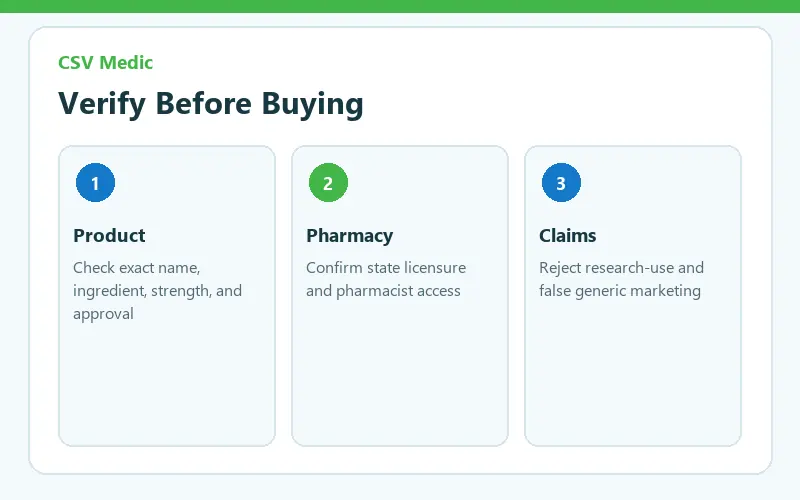
Before paying, verify:
- the exact product name, strength, and active ingredient form;
- whether the product appears in Drugs@FDA or the Orange Book;
- the prescriber’s professional license;
- the dispensing pharmacy’s license in the patient’s state;
- a physical address and working pharmacist contact;
- whether a legitimate prescription is required;
- how cold-chain delays and damaged packages are handled;
- whether the label includes lot, beyond-use or expiration date, storage, and concentration;
- whether “research use only” appears on a product promoted for human injection.
The FDA BeSafeRx program explains how to identify unsafe online pharmacies.
Counterfeit and Fraud Warning Signs
Warning signs include:
- “FDA registered” used as if it means product approval;
- guaranteed access without a prescription;
- payment only by cryptocurrency or wire transfer;
- no pharmacist or physical pharmacy address;
- prices far below credible market ranges;
- a vial or tablet called generic Ozempic without an ANDA approval;
- social-media messages offering bulk pens;
- packaging errors, poor printing, or an unfamiliar language label;
- pressure to inject a research-use product.
FDA has reported counterfeit Ozempic in the U.S. drug supply. Patients should inspect packaging and contact the pharmacy if anything appears unusual.
Patient Forums and Generic Questions
Online discussions often ask when a generic will launch or whether compounded semaglutide is equivalent. These conversations can identify common confusion, but users may cite outdated patent dates, non-U.S. products, or advertisements as evidence.
A Reddit discussion about compounded semaglutide and branded products is user-generated and should be treated as anecdotal. It cannot verify a product, pharmacy, approval, or personal dose. Regulatory status should be checked directly with FDA.
Frequently Asked Questions
Is there a generic Ozempic available now?
No FDA-approved generic Ozempic is listed in the United States as of September 1, 2026.
What is Ozempic generic called?
There is no approved U.S. generic name used as a marketed equivalent. Semaglutide is the active ingredient, not proof that a product is an approved generic.
Did FDA approve generic semaglutide in 2026?
FDA published revised draft development guidance. That is not an approval announcement.
Is compounded semaglutide the same as Ozempic?
No. Compounded drugs are not FDA approved and have not automatically demonstrated bioequivalence to Ozempic.
Is Rybelsus an Ozempic pill?
No. Rybelsus is a separate branded oral semaglutide product with its own approved uses and instructions.
Are Wegovy tablets generic Ozempic tablets?
No. Wegovy tablets are a branded product under separate labeling.
When will generic Ozempic be released?
There is no guaranteed U.S. launch date. Approval, patents, litigation, manufacturing, and commercial decisions can affect timing.
Will a generic use the same pen?
A proposed generic must meet FDA requirements for safe delivery and device performance. The final device may not look identical, and no product should be assumed equivalent before approval.
Can a pharmacy call compounded semaglutide generic Ozempic?
No. FDA has specifically objected to marketing compounded GLP-1 products as generic versions or the same as approved drugs.
How can I report a suspected counterfeit?
Contact the dispensing pharmacy, prescriber, and FDA. Serious adverse events can be reported through FDA MedWatch.
Conclusion
There is no FDA-approved generic Ozempic in the United States as of September 1, 2026. FDA’s draft semaglutide guidance is a step toward possible generic development, not a product approval or launch. Compounded semaglutide, Ozempic pills, Wegovy tablets, and supplements are not generic Ozempic.
Browse CSV Medic’s weight-loss medications or contact the team for information about legally available products, pharmacy services, and cost questions. Always verify the exact product and approval status before purchase.
Medical disclaimer: This article is for education only and is not medical, legal, or financial advice. Do not replace or stop prescribed treatment without a qualified clinician.
Editorial review: Prepared for CSV Medic and intended for Dr Spencer’s review before publication. FDA and market-status information checked September 1, 2026.
