
Weight Loss Education, Weight Loss Medication
Is NAD a Peptide? 9 Essential Healthy-Aging Facts

Jul
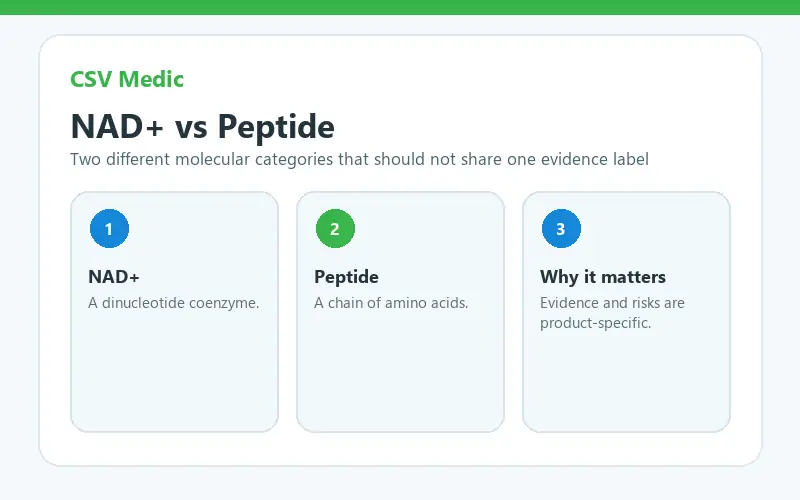
No. NAD is not a peptide. NAD+, short for nicotinamide adenine dinucleotide, is a dinucleotide coenzyme used in energy metabolism and cellular signaling. Peptides are short chains of amino acids. That chemical difference matters because products marketed together as longevity or wellness therapies can have very different evidence, quality standards, and safety concerns.
The question is nad a peptide has become more important as clinics and social-media posts place NAD+, peptide therapy, GLP-1 medicines, and supplements in the same conversation. They may appear in the same wellness program, but they are not interchangeable. This patient guide explains what NAD+ does, why the phrase NAD peptide is inaccurate, what human studies actually show, and how to evaluate healthy-aging and metabolic claims without relying on hype.
If you are new to this field, begin with CSV Medic’s plain-language explanation of what peptides are. It provides the amino-acid background that makes the answer to is nad a peptide much easier to understand.
Table of Contents
- 1. The direct chemistry answer
- 2. Why NAD+ is often called a peptide online
- 3. What NAD+ does in the body
- 4. What healthy-aging research can and cannot prove
- 5. NAD therapy compared with peptide therapy
- 6. Benefits claimed for NAD+
- 7. Injections, infusions, precursors, and safety
- 8. NAD+, weight loss, and metabolic health
- 9. A patient checklist for evaluating treatment
- Frequently asked questions
1. Is NAD a Peptide? The Direct Chemistry Answer
The clear answer to is nad a peptide is no. A peptide is made from amino acids joined by peptide bonds. NAD+ is built from two nucleotide units and functions as a coenzyme. The NIH PubChem record for nicotinamide adenine dinucleotide describes its molecular structure and chemical identity.
| Feature | NAD+ | Peptide |
|---|---|---|
| Basic structure | Two linked nucleotides | A short chain of amino acids |
| Main biological role | Coenzyme and metabolic electron carrier | Often a signaling molecule or hormone-like messenger |
| Examples | NAD+, NADH | Insulin, semaglutide, tirzepatide, tesamorelin |
| One product category? | No | No – evidence differs for every individual peptide |
| Automatic anti-aging treatment? | No | No |
This distinction is not merely academic. If a seller calls an injectable product a NAD peptide injection, the label can blur whether the product contains NAD+, a true peptide, a mixture, or something else. Patients need the exact active ingredient, concentration, route, pharmacy, and intended medical use before they can assess risk.
2. Why Is NAD+ Often Called a Peptide Online?
So, is nad a peptide if many clinics place it under peptide therapy? Usually, NAD+ and peptides are grouped as part of the same wellness service rather than the same chemical family. Marketing language may use NAD peptide as shorthand, even when the ingredients are biologically distinct.
The phrase NAD plus peptide can also describe a program that offers NAD+ alongside one or more peptides. It should not be interpreted as evidence that NAD+ itself is a peptide. A responsible clinician should name each ingredient separately, explain its regulatory status, identify the evidence for the proposed goal, and avoid presenting a bundle as one proven therapy.
The question “is NAD a peptide?” is therefore a useful label check. If the answer from a seller is vague, ask for the generic name of every active ingredient and a written explanation of why each one is being recommended.
CSV Medic’s peptide therapy safety guide explains why the exact molecule matters more than the broad category name. The same rule answers is nad a peptide: evaluate NAD+ as NAD+, not as a substitute label for every wellness injection.
3. What Does NAD+ Do in the Body?
NAD+ is present in living cells and participates in redox reactions that help convert nutrients into usable energy. It accepts electrons and can be converted to NADH, which helps move those electrons through metabolic pathways. NAD+ also serves as a substrate for enzymes involved in DNA repair, cell signaling, stress responses, and gene regulation.
These roles explain why NAD+ is frequently discussed with mitochondrial function, energy, metabolism, and aging. They do not prove that raising blood NAD+ will reverse aging, increase energy in every patient, or treat a disease. A molecule can be essential to biology without an extra dose becoming a universal therapy.
Answering “is NAD a peptide?” correctly prevents an important evidence error: research on a peptide receptor cannot be used as proof for NAD+, and NAD+ precursor data cannot be used as proof for an unrelated peptide.
NAD+ peptide: what does it do?
The wording NAD+ peptide what does it do combines two categories. NAD+ supports cellular metabolism as a coenzyme; a peptide acts according to its own amino-acid sequence and receptor targets. If a product contains both, each ingredient needs its own evidence and safety review. The answer to is nad a peptide remains no even when both are administered in the same clinic.
4. Is NAD a Peptide? What Healthy-Aging Research Shows
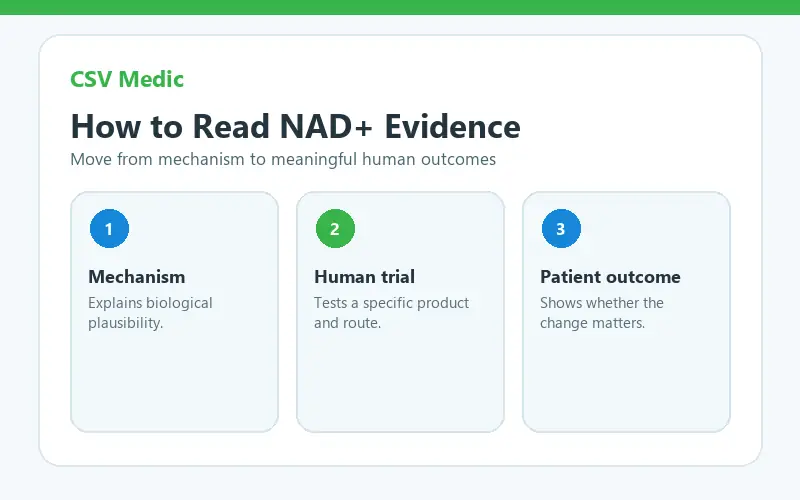
NAD+ biology is a serious research field. Laboratory and animal work links NAD+ metabolism to mitochondrial function, DNA repair, inflammation, and other processes associated with aging. A peer-reviewed review of NAD metabolism and longevity describes those mechanisms and the rationale for continued study.
Human evidence is more complicated. A critical review in NIH’s PubMed Central archive notes that early trials of NAD+ precursors can raise NAD-related metabolites, but clinical pharmacology and benefits for age-related disease remain incompletely understood. Raising a biomarker is not the same as extending lifespan, preventing disability, or improving how a person feels.
The assumption that human NAD+ always falls predictably with age is also being refined. A 2026 study of seven human cohorts reported that whole-blood NAD+ remained stable with age and lifestyle interventions, although it changed after nicotinamide riboside supplementation. Tissue, measurement method, health status, and the specific NAD metabolite can all affect results.
This is why is nad a peptide is only the first question. The next questions are whether the proposed product has human outcome data, whether the route was studied, whether the population resembles the patient, and whether the outcome was meaningful rather than only a laboratory measurement.
For healthy-aging claims, “is NAD a peptide?” should be followed by another direct question: has this exact product improved a meaningful human outcome, or has it only changed a laboratory marker in a small, short study?
What counts as meaningful evidence?
| Evidence level | What it can tell us | What it cannot establish alone |
|---|---|---|
| Cell experiment | Possible biochemical mechanism | Safety or benefit in a person |
| Animal study | Early biological plausibility | Human effectiveness or dosing |
| Small human pilot | Feasibility, biomarkers, early safety | Reliable benefit for broad populations |
| Randomized controlled trial | Stronger comparison of outcomes | Automatic relevance to every product or patient |
| Systematic review | Overall pattern across studies | Certainty when the underlying studies are small or different |
5. Is NAD a Peptide? NAD Therapy vs Peptide Therapy
NAD therapy and peptide therapy can overlap in a clinic, but the therapies are not one scientific category. Some true peptide medicines have FDA-approved indications. Other peptides are investigational, compounded, or sold only for research. NAD+ products can include oral precursors, supplements, infusions, or compounded injections, each with a different evidence base.
| Topic | NAD+ or NAD precursor | Peptide therapy |
|---|---|---|
| Chemistry | Dinucleotide coenzyme or a vitamin-derived precursor | Amino-acid chain |
| Examples | NAD+, NR, NMN, NADH | Insulin, GLP-1 medicines, tesamorelin, experimental peptides |
| Evidence | Depends on precursor, route, outcome, and population | Depends on the exact peptide and indication |
| FDA status | Must be checked product by product | Must be checked product by product |
| Common marketing risk | Calling every NAD+ product rejuvenating | Treating every peptide as proven or equivalent |
Patients comparing the two should read CSV Medic’s guide to peptide injections and safety. It explains why approval, clinical evidence, pharmacy quality, and monitoring must be checked separately. The answer to is nad a peptide does not make NAD+ automatically safer or riskier; it tells us to evaluate it in the correct category.
The answer to “is NAD a peptide?” also does not tell a patient whether either therapy is appropriate. Suitability depends on the exact product, indication, evidence, health history, potential interactions, and follow-up plan.
6. NAD Peptide Benefits: What Is Supported?
The phrase NAD peptide benefits is common, but it can overstate what has been proven. A 2024 systematic review of randomized human studies included 10 studies and 489 participants across different conditions. It reported that NADH and NAD-related precursors were generally tolerated in those trials, with some signals in selected outcomes, but it also emphasized the need for more research on specific diseases and regimens.
A small randomized pilot study in 20 older adults with mild cognitive impairment found that nicotinamide riboside raised blood NAD+ and was tolerated over 10 weeks, but it did not improve cognition. The peer-reviewed report and ClinicalTrials.gov record are useful examples of the difference between changing a biomarker and demonstrating a clinical benefit.
Another short trial in 30 overweight or obese middle-aged and older adults tested an oral NMN formulation. The published physiologic study reported changes in circulating NAD metabolites and several exploratory outcomes over 28 days. The study was small and short, so it cannot establish long-term weight-loss, disease-prevention, or longevity effects.
Potential advantages and important limitations
| Potential advantage | Important limitation |
|---|---|
| NAD biology is relevant to energy metabolism | Biological relevance does not prove a treatment outcome |
| Some precursors raise NAD-related biomarkers | A higher biomarker may not improve symptoms or longevity |
| Human trials are underway | Many studies remain small, short, or condition-specific |
| Multiple forms are available | Results from one form or route cannot be assumed for another |
| Medical monitoring can identify problems | Monitoring does not turn an unapproved claim into proven therapy |
When asking is nad a peptide, remember that the strongest conclusion is not that NAD+ has no biological value. It is that NAD+ should be discussed accurately and that benefits should match the product, route, population, and outcome actually studied.
7. NAD+ Precursors, Injections, and Infusions Are Not Equivalent
Oral nicotinamide riboside, oral nicotinamide mononucleotide, NADH supplements, intravenous NAD+, and compounded NAD+ injections are different interventions. Absorption, metabolism, dose exposure, sterility requirements, adverse effects, and clinical data vary. Evidence for an oral precursor should not be used as automatic proof for a NAD peptide injection.
This is a practical reason to ask “is NAD a peptide?” before discussing a dose or route. A recommendation that begins with an inaccurate product category may also confuse which clinical study, manufacturing standard, or safety warning applies.
The FDA has specifically warned sterile compounders about unsuitable food-grade NAD+ ingredients. The agency reported adverse events after injectable NAD+ products, including severe chills, shaking, vomiting, and fatigue, with some patients requiring medical treatment. FDA said the reactions were consistent with excessive endotoxin exposure.
Compounded drugs are not FDA-approved. According to the FDA’s compounding questions and answers, the agency does not verify their safety, effectiveness, or quality before marketing. Compounding can serve a legitimate patient need, but poor practices can lead to contamination or incorrect strength.
Possible concerns to discuss with a clinician
| Concern | Why it matters | Practical question |
|---|---|---|
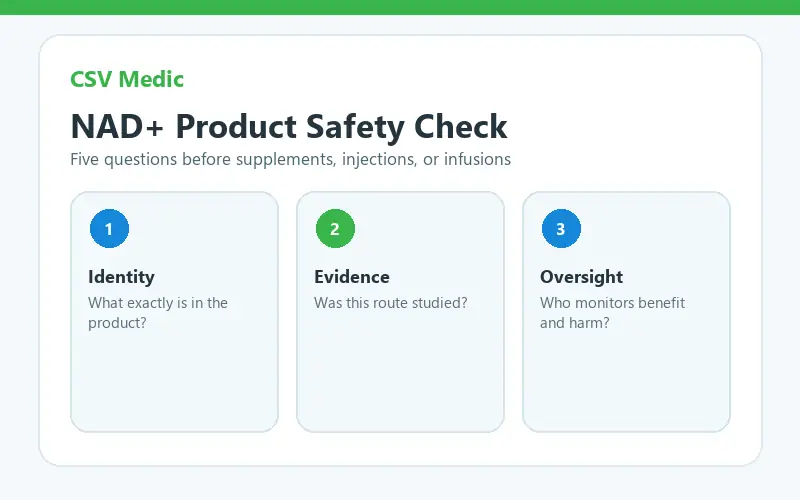
| Product identity | NAD+, a precursor, and a peptide are different | What exactly is the active ingredient? |
| Route | Oral and injectable evidence cannot be merged | Was this route studied for my goal? |
| Sterility | Injectables require appropriate sterile ingredients and controls | Who compounded and tested the product? |
| Adverse effects | Reactions can vary by product and route | What symptoms require urgent help? |
| Drug or disease interactions | Health history can change risk | What medications, labs, or conditions matter? |
| Follow-up | A one-time sale is not medical monitoring | Who reviews response and decides when to stop? |
CSV Medic’s guide to whether peptides are legal provides a broader explanation of approved, compounded, and research-only categories. Those distinctions remain useful after answering is nad a peptide because product status matters regardless of marketing language.
8. Is NAD a Peptide for Weight Loss?
NAD+ participates in metabolism, but that does not make NAD+ an FDA-approved weight-loss medication. Early studies of NAD-related precursors may measure insulin sensitivity, blood pressure, lipids, inflammation, body composition, or energy metabolism. These exploratory findings should not be converted into promises of predictable weight loss.
People researching NAD+ often also encounter GLP-1 medicines and weight-loss peptides. These are distinct therapies. FDA-approved obesity medicines have product-specific trials, labels, indications, contraindications, and dosing instructions. A NAD+ infusion does not become equivalent to an approved GLP-1 medicine because both are offered by the same clinic.
In weight management, “is NAD a peptide?” has a clear no answer. That distinction helps patients avoid comparing an NAD+ wellness claim with the product-specific outcome data for an approved peptide medicine.
For a patient-focused overview, see CSV Medic’s guide to peptides for weight loss and medical weight-loss programs page. They explain why treatment selection should begin with health history, body composition, nutrition, medications, goals, contraindications, and follow-up rather than a trending ingredient.
Lifestyle still carries the strongest healthy-aging foundation
The National Institute on Aging’s healthy-aging guidance emphasizes physical activity, nutritious food, adequate sleep, preventive care, mental health, and avoiding tobacco. These actions have broader human outcome evidence than claims that one infusion or peptide reverses aging.
- Use resistance training to support strength and lean mass, with a program appropriate for your health.
- Include regular aerobic activity and reduce long periods of sitting.
- Build meals around adequate protein, vegetables, fruit, whole grains, and appropriate total energy intake.
- Protect sleep and address snoring, insomnia, or daytime sleepiness with a clinician.
- Review blood pressure, glucose, lipids, medications, and age-appropriate screening.
- Avoid treating a supplement or injection as a replacement for established care.
The related CSV Medic article on peptides for muscle growth and fat loss explains why resistance training, nutrition, and realistic body-composition goals still matter when a medical therapy is being considered.
9. How to Evaluate an NAD+ or Peptide Program
After establishing that the answer to is nad a peptide is no, patients can use a structured review instead of relying on a product name. A good program should make it easy to identify the ingredient, clinical goal, evidence, legal status, pharmacy or manufacturer, expected monitoring, and stopping plan.
Write “is NAD a peptide?” at the top of a treatment checklist if the product description uses both terms. The provider should be able to explain the chemistry in plain language without using the category confusion to imply stronger evidence.
Patient product-selection checklist
- Write down the exact ingredient and do not accept NAD peptide as the complete name.
- Ask whether the product is FDA-approved for the proposed use, compounded, a supplement, or investigational.
- Request human evidence for the same ingredient, route, population, and health goal.
- Confirm the pharmacy or manufacturer and ask how quality and sterility are verified.
- Review medical conditions, medications, allergies, pregnancy status, and prior reactions.
- Ask what measurable outcome will be reviewed and when.
- Ask which side effects require a call, an appointment, or emergency care.
- Confirm that you can stop or change the plan if benefit is unclear or harms appear.
- Avoid products labeled for research only, not for human use, or sold without meaningful screening.
A licensed clinician can help separate a plausible biological mechanism from a suitable patient treatment. CSV Medic’s consultation process is designed to review the person, not simply match a trending phrase to a product. Review the site medical disclaimer for the limits of educational content.
Myths vs Facts About NAD Peptide Therapy
| Myth | Fact |
|---|---|
| NAD+ is a peptide | NAD+ is a dinucleotide coenzyme, not an amino-acid chain. |
| NAD peptide benefits are proven for everyone | Evidence varies by form, route, population, and outcome. |
| Higher NAD+ automatically means slower aging | Biomarker changes do not prove longer life or better function. |
| An infusion works like an oral precursor | Different routes have different exposure, evidence, and risks. |
| Natural molecules cannot cause harm | Endogenous molecules and sterile products can still cause adverse effects. |
| Compounded means FDA-approved | FDA does not approve compounded drugs. |
| One therapy can replace exercise and nutrition | Healthy aging depends on multiple behaviors and medical factors. |
The safest interpretation of online claims starts with one sentence: is nad a peptide? No. Once the categories are separated, it becomes easier to compare real studies, identify unsupported promises, and ask better questions.
A Practical Timeline for Reviewing Treatment
| Stage | What to review | Reasonable output |
|---|---|---|
| Before treatment | Diagnosis, goals, medications, labs, evidence, product source | A documented rationale and alternatives |
| Early follow-up | Tolerance, symptoms, adherence, and new concerns | Continue, adjust, pause, or investigate |
| Planned reassessment | Preselected clinical outcomes, not only a marketing biomarker | A benefit-risk decision |
| Long-term review | Ongoing need, cost, quality, and emerging evidence | Avoid indefinite treatment without a clear purpose |
There is no universal NAD+ timeline that guarantees more energy, weight loss, younger skin, or longer life. A useful timeline is built around a defined clinical question and measurable outcomes. If the goal, evidence, and stopping rule cannot be explained clearly, the plan is not ready.
Frequently Asked Questions
Is NAD a peptide or a vitamin?
NAD+ is a dinucleotide coenzyme. The body can make it through pathways that use vitamin B3-related precursors, but NAD+ itself is not a peptide and should not be described as a vitamin supplement without identifying the actual product.
Is NAD+ a peptide?
No. The answer to is NAD+ a peptide is the same: NAD+ is made from nucleotide components, while peptides are amino-acid chains. The plus sign describes the oxidized form of NAD; it does not change the molecule into a peptide.
What is NAD peptide?
What is NAD peptide usually refers to NAD+ offered within a peptide or wellness program. It is a marketing phrase rather than a precise chemical classification. Ask for the exact ingredient and route before judging evidence or safety.
What is NAD+ peptide?
What is NAD+ peptide is another version of the same terminology problem. NAD+ and peptides can be offered together, but NAD+ remains a dinucleotide coenzyme. A combined program requires a separate review of every ingredient.
What are NAD+ peptide benefits?
NAD+ peptide benefits should not be treated as one proven list. Some oral precursor trials show that NAD-related biomarkers can rise, while clinical benefits remain mixed and condition-specific. Injectable or infused NAD+ requires its own safety and effectiveness evidence.
Does NAD+ reverse aging?
No human evidence establishes NAD+ as a treatment that reverses aging. NAD metabolism is connected to processes studied in aging biology, but human healthspan and lifespan claims need adequately powered, long-term clinical trials.
Can NAD+ help with weight loss?
NAD+ is involved in metabolism, and small precursor studies have explored metabolic outcomes. It is not an FDA-approved weight-loss medication, and current evidence does not support a guaranteed weight-loss result from NAD+ injections or infusions.
Are NAD+ injections FDA-approved?
Patients should verify the specific product. Compounded NAD+ preparations are not FDA-approved, and FDA has warned about adverse events and unsuitable ingredients used in some sterile compounded NAD+ products.
Is peptide therapy the same as NAD therapy?
No. Peptide therapy uses specific amino-acid chains, while NAD therapy uses NAD+ or related precursors. They may be offered by the same provider, but they have different chemistry and product-specific evidence.
How should I decide whether to use an NAD+ product?
Begin with the health goal, exact ingredient, route, evidence, product status, pharmacy or manufacturer, possible interactions, and monitoring plan. A licensed clinician should explain alternatives and should not promise anti-aging or weight-loss results that the evidence cannot support.
Is NAD a peptide injection?
No. NAD+ may be prepared as an injectable or infusion, but the route does not change its chemical class. An injectable NAD+ product also carries sterility, sourcing, and compounding questions that do not apply in the same way to an oral precursor.
Is NAD a peptide supplement?
No. Some supplements contain NAD-related precursors such as nicotinamide riboside, but neither the precursor nor NAD+ becomes a peptide. Check the Supplement Facts panel for the actual ingredient and do not assume that all forms produce the same effect.
Is NAD a peptide hormone?
No. NAD+ is a coenzyme, not a peptide hormone. It supports many cellular reactions, while peptide hormones signal through specific biological pathways. Essential cellular function does not make NAD+ a hormone or prove a therapeutic benefit from extra administration.
Is NAD a Peptide? The Bottom Line
Is NAD a peptide? No. NAD+ is an essential dinucleotide coenzyme, while peptides are amino-acid chains. The distinction protects patients from combining unrelated evidence and from assuming that a wellness label proves effectiveness.
NAD+ research is scientifically important, and some human studies show that selected precursors can change NAD-related biomarkers. The evidence does not establish a universal anti-aging, energy, cognitive, or weight-loss benefit. Injectable products add sterility, sourcing, and compounding concerns that deserve special attention.
Use the question is nad a peptide as the beginning of a better conversation: What exactly is the product? What was tested in humans? Does the route match the research? What outcome will be measured? Who is responsible for follow-up? For more patient education, browse the CSV Medic health and weight-loss library.
Medical Sources and Further Reading
This guide was independently checked against government resources, trial records, and peer-reviewed research. The video discussion that prompted the topic is included for context, but it was not treated as proof of any medical claim.
- NIH PubChem: Nicotinamide adenine dinucleotide
- PubMed: NAD metabolism, aging, and longevity
- PubMed: Human whole-blood NAD+ and age
- NIH/PMC: NAD in aging biology – applications and unknowns
- PubMed: Systematic review of NAD safety and effectiveness
- PubMed: Nicotinamide riboside pilot trial in older adults
- ClinicalTrials.gov: Nicotinamide riboside pilot trial record
- PubMed: NAD augmentation in overweight or obese older adults
- NIH/PMC: Dietary NAD+-boosting compounds in humans
- FDA: Sterile compounding warning for injectable NAD+
- FDA: Compounding questions and answers
- National Institute on Aging: Healthy aging evidence
- National Institute on Aging: Exercise and physical activity
- Video discussion that inspired the patient questions in this guide
About the Author and Medical Review
This article was medically reviewed and published by Dr Spencer and the CSV Medic editorial team in collaboration with licensed healthcare providers specializing in medical weight management. CSV Medic content is checked against current FDA communications, clinical-trial records, and peer-reviewed research.
Medical Disclaimer
This article is for educational purposes only and does not provide a diagnosis, prescription, or personal treatment plan. NAD+, NAD precursors, peptide medicines, supplements, compounded preparations, and injectable products can have different risks and regulatory status. Always consult a licensed healthcare provider before starting, stopping, combining, or changing a treatment. Seek urgent medical care for severe or rapidly worsening symptoms.
