
Weight Loss Education, Weight Loss Medication
FDA PCAC Votes on 7 Peptides: What the Recommendations Mean for Compounding Pharmacies and Patients

Jul
The FDA’s Pharmacy Compounding Advisory Committee, or PCAC, voted on seven peptide ingredients during a two-day meeting on July 23 and 24, 2026. The committee recommended that six ingredients be considered for the Section 503A Bulks List: BPC-157, KPV, TB-500, MOTS-C, Semax, and Epitalon. It recommended against adding Emideltide, also called DSIP.
These votes did not create seven FDA approved peptides. They did not approve a finished drug, prove that any peptide is safe or effective, or immediately authorize pharmacies to compound the ingredients. PCAC gives non-binding expert advice. The FDA must still review the record and complete any required notice-and-comment rulemaking before the 503A Bulks List changes.
Key Takeaways
- PCAC recommended six of seven peptide ingredients for possible inclusion on the Section 503A Bulks List.
- Emideltide, commonly called DSIP, received an unfavorable recommendation.
- No peptide became FDA-approved because of the committee votes.
- A favorable recommendation does not immediately change what a pharmacy may legally compound.
- Compounded drugs are not FDA-approved and are not reviewed by FDA before marketing for safety, effectiveness, or manufacturing quality.
- FDA staff raised concerns about limited human evidence, product characterization, peptide-related impurities, immunogenicity, and other safety uncertainties.
What Did the FDA PCAC Vote On?
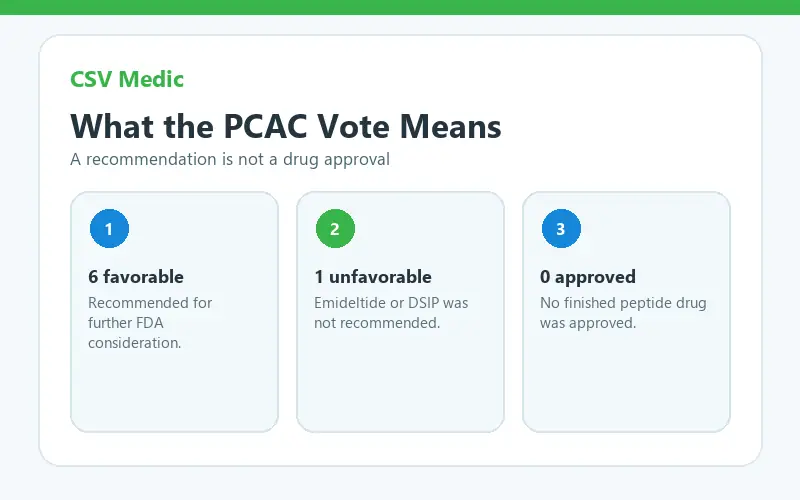
The official FDA meeting agenda listed seven peptide-related bulk drug substances. The committee considered both the free-base and acetate forms identified in the nominations.
FDA did not ask whether these substances should be approved as new drugs. The question was narrower: should each bulk drug substance be recommended for inclusion on the list of ingredients that may be used in pharmacy compounding under Section 503A when other statutory pathways do not apply?
| Peptide | Use FDA evaluated for the meeting | PCAC recommendation | Current status after the vote |
|---|---|---|---|
| BPC-157 | Ulcerative colitis | Favorable | Not FDA-approved; FDA action pending |
| KPV | Wound healing and inflammatory conditions | Favorable | Not FDA-approved; FDA action pending |
| TB-500 | Wound healing | Favorable | Not FDA-approved; FDA action pending |
| MOTS-C | Obesity and osteoporosis | Favorable | Not FDA-approved; FDA action pending |
| Semax | Cerebral ischemia, migraine, and trigeminal neuralgia | Favorable | Not FDA-approved; FDA action pending |
| Epitalon | Insomnia | Favorable | Not FDA-approved; FDA action pending |
| Emideltide/DSIP | Opioid withdrawal, chronic insomnia, and narcolepsy | Unfavorable | Not FDA-approved; not recommended for the list |
Regulatory reporting from RAPS described a divided committee. BPC-157 and KPV each received an 8-6 favorable vote with one abstention. Epitalon received a 7-5 favorable vote with one abstention, Semax received an 8-5 favorable vote, and Emideltide failed 6-7 with one abstention. All recommendations remain advisory until the FDA acts.
What Is the Pharmacy Compounding Advisory Committee?
PCAC is a federal advisory committee that provides independent expert advice to the FDA on pharmacy compounding matters. Its members discuss scientific evidence about peptides and other substances, quality questions, public comments, clinical needs, and regulatory considerations.
The FDA explains that advisory committee recommendations are non-binding. The agency often considers them seriously, but it is not legally required to follow them.
This means headlines describing the committee as having “approved peptides” are inaccurate. PCAC does not approve new drugs. It recommends whether FDA should take a particular regulatory action.
FDA staff recommended against adding all seven substances after reviewing the available characterization, safety, and effectiveness information. A majority of committee members nevertheless supported six nominations. That disagreement does not establish that the substances work.
What Does Section 503A Mean?
Section 503A of the Federal Food, Drug, and Cosmetic Act creates a framework for traditional pharmacy compounding. It can apply when a licensed pharmacist or physician prepares a medication for an identified individual patient based on a valid prescription and when all statutory conditions are met.
Under FDA’s Section 503A explanation, a compounder may use a bulk drug substance if:
- The substance complies with an applicable United States Pharmacopeia or National Formulary monograph, if one exists.
- If no applicable monograph exists, the substance is a component of an FDA-approved drug.
- If neither condition applies, the substance appears on the 503A Bulks List established by FDA regulation.
Section 503A is not a shortcut to drug approval. It is designed for patient-specific compounding. A pharmacy must still follow federal and state law and every applicable Section 503A condition.
Section 503B outsourcing facilities operate under a different federal framework. The July meeting focused on Section 503A.
Are These FDA Approved Peptides?
No. The seven substances discussed at the meeting did not become FDA approved peptides.
FDA approval generally follows review of a drug application covering identity, manufacturing, quality, safety, effectiveness, labeling, and the benefit-risk balance for a specific use. PCAC reviewed eligibility for a compounding list, a different legal decision.
Even if the FDA eventually places an ingredient on the 503A Bulks List:
- The ingredient itself would not become an FDA-approved drug.
- A compounded preparation made from it would not be FDA-approved.
- Inclusion would not prove effectiveness for every promoted use.
- Inclusion would not erase quality or safety risks.
- Pharmacies could only act within the final rule and all other applicable laws.
Patients searching for FDA approved peptides should check whether a specific finished drug has an FDA-approved label, not rely on a compounding list or seller claims.
Why FDA Reviewed Peptide Safety So Closely
Peptide quality depends on the exact sequence, salt form, purity, aggregation, degradation products, and manufacturing process.
FDA’s briefing documents repeatedly raised concerns about incomplete product characterization, peptide-related impurities, and possible immune reactions. The agency’s compounding safety-risk page also notes that human safety information is absent or limited for several of the reviewed substances.
Peptide structure, aggregation, impurities, route of administration, and patient factors can influence immunogenicity. Injectable preparations add concerns involving sterility, concentration, storage, and dosing.
These uncertainties are why peptide therapy should be discussed in the context of evidence, regulation, and clinical oversight, not social-media popularity.
BPC-157: Favorable Recommendation, Limited Human Evidence
Overview and research interest
BPC-157 is a synthetic peptide discussed in regenerative medicine and sports communities. Laboratory and animal research has investigated gastrointestinal injury, tissue repair, inflammation, and wound-healing pathways, but robust human evidence remains limited.
For this PCAC meeting, FDA evaluated BPC-157 free base and BPC-157 acetate for ulcerative colitis. Other commonly promoted uses were not automatically part of the formal review.
Why it was reviewed
BPC-157 lacks an applicable USP/NF drug-substance monograph and is not a component of an FDA-approved drug product. FDA staff also questioned whether products sold under the name BPC-157 are sufficiently and consistently characterized.
The FDA BPC-157 briefing package found insufficient evidence for ulcerative colitis. FDA also described adverse-event reports after injection, while noting that limited details and confounding prevented firm conclusions about causation.
Committee recommendation and current status
PCAC voted 8-6, with one abstention, to recommend inclusion. That recommendation did not make BPC-157 an approved drug or authorize immediate compounding.
Clinicians and patients should separate compounding eligibility from proof of benefit. CSV Medic’s BPC-157 safety and evidence guide provides more context. Patients should not self-inject products from unverified sellers.
KPV: Favorable Recommendation Without Established Clinical Benefit
Overview and research interest
KPV is a three-amino-acid peptide sequence associated with the larger alpha-melanocyte-stimulating hormone molecule. Preclinical research has examined inflammatory signaling, skin and intestinal models, and wound-related processes.
FDA evaluated KPV free base and KPV acetate for wound healing and inflammatory conditions, including proposed topical preparations. Early research is not demonstrated clinical effectiveness.
Why it was reviewed
Like the other substances, KPV was considered because it had been nominated for the 503A Bulks List and did not qualify through an applicable monograph or as a component of an approved drug.
The FDA KPV review did not identify sufficient human exposure data to characterize safety for the proposed uses. Questions about identity, impurities, and clinical benefit remained.
Committee recommendation and current status
PCAC voted 8-6, with one abstention, in favor of recommending KPV. KPV remains unapproved, and the recommendation does not establish that a KPV injection or topical product is safe, effective, or legally available for routine patient use.
Patients can review CSV Medic’s KPV peptide evidence overview for a closer look at what preclinical findings can and cannot tell us.
TB-500: Research Interest Does Not Equal Approval
Overview and research interest
TB-500 is commonly described as a synthetic fragment related to thymosin beta-4. Research involving thymosin beta-4 and related fragments has explored cell migration, tissue response, blood-vessel formation, and wound repair.
Marketing often stretches those findings into claims about recovery or athletic performance that are not established medical benefits.
Why it was reviewed
FDA evaluated TB-500 free base and acetate for wound healing. The FDA TB-500 review did not identify adequate human clinical studies supporting the proposed use and raised concerns about aggregation, impurities, characterization, and immune reactions.
Committee recommendation and current status
PCAC gave TB-500 a favorable recommendation. TB-500 did not become one of the FDA approved peptides, and no finished TB-500 product received FDA approval through the vote.
Providers should verify the exact ingredient and formulation, not assume data on full-length thymosin beta-4 applies to every fragment marketed as TB-500. Consumers should be cautious about self-directed injection products.
MOTS-C: Metabolic Research With Major Evidence Gaps
Overview and research interest
MOTS-C is a mitochondrial-derived peptide studied in metabolic and longevity research. Laboratory and animal studies have examined energy signaling, insulin sensitivity, exercise response, and age-related metabolic changes.
Limited human evidence exists. Claims that MOTS-C causes weight loss, reverses insulin resistance, or slows aging go beyond what has been established.
Why it was reviewed
FDA evaluated MOTS-C free base and acetate for obesity and osteoporosis. Nominations and public discussion also referenced broader metabolic and longevity uses, but FDA said the submitted information did not support a complete evaluation of every promoted indication.
The FDA MOTS-C review identified concerns about immunogenicity, peptide-related impurities, and the lack of adequate human exposure data.
Committee recommendation and current status
PCAC recommended MOTS-C for possible inclusion. The vote did not approve MOTS-C for obesity, osteoporosis, metabolic health, or longevity. It also did not create a clinically validated MOTS-C dosage or treatment protocol.
Patients should distinguish emerging peptide research from evidence-based obesity treatment. CSV Medic’s weight-loss programs page explains licensed-provider evaluation.
Semax: Favorable Vote, No U.S. Drug Approval
Overview and research interest
Semax is a synthetic heptapeptide that has been investigated in neurological research. Studies and foreign-market use have prompted interest in cerebral ischemia, migraine, trigeminal neuralgia, cognition, and nervous-system recovery.
Publications or use in another country do not replace FDA review of a complete drug application. Study quality, formulation, route, and population all matter.
Why it was reviewed
FDA evaluated Semax free base and acetate for cerebral ischemia, migraine, and trigeminal neuralgia. The FDA Semax review highlighted limited evidence, possible aggregation and impurities, immunogenicity concerns, and inadequate safety characterization.
Committee recommendation and current status
PCAC recommended Semax by an 8-5 vote. Semax remains unapproved in the United States. The favorable recommendation does not establish a standard dose, approve intranasal or injectable products, or confirm effectiveness for cognitive enhancement.
Clinicians should evaluate the exact proposed use and formulation. Patients should distrust “nootropic” marketing that presents uncertain outcomes as guaranteed.
Epitalon: A Favorable Recommendation Despite Uncertainty
Overview and research interest
Epitalon is a synthetic tetrapeptide associated with longevity and sleep research. Claims involving melatonin, telomeres, aging, or sleep quality are not approved indications.
FDA specifically evaluated Epitalon free base and acetate for insomnia. The agency also distinguished Epitalon from epithalamin, a different substance that may appear in older literature.
Why it was reviewed
The FDA Epitalon review found no adequate published clinical evidence establishing effectiveness for insomnia and raised concerns about characterization, impurities, immunogenicity, and possible long-term risks. Approved treatments already exist for insomnia.
Committee recommendation and current status
PCAC voted 7-5 in favor, with one abstention. Epitalon is not FDA-approved for insomnia, anti-aging, longevity, or any other use. The vote did not prove that it improves sleep or affects human lifespan.
Patients should not substitute an unapproved peptide for a sleep evaluation. Insomnia has many possible causes that require different approaches.
Emideltide or DSIP: The Committee’s Unfavorable Recommendation
Overview and research interest
Emideltide is also known as delta sleep-inducing peptide, or DSIP. Older, generally small studies investigated sleep, opioid withdrawal, and neurological effects. DSIP is often promoted as a sleep aid.
Why it was reviewed
The FDA Emideltide review evaluated opioid withdrawal, chronic insomnia, and narcolepsy. Reviewers found the evidence old, limited, inconsistent, or insufficient and raised concerns about characterization, impurities, immunogenicity, and available approved treatments.
Committee recommendation and current status
PCAC voted 6-7, with one abstention, against recommending Emideltide for the 503A Bulks List.
The unfavorable recommendation is not a recall or drug-application rejection. It means the committee did not support this nomination. FDA controls the final process.
Patients with insomnia, narcolepsy, or opioid withdrawal should seek established medical care. Opioid withdrawal can carry serious risks and should not be self-treated with research peptides purchased online.
What Happens After the PCAC Peptide Meeting?
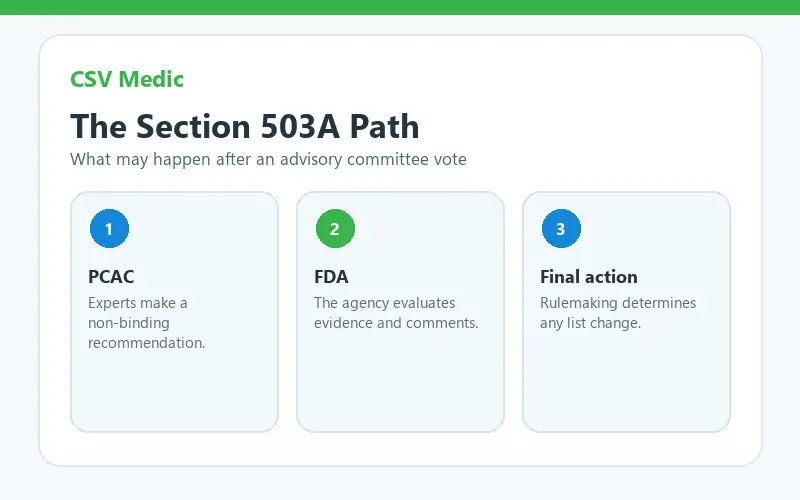
The next steps are regulatory, not automatic.
- FDA reviews the full record. This includes staff assessments, advisory votes, meeting discussion, public comments, and submitted materials.
- FDA decides whether to accept or reject each recommendation. The agency can agree with PCAC, disagree, or seek additional information.
- A proposed regulatory action may follow. FDA generally develops the 503A Bulks List through notice-and-comment rulemaking.
- The public may have an opportunity to comment. FDA evaluates comments and supporting evidence before a final rule.
- A final rule would define the legal change. Pharmacies would then need to determine how the rule interacts with Section 503A conditions, state law, professional standards, and any FDA guidance.
The process may take months or longer, and FDA has not announced a guaranteed date. Until a legally effective change is published, the recommendations should not be treated as implemented.
FDA can change interim enforcement policies while evaluating substances. Such a policy is not approval or a guarantee against enforcement.
What the Recommendations Mean for Compounding Pharmacies
Licensed compounding pharmacies should treat the votes as a regulatory development to monitor, not an immediate green light.
Key operational questions include:
- Has FDA published a proposed or final rule?
- Which chemical form and route are covered?
- Does the ingredient meet identity, purity, certificate-of-analysis, and supplier requirements?
- Is compounding based on a valid prescription for an identified patient?
- Do state pharmacy rules permit the activity?
- Are sterility, potency, stability, beyond-use dating, labeling, and adverse-event procedures adequate?
- Does the pharmacy’s legal analysis distinguish Section 503A from Section 503B?
A list change would not excuse poor manufacturing or unsupported promotion. Pharmacies must not market compounded preparations as FDA-approved.
What Healthcare Providers Should Know
Healthcare providers remain responsible for informed clinical judgment. Before considering any compounded product, a clinician should understand:
- The patient’s diagnosis and treatment goals
- Evidence for the exact ingredient, route, formulation, and proposed use
- Approved alternatives and why they may or may not meet the patient’s needs
- Known and unknown adverse effects
- Drug interactions, contraindications, and monitoring needs
- Pharmacy licensing and quality controls
- How adverse events will be recognized and reported
“Peptide therapy” covers very different substances, not a single risk level or evidence standard. Providers should document uncertainty when human data are sparse.
What Patients and Researchers Should Know
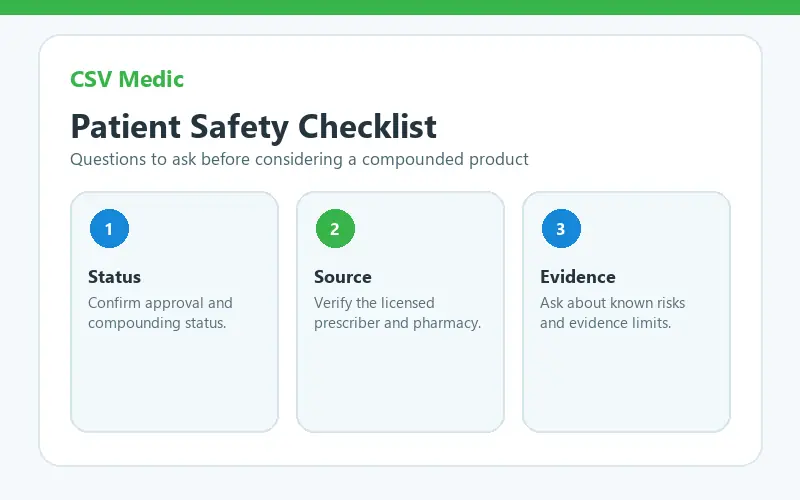
For patients, the most important message is simple: do not mistake a favorable advisory vote for permission to self-treat.
Avoid sellers that:
- Offer prescription products without a prescription
- Label injectable products “research use only” while marketing them for human use
- Hide the dispensing pharmacy or prescriber
- Promise rapid healing, anti-aging, fat loss, or cognitive enhancement
- Cannot provide ingredient identity, concentration, storage, and quality information
- Use “PCAC recommended” as a substitute for “FDA approved”
Researchers should distinguish biological plausibility from clinical evidence. Cell or animal findings can justify study but do not establish a favorable human benefit-risk balance.
For general education, CSV Medic’s guide to peptide injections and safety explains why product source, route, and evidence matter.
How This Differs From Weight-Loss Drug Approval
Searches for FDA approved peptides often mix approved drugs, investigational drugs, and compounded preparations.
Semaglutide and tirzepatide are active ingredients in FDA-approved branded drugs for specific indications and doses. Compounded versions are not themselves FDA-approved.
Retatrutide and cagrilintide are different. They remain under clinical development as of this update and should not be described as approved treatments. Their research programs are not affected by a PCAC recommendation involving BPC-157, KPV, TB-500, MOTS-C, Semax, Epitalon, or Emideltide.
A listing in a research peptide collection is not evidence of approval or suitability for patient use.
Frequently Asked Questions
Did the FDA approve six peptides in July 2026?
No. PCAC recommended six bulk substances for possible inclusion on the 503A Bulks List. The advisory vote did not approve a finished drug and did not immediately change the list.
Which peptides received favorable PCAC recommendations?
BPC-157, KPV, TB-500, MOTS-C, Semax, and Epitalon received favorable recommendations. Emideltide, also called DSIP, received an unfavorable recommendation.
Are these FDA approved peptides now?
No. None became an FDA-approved drug because of the meeting. A future 503A listing would concern compounding eligibility, not drug approval.
Can a compounding pharmacy start making them immediately?
The vote alone does not provide that authority. A pharmacy must wait for legally effective FDA action and comply with all federal and state requirements. Current status should be verified for the exact substance and chemical form.
What is the 503A Bulks List?
It is an FDA list of certain bulk drug substances that may be used in patient-specific compounding under Section 503A when no applicable USP/NF monograph exists and the substance is not a component of an approved drug. All other statutory conditions still apply.
Are compounded peptides FDA-approved?
No. Compounded drugs are not FDA-approved. FDA does not review each compounded product before marketing for safety, effectiveness, or manufacturing quality.
Does a favorable vote prove a peptide is safe?
No. FDA staff identified evidence and safety gaps for all seven substances. A favorable advisory recommendation is not a clinical guarantee.
Why did the committee recommend six substances when FDA staff opposed them?
Committee members may weigh clinical need, professional discretion, access, public testimony, and uncertainty differently. FDA staff focused heavily on characterization, safety, and effectiveness limitations. FDA will now evaluate the complete record.
How long will the FDA process take?
There is no guaranteed timeline. Rulemaking and related review can take months or longer. Readers should follow FDA publications rather than relying on seller announcements.
Is BPC-157 legal to buy online?
Peptide legality depends on the product, intended use, seller conduct, prescription requirements, and applicable federal and state law. An online listing does not establish legality, quality, or suitability for human use.
What should a patient ask before using a compounded medication?
Ask whether an approved drug can meet the medical need, why compounding is necessary, who prescribed it, which licensed pharmacy prepared it, what evidence supports the use, how quality is verified, and how side effects will be monitored.
Conclusion: Read the Votes Carefully
The July 2026 PCAC meeting was an important FDA peptide update, but it did not create a new category of FDA approved peptides. The committee supported BPC-157, KPV, TB-500, MOTS-C, Semax, and Epitalon for possible inclusion on the 503A Bulks List and recommended against Emideltide.
FDA must complete its review and any required rulemaking. A future listing would not approve a finished drug or prove every marketed use.
CSV Medic will continue to track FDA announcements and explain how peptide regulation affects patients and pharmacy practice. Readers seeking information about legally available medications, wellness injections, or pharmacy services can contact CSV Medic for general information. Availability, prescribing, and dispensing must always follow current law and appropriate clinical review.
About the Author
Prepared by Dr Spencer and the CSV Medic editorial team. Before publication, regulatory and medical claims should receive final review by a named, appropriately licensed professional. The reviewer name, credentials, jurisdiction, and review date should be displayed only after that review has occurred.
Medical Disclaimer
This article is for educational purposes only and does not constitute medical, legal, or pharmacy advice. It does not recommend any unapproved peptide or compounded product. Regulatory status can change. Patients should consult a licensed healthcare provider, and pharmacies should consult qualified regulatory counsel and current FDA and state-board materials before making decisions.
