
Weight Loss Education, Weight Loss Medication
AOD 9604 Peptide: 9 Important Research and Safety Facts
Sep
AOD 9604 peptide is a modified fragment of human growth hormone that was investigated as a possible obesity treatment. The most important fact for patients is simple: AOD-9604 is not an FDA-approved weight-loss medication, and the available human evidence does not establish that injections sold online produce meaningful or durable weight loss.
Interest in AOD peptide products has grown because sellers describe the fragment as a targeted way to influence fat metabolism without the broader effects of full growth hormone. That description is biologically interesting, but it is not the same as a proven clinical benefit. A large placebo-controlled obesity study reviewed by FDA reported no significant difference in weight loss, while important questions remain about product identity, immune reactions, impurities, and long-term safety.
This guide separates laboratory theory from human results. It also explains FDA and Pharmacy Compounding Advisory Committee findings, AOD 9604 side effects, dosage uncertainty, and safer evidence-based options for adults seeking medical weight management.
Key Takeaways
- AOD-9604 is a synthetic peptide related to a small C-terminal region of human growth hormone.
- It was investigated as an obesity drug, but it did not become an FDA-approved weight-loss treatment.
- FDA reviewers described limited safety information and possible concerns involving immunogenicity, peptide impurities, and product characterization.
- A 24-week placebo-controlled study in 502 adults did not show a significant weight-loss difference.
- There is no FDA-approved AOD 9604 peptide dosage, AOD 9604 dosing schedule, or validated AOD 9604 peptide dosage chart for self-treatment.
- Evidence from cells or animals cannot establish that an online injectable product is safe or effective in people.
- Compounded drugs are not FDA approved and do not undergo FDA premarket review for safety, effectiveness, or quality.
- Approved obesity medications have substantially more clinical evidence and standardized prescribing information.
- Adults considering weight-loss treatment should start with a licensed clinician and a verified pharmacy, not a research-use seller.
What Is AOD 9604 Peptide?
AOD-9604 is a modified fragment based on amino acids near the end of human growth hormone. It has also been called hGH fragment 176-191 and LAT8881 in research settings. Developers investigated whether a smaller fragment could influence lipid metabolism without producing all the growth-related effects associated with full-length growth hormone.
The phrase what is AOD peptide often produces confident online answers about fat burning. A more accurate answer is that AOD-9604 is an experimental drug substance with preclinical and clinical development history, but no FDA-approved indication for obesity, localized fat reduction, metabolic disease, or wellness.
It is also important to distinguish AOD-9604 from growth hormone, GLP-1 receptor agonists, and cosmetic fat-dissolving injections. These products have different structures, proposed mechanisms, evidence packages, and regulatory statuses. Sharing a marketing category does not make them medically interchangeable.
Readers who need a broader foundation can review what peptides are and CSV Medic’s peptide therapy safety guide.
Why Was AOD-9604 Studied for Weight Loss?
Researchers were interested in whether a fragment of growth hormone could affect lipolysis, the process by which stored fat is broken down, while avoiding unwanted stimulation of growth pathways. Early animal work and mechanistic studies supported continued investigation.
That research created several hypotheses:
- AOD-9604 might influence fat metabolism without acting like full growth hormone.
- A smaller peptide might produce fewer systemic hormonal effects.
- The compound might support weight loss when combined with diet and exercise.
- A targeted fragment might be easier to study as a metabolic drug.
These were reasonable research questions. They were not conclusions. Drug development requires human trials that show a clinically meaningful outcome, a favorable benefit-risk balance, reproducible manufacturing, and enough safety information to support a specific dose and population.
What Did Human AOD-9604 Studies Find?

FDA reviewed several development studies when the related bulk drug substances were considered by the Pharmacy Compounding Advisory Committee. The official FDA AOD-9604 briefing materials provide the most useful regulatory summary.
One abstract described a 12-week study in 300 adults with obesity. The authors reported a small difference in weight loss at one dose, but FDA noted that interpretation was limited by minimal published information, insufficient methodological detail, and a nonlinear dose response.
More importantly, the OPTIONS study was a double-blind, placebo-controlled trial involving 502 adults with obesity. Participants received oral AOD-9604 or placebo for 24 weeks alongside diet and exercise. FDA’s meeting transcript states that the study reported no significant difference in weight loss between the treatment and placebo groups.
That result matters because the largest controlled study did not confirm the online claim that AOD-9604 reliably produces meaningful weight loss.
| Evidence level | What it can tell us | What it cannot prove |
|---|---|---|
| Cell research | Possible molecular pathways | Weight loss or safety in patients |
| Animal studies | Biological plausibility | Human dose, benefit, or long-term risk |
| Small or incompletely reported trials | Early signals and research questions | Reliable effectiveness across populations |
| Large controlled obesity study | Direct comparison with placebo | Benefit when no significant difference was found |
| FDA approval review | Product-specific benefit, risk, quality, and labeling | AOD-9604 has not completed this process successfully |
AOD 9604 Benefits: Claims Versus Evidence
Commonly marketed AOD 9604 benefits include fat loss, reduced abdominal fat, improved metabolism, preservation of muscle, and weight loss without appetite suppression. Some pages also describe AOD 9604 peptide benefits as if the product were a selective version of growth hormone.
The evidence does not support presenting those outcomes as established facts.
| Marketing claim | Evidence-based interpretation |
|---|---|
| Burns stored fat | Mechanistic research does not establish meaningful patient weight loss |
| Targets abdominal fat | No approved indication or validated clinical protocol for regional fat reduction |
| Preserves muscle | Not established by robust comparative obesity trials |
| Avoids growth hormone effects | A different structure does not remove manufacturing, immune, or unknown long-term risks |
| Works without lifestyle changes | No credible evidence supports this promise |
| Works better when stacked | Controlled studies have not validated peptide stacks |
An AOD peptide benefits section should therefore use language such as “has been investigated” and “early research explored.” It should not promise that a vial will reduce fat or improve body composition.
FDA Status and the 2024 PCAC Review
AOD-9604 is not an FDA-approved drug. In December 2024, PCAC considered AOD-9604 free base and AOD-9604 acetate for possible inclusion on the Section 503A Bulks List.
PCAC is an advisory committee. Its vote is not drug approval. The committee evaluates nominated bulk substances and advises FDA, while FDA completes the regulatory process. The committee voted against adding the AOD-9604 forms to the 503A Bulks List.
FDA currently identifies AOD-9604 among nominated bulk substances associated with potential significant safety risks. The agency cites limited safety-related information, potential immunogenicity, peptide-related impurities, characterization complexity, and serious adverse events for which causality is unclear. See FDA’s bulk-substance safety information.
This status should not be summarized as “FDA banned all peptide research,” nor should a committee review be described as FDA approval. CSV Medic explains the wider legal framework in Are Peptides Legal?.
AOD 9604 Peptide Dosage and Dosing Charts
There is no FDA-approved AOD 9604 peptide dosage for weight loss. There is no validated AOD 9604 dosing schedule for self-treatment, and there is no official AOD 9604 peptide dosage chart that can convert an online vial into a safe patient protocol.
Online calculators and forum posts often mix several different concepts:
- oral doses from historical drug-development studies;
- unapproved subcutaneous injection protocols;
- different chemical forms or salts;
- different vial concentrations;
- animal-study amounts;
- “stack” schedules involving other experimental substances.
Those figures are not interchangeable. A numerical dose from a study does not validate a product purchased online, a different route of administration, or a different population. Route matters because oral and injected products can have very different absorption, immune, sterility, and contamination risks.
CSV Medic does not provide personal dosing instructions for unapproved research peptides. General information about injection risk is available in the peptide injection safety guide.
AOD 9604 Side Effects and Safety Unknowns
A complete frequency table for AOD 9604 side effects cannot be produced because the evidence and marketed products are not sufficiently standardized. FDA has highlighted the limited safety record and the difficulty of characterizing peptide impurities.
Potential concerns include:
- injection-site pain, redness, swelling, or infection;
- allergic or immune reactions;
- headache, nausea, or other nonspecific symptoms;
- contamination, endotoxin exposure, or inaccurate concentration;
- product degradation during shipping or storage;
- effects that vary by route or formulation;
- unknown interactions with diabetes, weight-loss, hormone, or cardiovascular medicines;
- unknown long-term effects in routine wellness use.
FDA has also published a recall involving compounded injectable AOD-9604 and sermorelin/ipamorelin products because of a lack of sterility assurance. The FDA recall notice illustrates why sterility is a clinical issue, not a paperwork detail.
Seek urgent medical attention after an injection for trouble breathing, facial or throat swelling, fainting, severe chest pain, rapidly spreading rash, confusion, or signs of serious infection.
Who Should Avoid Experimental AOD Peptide Products?
Self-directed use is particularly concerning for:
- pregnant or breastfeeding people;
- children and adolescents;
- people with cancer or an unexplained mass;
- patients with diabetes, recurrent hypoglycemia, or unstable glucose control;
- people with serious liver, kidney, heart, or endocrine disease;
- anyone taking multiple metabolic or hormonal medications;
- competitive athletes subject to anti-doping rules;
- people who cannot verify the prescriber, pharmacy, lot testing, and adverse-event support.
Adults with obesity deserve evidence-based care. An online weight-loss consultation can help identify contraindications, medication interactions, realistic goals, and approved options.
AOD-9604 Versus FDA-Approved Weight-Loss Medications
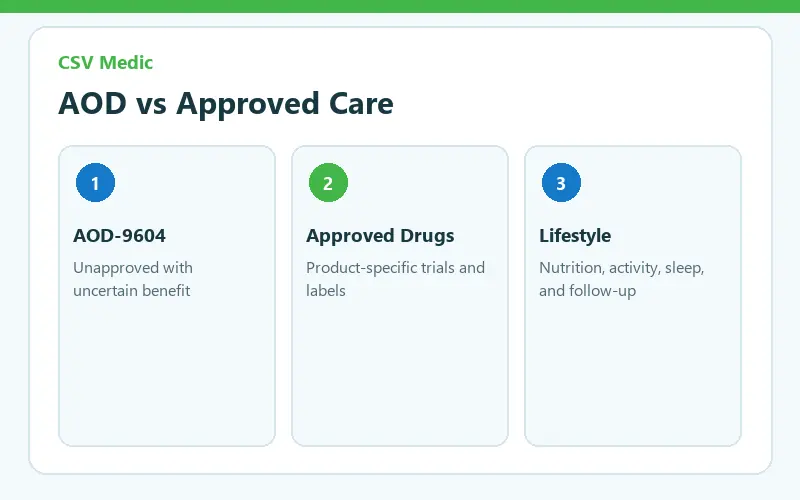
| Feature | AOD-9604 | FDA-approved chronic weight-management medication |
|---|---|---|
| FDA-approved obesity indication | No | Yes, for specific products and eligible patients |
| Standardized label | No approved label | Includes dosing, warnings, contraindications, and studies |
| Large controlled outcome evidence | Largest reviewed study did not show a significant weight-loss difference | Product-specific trials establish expected benefits and risks |
| Product quality review | Online and compounded products are not FDA approved | Approved manufacturing and quality controls apply |
| Medical monitoring | Often absent in direct-to-consumer sales | Prescriber assessment and follow-up are expected |
Approved treatment is not automatically appropriate for every patient. It does, however, provide a much stronger evidence and quality framework. CSV Medic’s GLP-1 prescription guide explains how clinicians evaluate those options.
How to Evaluate an AOD-9604 Product Claim
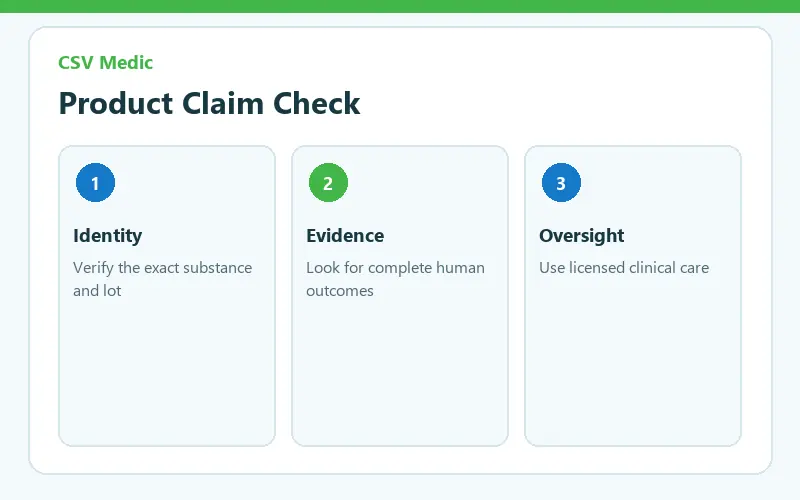
Before believing a commercial page, ask:
- Does the seller clearly state that AOD-9604 is not FDA approved for weight loss?
- Are human study limitations explained, including the negative large trial?
- Is the exact ingredient form identified?
- Is a licensed prescriber evaluating the patient?
- Is the dispensing pharmacy licensed for the patient’s location?
- Is lot-specific identity, potency, sterility, and endotoxin testing available?
- Is there a system for side effects, recalls, and follow-up?
- Are “research use only” products being promoted for human injection?
A certificate of analysis cannot replace clinical evidence. It may also be incomplete, unrelated to the shipped lot, or impossible for a patient to authenticate.
What Patient Forums Can and Cannot Tell Us
Patient discussions can reveal the questions people ask, but they cannot calculate effectiveness or prove causation. Two relevant examples are a Reddit discussion asking whether AOD-9604 works and a thread discussing the PCAC vote on AOD-9604 and CJC-1295.
These are user-generated anecdotes. Product identity, dose, diagnosis, reporting completeness, and concurrent treatments are usually unknown. They should generate questions for clinicians and researchers, not treatment instructions.
Evidence-Based Lifestyle Support
No peptide replaces the foundations of obesity care. A practical program may include:
- an eating pattern that produces a sustainable energy deficit;
- adequate protein and fiber based on individual medical needs;
- resistance training to support strength and lean tissue;
- regular aerobic activity appropriate to fitness and health status;
- sleep assessment and treatment when needed;
- review of medications that affect appetite or weight;
- screening for diabetes, hypertension, sleep apnea, and other complications;
- behavioral support and realistic maintenance planning.
The CDC adult physical activity guidance provides a useful general framework. Individual recommendations may differ for people with pain, disability, cardiovascular disease, or other limitations.
Frequently Asked Questions
What results should patients realistically expect from medical weight-loss care?
Results vary with the treatment, diagnosis, starting health, adherence, sleep, activity, and follow-up. A responsible program sets a measurable goal, reviews progress over months rather than days, protects nutrition and lean tissue, and changes the plan when benefit does not justify burden or risk. It does not promise that one compound will selectively remove fat from a preferred body area.
Scale weight is also only one outcome. Clinicians may monitor waist circumference, blood pressure, glucose, lipids, medication tolerance, strength, sleep, mobility, and quality of life. This broader view makes it easier to distinguish a meaningful health improvement from a temporary water-weight change or an edited before-and-after photograph.
Is AOD 9604 peptide FDA approved?
No. AOD-9604 is not FDA approved for obesity, fat loss, localized fat reduction, or wellness. A PCAC review is not an approval process for a finished drug product.
What is AOD peptide supposed to do?
It was designed from a fragment of human growth hormone and investigated for effects on fat metabolism. Mechanistic interest did not translate into an approved treatment, and the largest reviewed obesity study reported no significant weight-loss difference.
Does AOD 9604 cause weight loss?
Current evidence does not establish reliable, clinically meaningful weight loss from the injectable products sold online. Small signals and preclinical findings should not be presented as proof.
What are the claimed AOD peptide benefits?
Sellers commonly claim fat loss, metabolic support, and muscle preservation. These claims exceed the strength of available clinical evidence.
Is there a safe AOD 9604 peptide dosage?
There is no FDA-approved dose for weight loss or wellness. Online dosage charts should not be treated as validated medical instructions.
Is compounded AOD-9604 FDA approved?
No. Compounded drugs are not FDA approved. FDA does not review them before marketing for safety, effectiveness, or quality. Federal and state compounding requirements still apply.
Is AOD-9604 the same as a GLP-1 medicine?
No. AOD-9604 and GLP-1 receptor agonists differ in structure, mechanism, evidence, approval status, and clinical use.
Can AOD-9604 be stacked with ipamorelin or CJC-1295?
There is no robust controlled evidence establishing that these combinations improve outcomes or remain safe. Combining experimental substances increases uncertainty and makes adverse reactions harder to interpret.
Where can patients find reliable information?
Start with FDA meeting materials, FDA compounding pages, PubMed, ClinicalTrials.gov, and a licensed clinician. Commercial pages and forums should not be the primary evidence source.
Selected Medical Sources
- FDA PCAC briefing on AOD-9604-related substances
- FDA December 2024 PCAC meeting materials
- FDA safety-risk list for compounded bulk substances
- FDA sterile compounded-drug recall example
- PubMed: metabolic studies of AOD-9604
- PubMed: AOD-9604 and lipid metabolism
- CDC adult physical-activity guidance
These sources distinguish preclinical mechanisms, the incomplete human evidence base, regulatory review and established lifestyle guidance. They should be read as a group rather than using one laboratory result to infer a clinical benefit.
Conclusion
AOD 9604 peptide is an instructive example of the difference between a plausible mechanism and a successful medicine. The fragment was investigated for obesity, but it did not become an FDA-approved weight-loss drug, and the largest placebo-controlled study reviewed by FDA did not show a significant weight-loss advantage.
Patients should be cautious when an AOD 9604 benefits page omits this history or presents an online dosage chart as settled medical guidance. Adults seeking effective weight management can explore CSV Medic’s weight-loss education and discuss legally available, evidence-based services through How It Works.
Editorial and Medical Review Status
This educational draft was prepared from FDA materials, peer-reviewed literature and public-health guidance available on September 1, 2026. It is saved for medical and editorial review by Dr Spencer before publication. References, regulatory status and internal links should be checked again on the publication date because peptide regulation can change.
Medical disclaimer: This article is for general educational purposes only. It does not provide medical advice, diagnosis, a prescription, or instructions for using an unapproved peptide. Consult a qualified healthcare professional about symptoms, treatment options, medication interactions, and product legality.
