
Weight Loss Education, Weight Loss Medication
BPC 157 Peptide: 11 Essential Safety and Evidence Facts

Jul
BPC 157 peptide is promoted online for tendon recovery, gut repair, inflammation, athletic performance, and even weight loss. Most of those claims come from animal experiments, laboratory findings, or marketing that moves far beyond the evidence. BPC-157 is not an FDA-approved medicine, no standard human dose has been established, and the FDA has identified potential safety concerns for compounded products.
That does not mean the research is uninteresting. It means patients need a clear line between early science and proven treatment. This guide explains what BPC 157 peptide is, which benefits are being studied, why human evidence remains limited, the FDA and sports status, possible side effects, weight-loss claims, and safer questions to ask before considering any peptide product.
BPC 157 Peptide: Quick Evidence Summary
| Question | Current evidence-based answer |
|---|---|
| Is it FDA approved? | No |
| Is there a standard human dose? | No approved dose or regimen |
| Are there human trials? | Very limited data; not enough to establish routine safety or effectiveness |
| What drives the claims? | Mostly cell and animal studies, reviews, and marketing |
| Can athletes use it? | It is prohibited under anti-doping rules as an unapproved substance |
| Is it proven for weight loss? | No established human weight-loss benefit |
1. What Is BPC 157 Peptide?
BPC-157 is a synthetic 15-amino-acid peptide often described as a fragment related to a body protection compound found in gastric juice. The name is sometimes expanded as Body Protection Compound 157. It is also called a pentadecapeptide because it contains 15 amino acids.
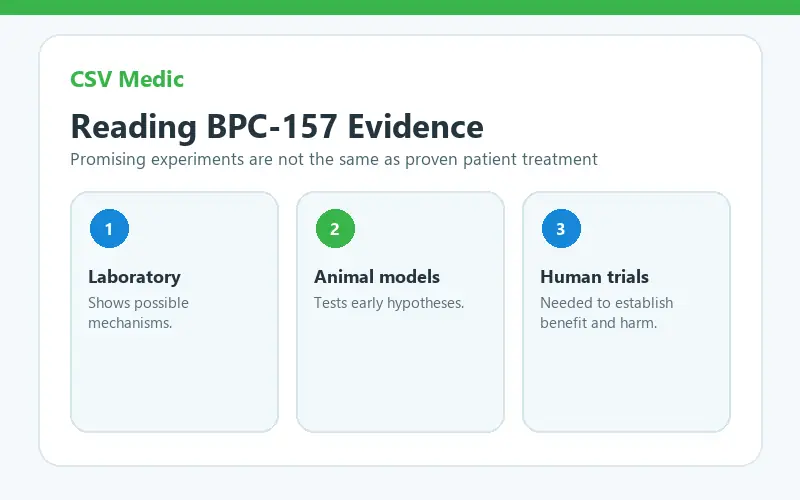
When patients ask what BPC 157 peptide does, the honest answer is that researchers have explored possible effects on tissue repair, blood-vessel signaling, inflammation, and gastrointestinal injury models. The 2019 PubMed review of musculoskeletal healing research notes that most studies were performed in small rodent models and that effectiveness had not been confirmed in people.
The peptide BPC 157 is also written with a hyphen, and products described as BPC 157 peptides can vary in route, concentration, labeling, and source. Those wording differences do not create separate approved medicines or solve the evidence gap.
CSV Medic’s guide to what peptides are explains why a short amino-acid chain can show biological activity without becoming an approved or clinically proven treatment.
2. What Benefits Are Being Studied?
Online lists of BPC 157 peptide benefits often include tendon healing, muscle recovery, ligament repair, stomach protection, inflammatory-bowel support, nerve effects, and faster recovery after injury. These are research topics, not an approved list of medical uses.
Claims about BPC-157 peptide benefits should therefore be read as hypotheses that still need controlled human testing. The same standard applies to lists of BPC-157 peptide side effects: limited reporting cannot define a complete safety profile.
Tendon and soft-tissue research
Rat studies have reported improved measures after experimental Achilles tendon injury. A PubMed-indexed rat Achilles tendon study described biomechanical and microscopic changes after BPC-157 exposure. Another laboratory study examined tendocyte outgrowth and survival. These findings can justify further research, but they do not prove that an online vial repairs a human tendon or replaces diagnosis, rehabilitation, or surgery.
Digestive and inflammatory research
BPC-157 has also been studied in experimental gastrointestinal and inflammatory models. Animal outcomes cannot establish treatment for ulcers, inflammatory bowel disease, reflux, or persistent abdominal pain in patients. Similar symptoms can have very different causes, and delaying evaluation may allow a serious condition to worsen.
A very small human pilot study
A 2025 pilot report described intravenous BPC-157 exposure in only two adults and reported no measured adverse effects in the limited observations. The PubMed pilot study record is not evidence of effectiveness and is far too small to establish common, rare, or long-term risks. Two participants cannot define a safe dose for the general population.
3. Is BPC 157 FDA Approved?
No. BPC 157 peptide is not an FDA-approved drug, dietary supplement ingredient, or routine medical therapy. The FDA’s list of bulk substances that may present significant safety risks states that compounded drugs containing BPC-157 may raise immunogenicity concerns and present complexities involving peptide impurities and active-ingredient characterization.
The agency also states that it has identified no or only limited safety information for proposed routes of administration and lacks enough information to know whether the substance would harm humans. This is more specific than simply saying a product is ‘not approved.’ It identifies uncertainty about product quality, immune response, impurities, route of administration, and human safety.
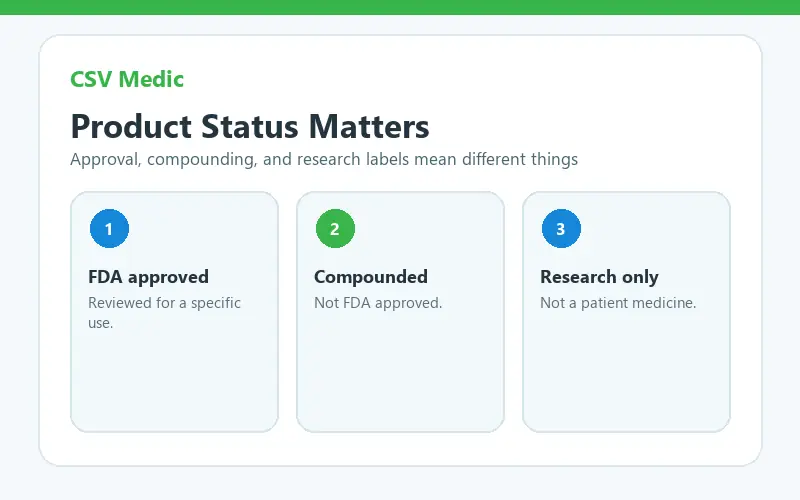
The FDA explains that compounded drugs are not FDA approved and are not reviewed for safety, effectiveness, or quality before marketing. Compounding can meet certain patient needs, but it should not be treated as a shortcut around the evidence required for an approved product.
4. Is BPC 157 Legal?
The word legal can hide several separate questions: Is it approved as a human drug? Can it be lawfully compounded? Can it be marketed as a dietary supplement? Is it permitted in sport? Availability on a website does not answer any of them.
The U.S. Anti-Doping Agency’s BPC-157 athlete advisory states that the substance is not approved for human clinical use and is prohibited under the World Anti-Doping Agency’s S0 unapproved-substances category. Competitive athletes should consult current anti-doping rules before using any prescription, supplement, or experimental product.
For a broader patient explanation, see CSV Medic’s Are Peptides Legal? guide. Approval, prescription status, pharmacy law, supplement rules, and anti-doping policy are related but not interchangeable.
5. BPC 157 Peptide Side Effects and Unknowns
A reliable complete side-effect profile does not exist because BPC 157 peptide has not been studied in large controlled human trials or monitored like an approved medicine. Reported or plausible concerns include injection-site reactions, allergy, immune reactions, infection, contamination, an incorrect strength, peptide-related impurities, and effects that have not yet been recognized.
An FDA briefing document has discussed adverse-event reports involving injection-site reaction, shortness of breath, and pigment changes, while also explaining that causality could not be determined from those reports. Uncertain causality should not be turned into certainty in either direction. It does not prove BPC-157 caused each event, and it does not prove the product was safe.
Research products add another layer of risk because the label may not reliably establish identity, purity, strength, sterility, or storage history. The FDA’s compounding questions and answers explains how contamination or too much or too little active ingredient can cause serious harm.
6. Does BPC 157 Help With Weight Loss?
BPC 157 peptide is not an approved weight-loss medication, and controlled human evidence has not established that it produces meaningful fat loss. Search terms such as BPC 157 weight loss, BPC 157 fat loss, and does BPC 157 burn fat reflect interest, not proof.
Recovery from an injury could indirectly help a person return to activity, but that is different from showing that a compound reduces body fat. Patients interested in evidence-based care should start with CSV Medic’s weight-loss program overview and discuss approved treatment options, nutrition, strength training, sleep, and medical causes of weight change with a licensed provider.
7. BPC 157 Injections, Capsules, and Online Products
BPC 157 injections and capsules are marketed with different absorption and benefit claims, but no FDA-approved formulation provides a standard comparison. A research-use-only label does not make a product suitable for self-treatment. It usually indicates that the seller is not offering an approved human medicine.
Buying considerations should begin with regulatory status and evidence, not a concentration, testimonial, or discount. Avoid sellers that promise guaranteed healing, provide a self-injection protocol without medical assessment, hide the pharmacy or manufacturer, or use a certificate as if it proves clinical safety. Laboratory purity testing cannot replace human safety and effectiveness trials.
Our peptides for muscle growth and fat loss guide explains why recovery marketing, body-composition claims, and research-peptide sales need separate evidence checks.
8. Myths vs Facts
| Myth | Evidence-based fact |
|---|---|
| It is natural, so it must be safe | A peptide can be biologically active and still have unknown or serious risks |
| Animal healing proves human recovery | Animal studies generate hypotheses; controlled human trials are needed |
| Compounded means FDA approved | Compounded drugs are not FDA approved |
| A purity report proves effectiveness | Chemical testing cannot prove a clinical benefit or complete safety |
| No reported side effects means no risk | Limited surveillance and small studies can miss common, rare, and long-term effects |
| It burns fat | Human weight-loss effectiveness has not been established |
9. Who Should Avoid Self-Experimentation?
No patient should self-inject an unapproved research product. Extra caution is warranted for people who are pregnant or breastfeeding, have severe allergies, immune disorders, active cancer, unexplained symptoms, liver or kidney disease, take multiple medicines, compete in tested sport, or are preparing for surgery. The absence of an approved contraindication list is not reassurance; it reflects missing data.
Persistent tendon pain, weakness, swelling, bruising, a sudden pop, inability to bear weight, fever, gastrointestinal bleeding, unexplained weight loss, or worsening abdominal pain deserves medical evaluation. An experimental peptide should not delay imaging, rehabilitation, gastroenterology care, or another evidence-based treatment.
10. Safer Product and Clinic Questions
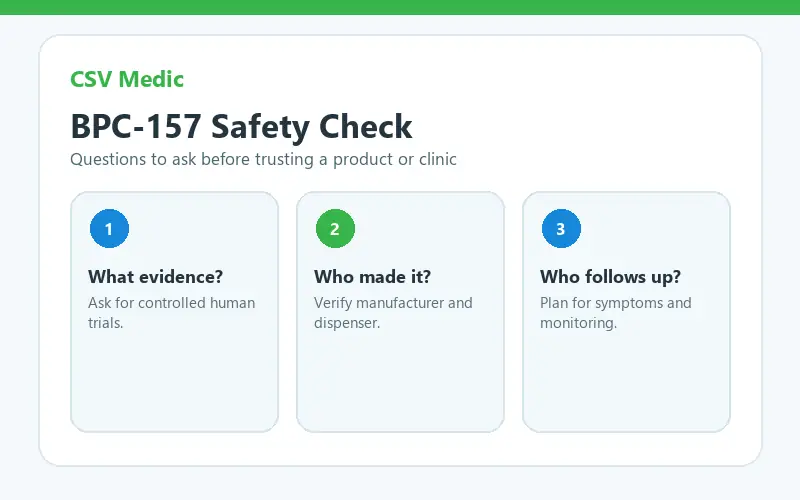
- Is this exact product FDA approved for the condition being discussed?
- Which controlled human trials support the promised benefit?
- Who manufactured, prescribed, dispensed, and stored the product?
- Is the product presented as research use only?
- What known and unknown harms were explained?
- Who will monitor symptoms, interactions, and laboratory findings?
- What evidence-based alternatives address the same problem?
- What findings would make the clinician stop treatment or refer for further evaluation?
A genuine medical consultation should investigate the problem a patient wants to solve rather than begin with a guaranteed product. The safest answer may be rehabilitation, a diagnostic work-up, an approved medication, a nutrition plan, or referral to another specialist. Patients can also review the CSV Medic medical disclaimer for the limits of general online health information.
11. What Future Research Needs to Show
Useful future BPC 157 peptide research would need well-designed human trials with transparent manufacturing, defined dosing, meaningful clinical outcomes, adequate comparison groups, adverse-event monitoring, and long-term follow-up. Independent replication would be important because much of the existing literature comes from a limited set of research groups.
A recent literature review on possible medical applications of BPC-157 describes broad preclinical interest while acknowledging that sufficient comprehensive clinical studies have not established approved human use. That gap is the central fact patients should remember.
Frequently Asked Questions About BPC 157 Peptide
What is BPC 157 peptide used for?
It is promoted for recovery, tendons, ligaments, muscle, and digestive concerns, but these are not FDA-approved uses. Most supporting evidence is preclinical.
Is BPC 157 peptide safe?
Human safety has not been established through large controlled trials. The FDA has identified potential immunogenicity, impurity, characterization, and information-gap concerns.
Is BPC 157 FDA approved?
No. BPC-157 is not an FDA-approved human drug.
What are BPC 157 peptide benefits?
Animal and laboratory studies have explored tissue repair, inflammatory pathways, and gastrointestinal injury models. Those findings do not establish benefits for patients.
What are BPC 157 peptide side effects?
The full profile is unknown. Potential concerns include allergy, immune reactions, injection problems, contamination, incorrect strength, impurities, interactions, and presently unrecognized effects.
Does BPC 157 help with weight loss?
There is no established controlled human evidence that it produces clinically meaningful weight loss. It is not an approved obesity treatment.
Can I buy BPC 157 peptide online?
Online availability does not establish approval, legality, purity, sterility, or safety. Research-use products should not be self-administered as patient medicines.
Is BPC 157 banned for athletes?
Yes. Anti-doping authorities identify BPC-157 under the prohibited unapproved-substances category. Athletes should check the current 2026 WADA Prohibited List and consult their anti-doping organization.
Are BPC 157 injections better than capsules?
No approved human formulations establish a reliable comparison. Different routes can produce different exposure and risks, and neither format should be assumed effective or safe.
What should I do for tendon pain instead?
Seek an evidence-based diagnosis. Depending on the injury, treatment may include activity modification, physical therapy, progressive loading, pain management, imaging, or specialist review.
The Bottom Line
BPC 157 peptide is an experimental compound with interesting animal and laboratory findings, but its benefits, dose, product quality, interactions, and long-term safety have not been established for routine human treatment. FDA safety concerns, sparse human data, and anti-doping restrictions make self-experimentation a poor substitute for diagnosis and evidence-based care. Patients should discuss the health goal itself with a licensed professional and compare regulated options before considering any peptide product. The CSV Medic education library provides additional patient guides on approved medicines, peptide safety, and medical weight management.
Medical Sources and Further Reading
The clinical and regulatory information in this guide was checked against the following government resources, prescribing information, trial records, and peer-reviewed studies.
- FDA: BPC-157 and bulk substances presenting potential safety risks
- FDA: Understanding compounded-drug risks
- FDA: Compounding questions and answers
- FDA: Report adverse events through MedWatch
- USADA: BPC-157 experimental peptide advisory
- WADA: 2026 Prohibited List
- PubMed: BPC-157 literature and patent review
- PubMed: Musculoskeletal soft-tissue healing review
- PubMed: Small intravenous pilot study in two adults
- PubMed: Narrative review of musculoskeletal evidence
- PubMed: Rat Achilles tendon experiment
- ClinicalTrials.gov: BPC-157 study search
About the Author and Medical Review
This article was medically reviewed and published by Dr Spencer and the CSV Medic editorial team in collaboration with licensed healthcare providers specializing in medical weight management. CSV Medic content is checked against current regulatory information, prescribing information, clinical-trial records, and peer-reviewed research.
Medical Disclaimer
This article is for educational purposes only and does not provide a diagnosis, prescription, or personal dosing instruction. A licensed healthcare provider must determine whether a medication is appropriate, select the dose, and monitor treatment. Never start, stop, combine, reconstitute, split, or change a prescription or experimental product without professional guidance. Seek urgent medical care for severe or rapidly worsening symptoms.
