
Weight Loss Education, Weight Loss Medication
Are Peptides Safe? 11 Checks Before You Trust a Source

Sep
Are peptides safe? The answer depends on the exact molecule, its regulatory status, the evidence for the intended use, the product’s identity and strength, how it was manufactured or compounded, and whether a qualified clinician and licensed pharmacy are involved. A peptide can be a well-studied prescription medicine, an investigational drug, or an unverified vial sold online. Those categories are not interchangeable.
Public concern has grown alongside the peptide boom. A July 2026 60 Minutes Australia report featuring Dr Terry Dubrow focused on products from untrusted sources and uneven oversight. It does not endorse CSV Medic or settle every peptide’s safety. Instead, it asks how two similarly labeled vials can be verified for identity, strength, purity, and quality.
Quick answer: Are peptides safe? Some FDA-approved peptide medicines have established uses, labeled doses, and known risks. Compounded drugs can meet a specific patient need but are not FDA approved. Investigational and research-only peptides may have limited human evidence. Safety therefore depends on the exact product, lawful source, reliable testing, clinical context, and professional oversight.
Key Takeaways
- Peptides are a broad class, not one treatment. Safety must be assessed molecule by molecule and product by product.
- FDA approval applies to a specific finished drug, indication, formulation, strength, and labeling. It does not extend to every product with a similar ingredient name.
- Compounded medications are not FDA approved. Compounding may serve a patient whose needs cannot be met by an available approved drug when applicable requirements are satisfied.
- A product marked research use only is not authorized as a human medication simply because it can be purchased online.
- A Certificate of Analysis can support batch documentation, but a reported purity result does not prove identity, dose accuracy, sterility, clinical effectiveness, or legal status.
- Injectable products require attention to sterility, bacterial endotoxins, container integrity, storage, and traceability in addition to chemical identity and purity.
- FDA’s July 2026 peptide advisory-committee votes were recommendations, not approvals or immediate changes in compounding law.
- CSV Medic supports an education-first approach: verify the product category, regulatory status, pharmacy, documentation, and medical need before making a treatment decision.
Are Peptides Safe When Popularity Outruns Evidence?
Peptides are short amino-acid chains. The body makes many naturally, and some act as chemical messengers. Insulin, glucagon, and glucagon-like peptide-1 are examples. Scientists also manufacture peptide drugs and investigate new molecules.
GLP-1 medicines changed public conversations about obesity and metabolic health. Social media then grouped weight-loss drugs, recovery compounds, longevity products, cosmetics, and laboratory materials under one word. CSV Medic’s guide to what peptides are explains why the name alone cannot define a product.
Online marketing can turn a laboratory finding into a promised human benefit or promote one molecule for several unrelated goals. A commercial vial may also borrow a studied molecule’s name without demonstrating that it matches the study material. That is why are peptides safe must be followed by five questions: which peptide, product, route, purpose, and source?
Are Peptides Safe From Untrusted Sources? Dr Dubrow’s Warning
In the segment, Dr Dubrow does not say every peptide is inherently bad. He focuses on products from sources patients may not be able to verify, uneven oversight, and insufficient testing behind wellness claims. His practical position is cautious while evidence and oversight remain inadequate.
A molecule’s theoretical mechanism cannot establish the quality of a vial. Even credible research on a named peptide cannot validate an unrelated online product. The useful lesson is to ask whether the product and proposed use have evidence, lawful oversight, and traceable quality. The CSV Medic peptide therapy safety guide provides a second framework.
Are Peptides Safe Across Every Regulatory Category?
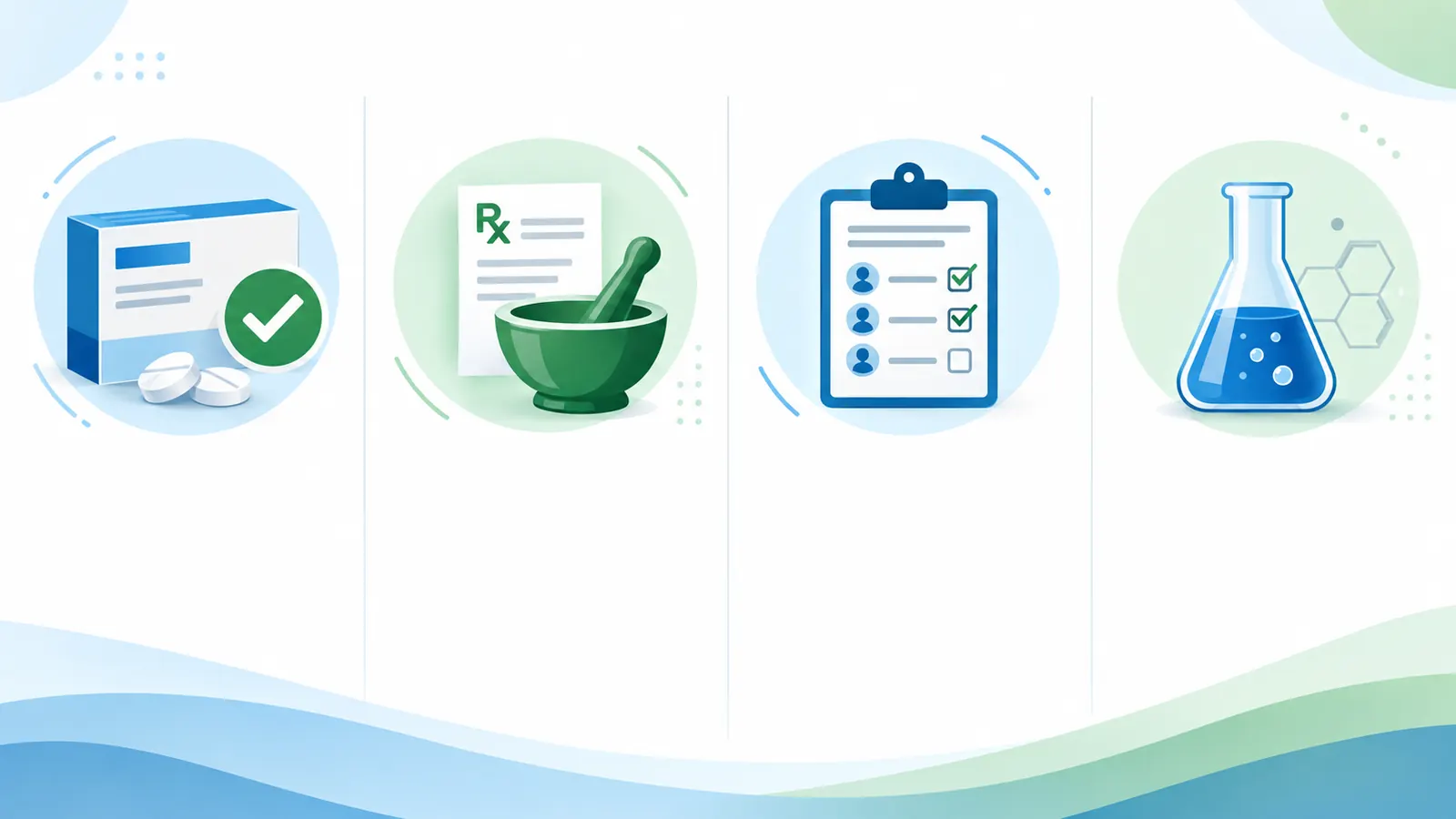
No. The word peptide describes chemical structure, not a single regulatory status. Four categories appear frequently in search results, and they should never be treated as synonyms.
| Category | FDA approved? | Intended setting | Oversight and quality | Prescription? | Main patient question |
|---|---|---|---|---|---|
| FDA-approved peptide medicine | Yes, for the specific product and indication | Clinical care under the approved label | FDA reviews submitted evidence and manufacturing information; post-market monitoring continues | Usually yes | Is this approved product appropriate for me? |
| Compounded peptide medication | No | A patient-specific medical need or another lawful compounding circumstance | Federal and state requirements may apply; FDA does not conduct premarket approval of the finished compounded drug | Generally tied to a valid prescription under Section 503A | Why is an approved product not meeting my need, and which licensed pharmacy will dispense it? |
| Investigational peptide | No, unless another finished product has a separate approval | A regulated clinical investigation | Study protocol, investigator oversight, consent, and applicable FDA/IRB requirements | Access is through the study, not ordinary retail sale | Is there a registered trial for which I may be eligible? |
| Research-use-only material | No | Laboratory research, not patient treatment | Seller documents do not substitute for drug approval, pharmacy standards, or clinical oversight | Not a legitimate shortcut to patient use | Why is a laboratory material being marketed to me as treatment? |
The FDA's compounding questions and answers state plainly that compounded drugs are not FDA approved. FDA does not verify their safety, effectiveness, or quality before they are marketed. The agency also explains that compounding can meet an important need when an available approved drug is not medically appropriate for a particular patient.
So, are peptides safe when compounded? There is no automatic yes or no. The prescriber must identify a legitimate medical need, and the patient should verify the pharmacy, ingredient, concentration, directions, storage, and follow-up. A compounded product should not be represented as a generic or FDA-approved equivalent.
Are Peptides Safe From an Unknown Online Vendor?
An unfamiliar website can present a polished label, customer reviews, and a downloadable report without resolving the central safety questions. The FDA BeSafeRx campaign advises consumers to obtain prescription medicines from state-licensed online pharmacies.
Potential problems include:
- Misidentification: the vial may contain a different substance from the label.
- Incorrect strength: too little, too much, or unevenly distributed material changes exposure.
- Peptide-related impurities: synthesis can produce truncated, deleted, added, oxidized, aggregated, or otherwise altered material.
- Microbial contamination: sterile-appearing packaging does not establish sterility.
- Bacterial endotoxins: these can remain even when living bacteria are not detected and can cause serious reactions.
- Poor storage: heat, light, agitation, or repeated temperature changes can degrade some products.
- Counterfeit records: a report may be copied, edited, expired, unrelated to the supplied lot, or issued by a laboratory that cannot be independently verified.
- No chain of custody: the seller may not identify the manufacturer, importer, compounder, or handling steps.
- Unsupported claims: treatment promises may go far beyond available human evidence.
- No clinical safety net: a buyer may receive no screening, interaction review, dosing verification, or adverse-event support.
FDA has warned about fraudulent labels and dosing errors involving unapproved semaglutide and tirzepatide products. Its current GLP-1 safety page recommends an appropriate prescription and state-licensed pharmacy. The product and care pathway must be verifiable.
Are Peptides Safe if a COA Says 99% Pure?

A Certificate of Analysis, or COA, records selected testing of a material or batch. A useful report identifies the product, lot, date, laboratory, method, results, specifications, and authorization. Those details should match the supplied batch.
For anyone asking are peptides safe, a COA is one piece of evidence, not a safety certificate. A reported value such as 99% purity may describe the relative chromatographic area observed under one method. It does not automatically establish how many milligrams are in a vial, whether the main peak is the claimed peptide, whether the sample was representative, or whether the product is sterile.
Check whether the laboratory can be independently identified and whether the report came from the lab or only the seller. Match the batch on the vial, package, invoice, and report. A QR code is useful only when it resolves to a laboratory-controlled record for that lot.
What Can HPLC Testing Show?
High-performance liquid chromatography, or HPLC, separates components in a sample. It can help characterize purity, related substances, and sometimes assay when the method is appropriately designed, validated, and paired with suitable standards.
HPLC has limits. A large peak does not prove that the peak is the intended peptide. Results depend on the detector, standards, sample preparation, integration, and method suitability. FDA’s analytical-method guidance explains why a method must be fit for its intended measurement.
What Can LC-MS or Mass Spectrometry Show?
Liquid chromatography coupled with mass spectrometry, or LC-MS, can add information about molecular mass and identity. Used with other well-controlled methods, it can help distinguish the target compound from some impurities or degradation products.
LC-MS is not a universal verdict. It does not automatically establish potency, biological activity, sterility, endotoxin level, container quality, or clinical benefit. The strongest characterization often uses complementary, or orthogonal, methods that answer different questions.
Peer-reviewed research explains why synthetic peptide impurities can affect immunogenicity assessment. This does not prove a particular sample is unsafe; it shows why one purity number is incomplete.
Why Do Sterility and Endotoxin Testing Matter for Injections?
Products intended for injection bypass several of the body’s normal barriers. USP General Chapter 797 describes practices intended to prevent harm from microbial contamination, excessive bacterial endotoxins, strength variability, unintended contaminants, and inappropriate ingredients in compounded sterile preparations. The USP sterile-compounding chapter is much broader than a seller’s purity screenshot.
Sterility testing looks for viable contamination under defined conditions; endotoxin testing addresses pyrogenic bacterial components. HPLC and visual inspection replace neither test. Container closure, aseptic processing, dating, shipping, and handling also matter.
The CDC's safe injection guidance explains that unsafe practices can transmit bacterial, fungal, and bloodborne infections. Patients should never assume a vial is suitable for injection because it is clear, sealed, or labeled sterile.
Are Peptides Safe? Use This 11-Point Source Checklist

Use this 11-point checklist before treating marketing as evidence.
- Name the exact product. Ask for the active ingredient, salt or form, concentration, route, and finished dosage form.
- Check the regulatory status. Search the FDA label or Drugs@FDA rather than relying on a seller’s use of words such as pharmaceutical, clinical, or medical grade.
- Identify the prescriber and medical need. A legitimate clinical pathway includes history, contraindications, interactions, alternatives, and follow-up.
- Identify the dispensing pharmacy. Verify state licensure and the name shown on the prescription label.
- Trace the batch. The lot on the vial and package should correspond to the supporting records.
- Review a batch-specific COA. Confirm the laboratory, methods, dates, specifications, and report authorization.
- Look beyond purity. Ask about identity and assay or strength, not only an HPLC area percentage.
- For injections, ask about sterile controls. Sterility, endotoxins, aseptic processing, container closure, and beyond-use dating require specific attention.
- Review storage and shipping. Ask what temperature and light controls apply and what to do if the shipment arrives warm, damaged, or delayed.
- Compare claims with evidence. A laboratory or animal study does not prove treatment benefit in people.
- Plan for problems. Know whom to contact for side effects, dosing confusion, damaged product, recalls, or an unexpected reaction.
This turns are peptides safe into verifiable product and care questions. CSV Medic’s guide to peptide legality explains why approval, prescription status, compounding law, and research labeling must be considered separately.
Research Peptides Are Not Prescription Peptide Therapy
The phrase research peptide usually describes material offered for laboratory investigation. It does not mean the product passed FDA review, was manufactured as a medicine, or is appropriate for self-injection. A disclaimer printed on the bottle does not erase patient-directed marketing elsewhere on a website or social channel.
Human studies do not validate every retail version of a named molecule. Clinical investigators use a defined product, protocol, eligibility criteria, monitoring plan, and adverse-event process. An unrelated retail vial does not inherit those protections.
Are research peptides safe if the seller posts a COA? The report may provide useful analytical information, but it cannot authorize human use or replace the missing clinical and regulatory evidence. Patients should not use a research-only label as a route around medical review.
Where Does Compounding Fit Into the Peptide Debate?
Pharmaceutical compounding generally involves a licensed pharmacist, licensed physician, or registered outsourcing-facility process combining, mixing, or altering ingredients to create a medication. Under Section 503A, traditional pharmacy compounding is generally associated with an identified individual patient’s prescription and must meet statutory conditions. Section 503B describes a separate federal outsourcing-facility framework.
Compounding can meet a real need, such as a dosage form without a particular allergen. The reason must be more specific than lower price or online popularity, and the compounded drug remains unapproved.
CSV Medic presents itself as a medically supervised weight-management and pharmacy-services platform. Its online weight-loss consultation guide describes the role of clinician screening, while the weight-loss programs page provides an overview of care pathways. When CSV Medic discusses compounding-pharmacy services, the relevant questions remain the same: what is the patient-specific need, which licensed pharmacy dispenses the medication, what documentation applies, and what approved alternatives exist?
Use the FDA human drug compounding hub for current federal information. State-board requirements and product-specific policies also matter.
What Is the Status of BPC-157, TB-500, MOTS-C, KPV, Semax, and Epitalon?
FDA’s Pharmacy Compounding Advisory Committee, or PCAC, discussed seven peptide-related bulk drug substances on July 23 and 24, 2026. The committee gave favorable recommendations for BPC-157, KPV, TB-500, MOTS-C, Semax, and Epitalon, and an unfavorable recommendation for emideltide, also called DSIP.
Those advisory votes did not approve finished drugs, prove safety or effectiveness, or immediately change compounding law. See the FDA PCAC meeting page and CSV Medic’s PCAC explainer.
| Peptide | Common research interest | FDA-approved finished drug for these uses? | Human evidence | Current safety and regulatory note |
|---|---|---|---|---|
| BPC-157 | Gastrointestinal and tissue-repair questions | No | Limited and insufficient to establish broad marketed benefits | Favorable July 2026 PCAC recommendation is not approval; FDA has identified impurity, characterization, and immunogenicity concerns |
| TB-500 | Wound healing and recovery claims | No | FDA briefing materials identified major gaps, including lack of direct human evidence for the nominated substance | Do not transfer evidence from full thymosin beta-4 automatically to TB-500; PCAC recommendation remains advisory |
| MOTS-C | Metabolism, obesity, and mitochondrial signaling | No | Predominantly preclinical; adequate therapeutic human evidence is lacking | FDA previously reported no identified human exposure data for compounded products; favorable PCAC vote did not establish safety |
| KPV | Inflammation, wound, gut, and skin research | No | Primarily preclinical with no established therapeutic benefit | FDA reported no identified human exposure data for drug products in its safety summary; PCAC recommendation is not approval |
| Semax | Neurologic research interests | No U.S. approval | Selected research exists, but it does not support broad U.S. wellness claims | FDA has noted aggregation, peptide-impurity, and possible immunogenicity concerns; favorable PCAC vote is advisory |
| Epitalon | Sleep and longevity research claims | No | Limited evidence does not establish anti-aging or insomnia treatment | FDA reported insufficient safety information for proposed administration; favorable PCAC vote is not approval |
FDA lists bulk substances that may present significant safety risks. A favorable advisory vote and prior safety concern can coexist while FDA considers the record; neither is a marketing claim.
Readers who want product-specific evidence can review CSV Medic’s guides to BPC-157, TB-500, MOTS-C, and KPV. These articles discuss evidence and status; they are not endorsements of self-treatment.
Peptides vs GLP-1 Medications: Why Does the Difference Matter?
Semaglutide and tirzepatide are peptides or peptide-based medicines, but approved branded products have product-specific labels and clinical evidence. For example, FDA-approved Wegovy products contain semaglutide and FDA-approved Zepbound products contain tirzepatide for specified indications and populations. Approval belongs to those finished products and labeled uses, not to every vial of semaglutide or tirzepatide sold online.
Compounded semaglutide or tirzepatide is not generic Wegovy or Zepbound and is not FDA approved. Retatrutide remains investigational as of this review. Anyone asking are peptides safe for weight loss may encounter approved prescriptions, compounded products, trials, and research vials on one results page.
CSV Medic’s GLP-1 prescription guide explains clinician screening and approved options. The correct choice depends on diagnosis, contraindications, availability, treatment goals, and an individualized discussion rather than the broad label peptide therapy.
Could Better Testing and Oversight Improve Peptide Therapy?
Better testing can answer quality questions, but it cannot replace clinical trials or approval. A responsible system connects qualified suppliers, controlled production, batch traceability, validated methods, sterile controls when needed, accurate labeling, stable shipping, prescribing, and adverse-event follow-up.
The future should separate credible medicine and research from unsupported human-use claims. The strongest answer to are peptides safe is that safety grows from evidence, product quality, lawful oversight, and honest uncertainty.
CSV Medic’s Approach to Peptide Education and Pharmacy Services
CSV Medic helps readers identify the correct product category and ask better questions. The site separates approved medicines, compounded-drug considerations, investigational peptides, and research products.
Readers should expect clarity about intended use, prescription requirements, clinician review, dispensing source, and regulatory status. CSV Medic has no relationship with Dr Dubrow, 60 Minutes Australia, or Channel 9, and their reporting is not an endorsement.
For questions about legally available products and pharmacy services, contact CSV Medic. Do not use a research-only peptide as a substitute for clinical care.
Frequently Asked Questions
Are Peptides Safe and FDA Approved as a Class?
Some specific peptide medicines are FDA approved for specific indications. Peptides as a class are not approved, and approval does not transfer to compounded, counterfeit, or research-only versions with a similar name.
Are Peptides Safe When Injected?
Are peptides safe when injected? Risk depends on the exact medicine, patient, dose, source, sterility, administration, and monitoring. Injection adds contamination, endotoxin, dosing, and handling concerns that a purity result alone cannot resolve.
What are unregulated peptides?
The phrase commonly refers to products marketed outside established drug-approval, prescription, pharmacy, or clinical-trial pathways. It is not a precise legal category, so identify the substance, intended use, seller, manufacturer or compounder, and applicable law.
Are Peptides Safe When They Are Compounded?
No. Compounded drugs are not FDA approved. They may be prepared for a legitimate patient need when federal and state conditions are met, but FDA does not conduct the same premarket review applied to an approved finished drug.
What is the difference between compounded and research peptides?
A compounded medication is prepared within a pharmacy or outsourcing framework for a medical purpose under applicable requirements. A research peptide is intended for laboratory work and should not be sold or used as a patient-treatment shortcut.
What does 99% peptide purity mean?
It usually describes a result produced by a particular analytical method and calculation. It may not establish identity, total vial content, concentration after preparation, sterility, endotoxin level, stability, or clinical safety.
How do you verify a peptide COA?
Match the product and batch number, identify the laboratory, confirm the test date and methods, review specifications and units, and seek a laboratory-controlled copy. Verify identity and assay information in addition to purity.
Are Peptides Safe to Inject When a COA Is Available?
No. A COA can document selected tests, but injection safety also depends on sterility, endotoxins, strength, formulation, container closure, storage, handling, patient factors, and lawful medical oversight.
What is HPLC peptide testing?
HPLC separates components in a sample and can help evaluate purity or assay when the method is suitable and validated. It does not automatically prove the identity of the main peak or the safety of the finished product.
Are BPC-157 and TB-500 FDA approved?
No FDA-approved finished BPC-157 or TB-500 drug exists for the commonly promoted recovery uses. The July 2026 PCAC recommendations concerned possible compounding-list status and were advisory, not drug approvals.
Conclusion: Ask Better Questions Before You Trust a Vial
Are peptides safe? Some approved peptide medicines have well-defined uses and risks. Other substances remain investigational, have limited human evidence, or are sold as laboratory materials. Compounded medications occupy a separate, patient-specific pathway and are not FDA approved.
Start by identifying the product, status, evidence, prescriber, pharmacy, batch, tests, storage, and follow-up. A clean label, purity number, or popular video cannot answer every question.
CSV Medic encourages readers to use FDA records, primary medical literature, licensed clinicians, and verifiable pharmacy information before considering any treatment. Browse CSV Medic’s peptide education library and contact the team for information about legally available products, pharmacy services, and medically supervised weight-management options.
Editorial and Medical Disclaimer
Prepared by the CSV Medic editorial team for review by Dr Spencer before publication. Regulatory information was checked on September 9, 2026. A named medical-review claim should be added only after the reviewer completes and documents review.
This article is for educational purposes only and is not medical advice, diagnosis, a prescription, or a recommendation to use an unapproved or research-only product. Do not start, stop, combine, reconstitute, inject, or change any medication based on this article. Consult a qualified healthcare professional and licensed pharmacist. Seek urgent medical care for a severe allergic reaction, breathing difficulty, chest pain, fainting, confusion, persistent vomiting, severe abdominal pain, or rapidly worsening symptoms.
