
Weight Loss Education, Weight Loss Medication
TB 500 Peptide: 10 Essential Safety and Evidence Facts

Aug
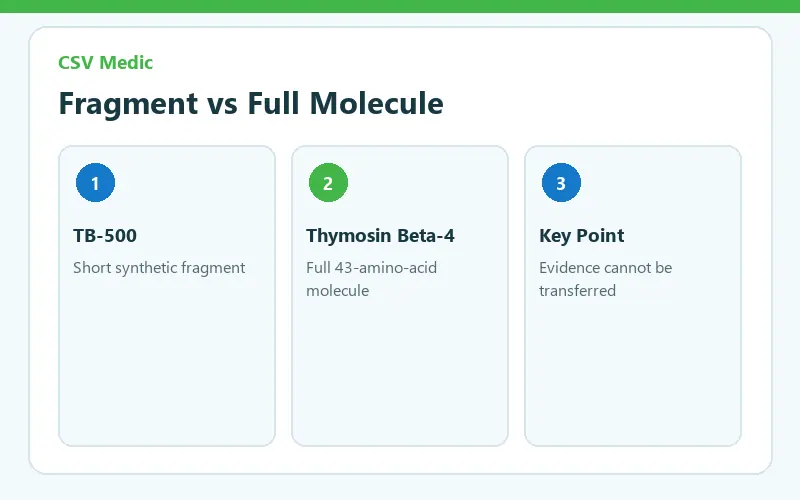
TB 500 peptide is a synthetic seven-amino-acid fragment associated with one region of the naturally occurring 43-amino-acid peptide thymosin beta-4. It is widely promoted online for injury recovery, inflammation, flexibility, and tissue repair, but it is not an FDA-approved medicine and FDA has said it did not identify human exposure data for drug products containing the TB-500 fragment.
That distinction is the center of this article. Human studies involving full-length recombinant thymosin beta-4 do not prove that TB 500 peptide injections are safe or effective. The molecules differ in size, structure, exposure, and potentially in biological behavior.
Patients searching for TB500 peptide benefits, TB 500 peptide dosage, or TB 500 peptide before and after results need a clear map of what is known, what is inferred, and what remains untested.
Key Takeaways
- TB 500 peptide is a short synthetic fragment, not full-length thymosin beta-4.
- FDA has not approved TB-500 for injury recovery, muscle growth, inflammation, or another therapeutic use.
- FDA’s 2026 review did not identify human exposure data for drug products containing the fragment.
- Animal or laboratory findings cannot establish a safe TB 500 peptide dose for a patient.
- No validated TB 500 peptide dosage chart or clinical protocol exists.
- Online results and recovery stories are anecdotes, not proof.
- Athletes must also consider anti-doping rules.
What Is TB 500 Peptide?
TB-500, also written TB500 peptide or TB 500 peptide, is a synthetic N-acetylated heptapeptide. Its sequence corresponds to amino acids 17 through 23 of thymosin beta-4. FDA’s substance record identifies it as the sequence LKKTETQ but warns that a UNII record is an identity reference, not regulatory approval.
Thymosin beta-4 is naturally present in many tissues and body fluids. It interacts with actin and has been investigated in tissue repair, cell migration, inflammation, and vascular biology. TB-500 captures only a small section of that molecule. A fragment may retain, lose, or alter activities associated with the parent peptide.
| Term | Meaning | Why it matters |
|---|---|---|
| Thymosin beta-4 | Full 43-amino-acid peptide | Has a broader research history, including some human studies |
| TB-500 | Synthetic seven-amino-acid fragment | FDA found no human exposure data for drug products containing this fragment |
| TB-500 acetate | A salt form of the fragment | Salt form and manufacturing details affect identity and characterization |
| TB 500 peptide blend | A mixture with substances such as BPC-157 or GHK-Cu | The combination creates additional untested variables |
The FDA TB-500 briefing document provides the most useful current regulatory and scientific overview. It should be read before relying on seller descriptions.
Why Is TB-500 Associated With Recovery?
The recovery story largely comes from research on thymosin beta-4 and laboratory studies of related fragments. Thymosin beta-4 participates in actin dynamics, a basic process involved in cell shape and movement. Researchers have studied it in models involving corneal injury, dermal wounds, inflammation, and cardiovascular tissue.
A PubMed review of thymosin beta-4 research describes several clinical and preclinical programs. A phase I study of recombinant human thymosin beta-4 also evaluated the full molecule in healthy volunteers.
Neither source proves TB500 peptide works for a tendon tear, muscle strain, joint pain, or sports recovery. Full-length thymosin beta-4 and its short fragment should not be treated as interchangeable products.
What Did FDA Find About TB-500?
FDA evaluated TB-500-related bulk drug substances for possible inclusion on the Section 503A bulks list. That process concerns whether a substance may be used in compounding under specific federal conditions. It is not a drug-approval review.
FDA reported that it did not identify human exposure data for drug products containing TB-500. The agency raised concerns about immunogenicity, aggregation, peptide-related impurities, and the absence of a recognized U.S. Pharmacopeia drug-substance monograph.
In July 2026, the Pharmacy Compounding Advisory Committee considered TB-500 and other peptides. Advisory committee recommendations do not equal FDA approval and do not immediately change the legal status of a finished product. FDA must complete its regulatory process. The FDA PCAC meeting page hosts the official materials.
Readers can see the wider context in CSV Medic’s peptide education library.
Patients new to the topic can also start with What Are Peptides and CSV Medic’s guide to peptides for muscle growth and fat loss. These pages explain why a proposed mechanism is not the same as a proven patient outcome.
Claimed TB500 Peptide Benefits
Marketing commonly associates TB 500 peptide with faster healing, reduced inflammation, improved flexibility, better muscle recovery, new blood-vessel formation, and less scar tissue. These claims are more confident than the evidence permits.
| Claimed benefit | Basis for interest | Evidence gap |
|---|---|---|
| Tendon or ligament recovery | Preclinical tissue-repair biology | No robust controlled human trial of TB-500 for the claim |
| Muscle recovery | Animal and laboratory hypotheses | No established patient outcome, dose, or treatment duration |
| Reduced inflammation | Thymosin-related signaling research | Fragment-specific clinical effect remains uncertain |
| Wound healing | Full thymosin beta-4 and laboratory research | Cannot be assigned to an unapproved TB-500 injection |
| Improved flexibility | Anecdotal reports | No validated clinical endpoint or comparison group |
It is reasonable to say TB-500 has been investigated as a research peptide. It is not reasonable to present these potential benefits as established medical facts.
TB 500 Peptide Side Effects and Unknowns
A reliable TB 500 peptide side effects profile cannot be calculated without adequate human studies. Potential concerns include injection-site reactions, allergy, immune responses, contamination, endotoxins, incorrect concentration, peptide impurities, and interactions with other medicines or health conditions.
Angiogenesis is often advertised as a benefit. Yet blood-vessel growth is biologically complex, and a pathway described in tissue models may have unwanted implications in some diseases. Patients with active cancer, unexplained masses, significant cardiovascular disease, immune conditions, or complex medication regimens require careful medical assessment rather than online experimentation.
The FDA safety-risk list for compounded bulk substances explains the agency’s concerns. Compounded drugs are not FDA approved, and quality failures can result in contamination or the wrong amount of active ingredient.
FDA’s compounding oversight and compliance page documents why sterility, potency, and lawful dispensing matter. Patients can use ClinicalTrials.gov and the PubMed TB-500 search to see how little direct human evidence is available for the fragment itself.
Urgent symptoms such as trouble breathing, facial swelling, fainting, chest pain, confusion, or rapidly spreading redness require immediate medical care. Fever, drainage, severe pain, or a worsening injury also need prompt evaluation.
Is There an Evidence-Based TB 500 Peptide Dosage?
No FDA-approved TB 500 peptide dosage exists. FDA found no human exposure data for drug products containing the fragment, so there is no validated dose-ranging foundation from which to create a patient protocol.
Searches for a TB 500 peptide dose per day, TB 500 peptide dosage chart, TB-500 peptide vial calculations, or BPC 157 TB 500 peptide schedules often lead to seller calculators and forum instructions. Those tools can perform arithmetic, but they cannot establish identity, sterility, pharmacokinetics, effectiveness, or individual safety.
This article therefore does not provide injection units or a reconstitution schedule. A number on an insulin syringe depends on the vial’s verified concentration and dilution volume. Even perfect arithmetic cannot turn an unapproved, poorly characterized product into a proven treatment.
TB-500 vs Thymosin Beta-4
| Question | TB-500 | Full thymosin beta-4 |
|---|---|---|
| Length | Seven amino acids | 43 amino acids |
| Natural full human sequence | No; synthetic fragment | Corresponds to a naturally occurring human peptide |
| Human clinical research | FDA did not identify exposure data for TB-500 drug products | Some human studies exist for specific full-length formulations |
| FDA-approved therapeutic product | No | No general FDA approval for the wellness claims discussed here |
| Can evidence be transferred between them? | No | Findings remain product-, route-, and indication-specific |
Conflating these molecules is one of the most common errors in TB 500 peptide reviews. A study title containing “thymosin beta-4” should not be cited as a TB-500 clinical trial unless the actual intervention was the fragment.
TB-500 vs BPC-157
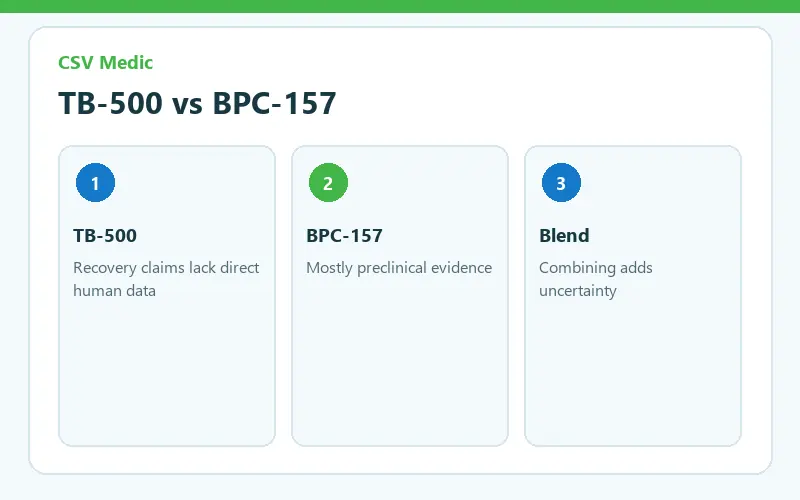
TB-500 and BPC-157 are often paired in a so-called recovery stack. They are different molecules with different proposed mechanisms and separate evidence gaps. The combination has not been established as safer or more effective than either ingredient alone.
CSV Medic’s patient guide to peptides explains why animal findings should not become treatment guarantees. Our peptides for muscle growth and fat loss guide also covers evidence, safety, and sourcing questions relevant to this topic.
For currently published patient guidance, review CSV Medic’s Are Peptides Legal article and medical disclaimer. These resources help separate product availability from approval, evidence, and individual medical suitability.
Sports and Anti-Doping Considerations
Competitive athletes face an additional risk. The World Anti-Doping Agency Prohibited List covers growth factors and related substances, and rules can change. Athletes should obtain current guidance from their governing body and qualified sports-medicine professionals before using any peptide product.
The U.S. Anti-Doping Agency supplement and medication guidance is another useful source for athletes. A product’s sale online does not determine whether it is permitted in sport.
A product being easy to buy online does not mean it is permitted in competition. Contamination or undeclared ingredients can also create an anti-doping violation.
How to Evaluate a TB-500 Claim
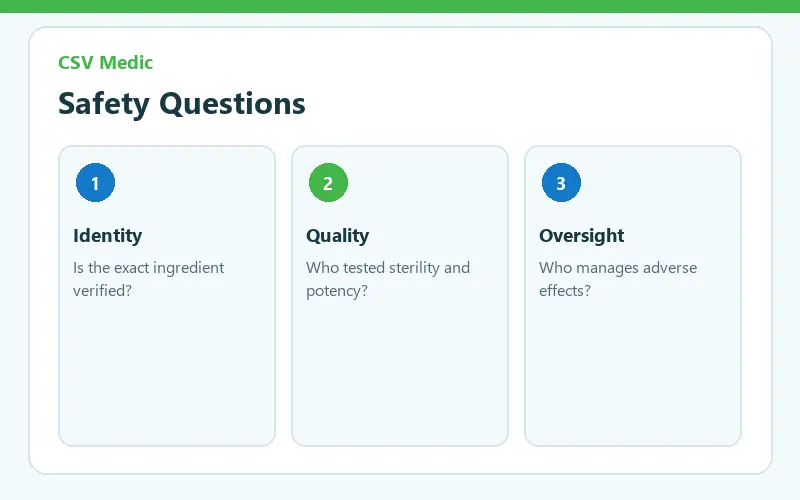
Ask the seller, pharmacy, or clinician:
- Are you discussing TB-500 or full thymosin beta-4?
- Is the proposed product FDA approved for this use?
- What human study tested the exact molecule, route, and indication?
- Which licensed pharmacy would dispense it?
- How are identity, strength, sterility, and endotoxins tested?
- What patient-specific medical need supports compounding?
- What conditions or medicines could raise risk?
- What outcomes will be monitored, and when should treatment stop?
- What approved treatments, rehabilitation options, or diagnostic steps are alternatives?
For an overview of lawful compounding, review the FDA compounding questions and answers and CSV Medic’s are peptides legal guide.
People comparing recovery products can browse CSV Medic’s peptide category and then bring the exact ingredient list to a licensed clinician. A Reddit search for TB-500 experiences can show common patient questions, but forum reports cannot verify identity, dose, or causation and are not medical evidence.
Myths vs Facts
| Myth | Fact |
|---|---|
| TB-500 is simply thymosin beta-4 | TB-500 is a short synthetic fragment of the larger peptide |
| Human thymosin beta-4 trials prove TB-500 works | Results cannot be transferred without fragment-specific clinical evidence |
| A research label confirms high quality | “Research use only” does not establish pharmaceutical identity or sterility |
| A dosage calculator makes use safe | Arithmetic does not replace clinical evidence and medical review |
| Online recovery stories establish benefit | Anecdotes cannot exclude natural healing, rehabilitation, or other treatments |
Frequently Asked Questions About TB 500 Peptide
What is TB 500 peptide used for?
It is promoted online for recovery and tissue-repair goals, but it is not FDA approved for those uses and clinical evidence for the fragment is inadequate.
Is TB-500 the same as thymosin beta-4?
No. TB-500 is a seven-amino-acid fragment; full thymosin beta-4 contains 43 amino acids.
Is TB 500 peptide FDA approved?
No FDA-approved therapeutic product uses TB-500 for the commonly marketed recovery claims.
What are TB500 peptide benefits?
Proposed benefits are based mainly on laboratory, animal, parent-peptide, and anecdotal information. They have not been confirmed for patients in robust TB-500 trials.
What are the side effects of TB-500?
The complete profile is unknown. Injection reactions, infection, immune responses, impurities, incorrect strength, and interactions are concerns.
Is there a TB 500 peptide dosage chart?
Charts exist online, but there is no validated FDA-approved dosing schedule for the fragment.
Can TB-500 heal a tendon injury?
There is not enough controlled human evidence to make that claim. Tendon pain may require diagnosis, load management, rehabilitation, imaging, or other care.
Is a TB 500 peptide blend safer?
Not necessarily. Combining peptides creates additional uncertainty and does not establish synergy or safety.
Can athletes use TB-500?
Athletes should check the current WADA list and sport-specific rules. The substance may create anti-doping consequences.
Where should patients verify regulatory updates?
Use FDA pages, official advisory materials, state pharmacy boards, and licensed healthcare professionals rather than seller pages alone.
Final Perspective
TB 500 peptide has an interesting scientific origin, but a plausible biological story is not the same as a proven treatment. The strongest patient guidance is to distinguish the short fragment from full thymosin beta-4, recognize the lack of validated human dosing, and evaluate product quality and regulatory status before believing recovery claims.
To ask CSV Medic about legally available services or evidence-based alternatives, visit the contact page. Contact does not guarantee access to an unapproved peptide.
About the Author
This article was medically reviewed and published by the CSV Medic editorial team in collaboration with licensed healthcare providers specializing in weight management, metabolic health, and peptide education. Medical claims are limited to what current regulatory guidance and published evidence can support.
Medical Disclaimer
This article is for educational purposes only and does not constitute medical advice, diagnosis, dosing instructions, or a prescription. TB-500 is not an FDA-approved treatment for injury recovery or the other claims discussed. Consult a licensed healthcare professional for symptoms, injuries, and treatment decisions.
