
Weight Loss Education, Weight Loss Medication
PT-141 Peptide: 9 Important Uses and Safety Facts
Sep
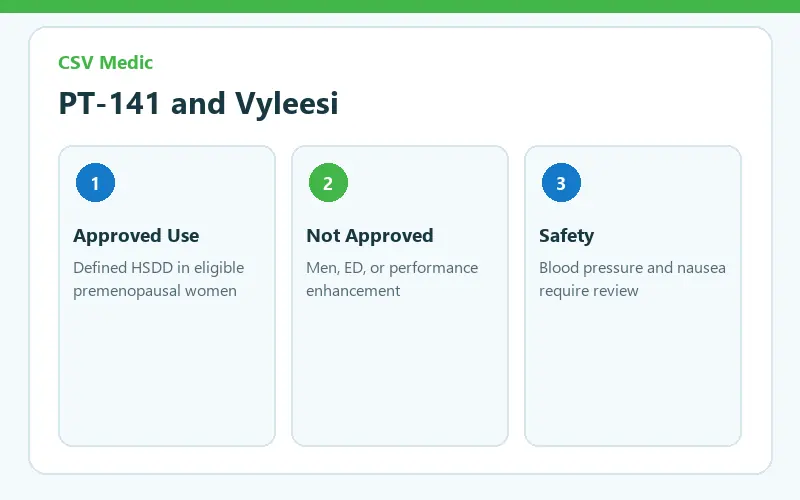
PT 141 peptide is a development name for bremelanotide, a melanocortin receptor agonist. FDA approved the specific prescription product Vyleesi in 2019 for premenopausal women with acquired, generalized hypoactive sexual desire disorder that causes marked distress or interpersonal difficulty and is not explained by another condition, relationship problem, or medication.
That approval is narrower than most online PT-141 marketing. Vyleesi is not approved for men, postmenopausal women, erectile dysfunction, bodybuilding, sexual-performance enhancement, or general libido boosting. A research vial labelled PT-141 is not automatically the same as the FDA-approved prefilled autoinjector.
This article explains the approved use, clinical evidence, common side effects, contraindications, product-quality concerns, and why PT-141 peptide for men remains an off-label or unapproved marketing claim rather than an FDA-approved indication.
Key Takeaways
- PT-141 is another name associated with bremelanotide.
- Vyleesi is an FDA-approved bremelanotide product for a defined group of premenopausal women with acquired, generalized HSDD.
- It is not approved for men, postmenopausal women, erectile dysfunction, or sexual-performance enhancement.
- Approval of Vyleesi does not approve research-grade or compounded PT-141 products.
- Phase 3 trials found modest average improvements in sexual desire and related distress compared with placebo.
- Nausea, flushing, headache, vomiting, fatigue, and injection-site reactions are important adverse effects.
- Bremelanotide temporarily increases blood pressure and reduces heart rate after dosing.
- It is contraindicated in uncontrolled hypertension or known cardiovascular disease.
- An FDA-approved product must be used according to its current label and prescriber’s instructions.
What Is PT 141 Peptide?
Bremelanotide is a synthetic cyclic peptide that activates melanocortin receptors. It was developed from research involving melanocortin pathways and sexual response. Unlike phosphodiesterase-5 inhibitors, which act mainly through vascular mechanisms, bremelanotide is believed to act through central nervous system pathways involved in sexual desire.
The name PT-141 peptide appears frequently in peptide forums and clinic marketing. The approved drug name is bremelanotide, and the approved brand is Vyleesi. Product names matter because FDA approval is tied to a particular formulation and delivery system.
The reversed search phrase peptide PT 141 refers to the same molecule. Online wording varies, but regulatory status depends on the exact drug product, indication and patient population, not on the name used in a search or advertisement.
Readers researching injectable products should first review CSV Medic’s peptide injection safety guide and peptide therapy overview.
What Is Vyleesi Approved to Treat?
Vyleesi is indicated for premenopausal women with acquired, generalized hypoactive sexual desire disorder, commonly abbreviated HSDD.
The label defines important boundaries:
- low sexual desire causes marked distress or interpersonal difficulty;
- the problem developed after a period of previously normal sexual desire;
- it occurs across situations and partners rather than only in one circumstance;
- it is not due to another medical or psychiatric condition;
- it is not caused by relationship problems;
- it is not an effect of medication or another drug.
Vyleesi is not indicated for postmenopausal women or men. It is not indicated to enhance sexual performance.
The FDA-approved Vyleesi label provides the authoritative indication, limitations, contraindications, and administration information.
What Did the PT-141 Clinical Trials Show?
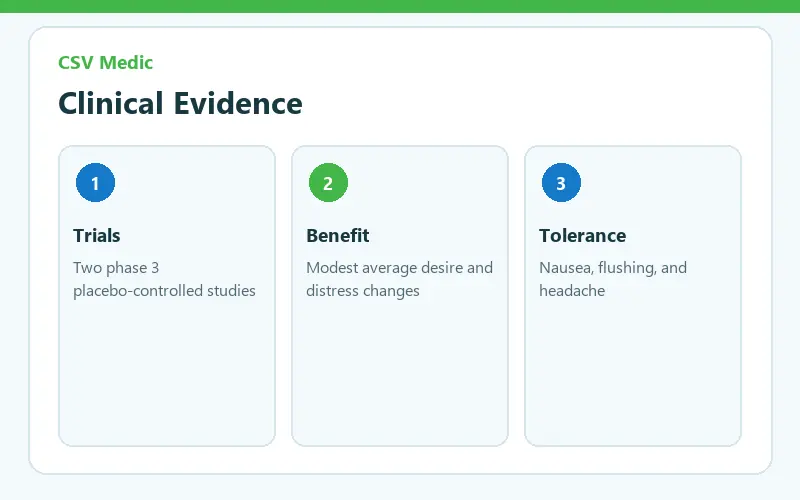
Two phase 3 randomized, double-blind, placebo-controlled trials evaluated bremelanotide in premenopausal women with HSDD. The integrated program included more than 1,200 participants in the efficacy and safety populations.
The published phase 3 trials reported statistically significant average improvements in sexual desire scores and reductions in distress related to low sexual desire compared with placebo. The numerical differences were modest, which is important for setting realistic expectations.
More participants receiving bremelanotide experienced nausea, flushing, and headache. Trial eligibility, standardized product, outcome definitions, and monitoring distinguish this evidence from informal use of PT-141 peptide for men or research products purchased online.
| Outcome | Trial finding | Practical interpretation |
|---|---|---|
| Sexual desire score | Improved more than placebo on average | Benefit varied and was not universal |
| Distress related to low desire | Reduced more than placebo | The approved goal includes distress, not performance enhancement |
| Satisfying sexual events | Not the sole basis of benefit | Treatment is not a guarantee of a particular event count |
| Nausea | Common and sometimes treatment-limiting | Tolerability matters in the benefit-risk decision |
PT 141 Peptide Benefits: Approved and Unapproved Claims
The established PT 141 peptide benefits relate to the approved Vyleesi indication. Online pages frequently extend the claim to male libido, erectile quality, athletic confidence, mood, or relationship performance.
| Claim | Evidence-based status |
|---|---|
| Treats acquired generalized HSDD in eligible premenopausal women | FDA-approved Vyleesi indication |
| Improves erections in men | Not an FDA-approved indication |
| Enhances sexual performance | Specifically outside the approved indication |
| Works for every cause of low desire | False; diagnosis excludes several causes |
| Treats relationship problems | No |
| Research vial equals Vyleesi | No; product quality and formulation are not established |
Low sexual desire can result from depression, anxiety, pain, menopause, endocrine disease, medication effects, relationship stress, trauma, sleep problems, or another cause. Evaluation matters because the right treatment depends on the cause.
Is PT-141 FDA Approved for Men?
No. PT 141 peptide for men and PT-141 peptide for men are popular searches, but Vyleesi is not approved for men. It is also not approved as an erectile dysfunction treatment.
That does not mean no research has examined melanocortin pathways in men. It means FDA has not approved a bremelanotide product for that population and indication. A clinician considering any off-label use must evaluate evidence, cardiovascular risk, interactions, alternatives, and the approved label. Direct-to-consumer sellers should not imply that male use is an approved application.
Persistent erectile dysfunction can be an early sign of vascular disease, diabetes, medication effects, low testosterone, neurologic disease, or psychological distress. It deserves a clinical assessment rather than an anonymous peptide protocol.
PT-141 Dosage and the Difference Between a Label and a Forum
The FDA-approved Vyleesi label provides a product-specific, as-needed regimen and limits dosing frequency. Patients prescribed Vyleesi should follow that label and their clinician’s instructions.
This article does not reproduce an individualized protocol because the safety decision depends on diagnosis, blood pressure, cardiovascular history, kidney and liver function, concurrent medicines, pregnancy considerations, and previous adverse reactions.
Online research-vial instructions create additional uncertainty:
- the product may not be the approved formulation;
- concentration and purity may be inaccurate;
- injection devices and excipients differ;
- sterility may not be assured;
- dose limits may be ignored;
- adverse-event support may be absent.
The existence of an FDA-approved bremelanotide product does not make every bulk or compounded PT-141 product approved. FDA explains that compounded drugs are not FDA approved.
PT-141 Side Effects
Common adverse reactions in the approved label include:
- nausea;
- flushing;
- injection-site reactions;
- headache;
- vomiting;
- fatigue;
- dizziness;
- cough, nasal symptoms, or altered sensations in some patients.
Nausea is particularly important and can be severe for some patients. The label advises discontinuation when nausea is severe or does not resolve.
Bremelanotide can temporarily increase blood pressure and reduce heart rate. It is contraindicated in patients with uncontrolled hypertension or known cardiovascular disease. Clinicians should consider overall cardiovascular risk before prescribing it.
Focal hyperpigmentation, including changes involving the face, gums, or breasts, may occur and may not resolve completely. Risk can increase with more frequent use or darker skin pigmentation.
The drug can also slow gastric emptying and potentially affect absorption of oral medications. The current label should be checked for specific interaction concerns.
Who Should Avoid Vyleesi or Unsupervised PT-141?
Vyleesi is contraindicated in uncontrolled hypertension or known cardiovascular disease. Additional caution or clinical review is important for:
- postmenopausal women and men because these are not approved populations;
- pregnant or breastfeeding people;
- patients with significant kidney or liver impairment;
- people taking oral medicines where delayed absorption could matter;
- anyone with unexplained low desire that has not been evaluated;
- patients using several sexual-health or blood-pressure medicines;
- people who previously had a severe reaction;
- anyone considering an online research-use vial.
Trouble breathing, throat swelling, fainting, severe chest pain, a prolonged painful erection, or severe neurologic symptoms require urgent medical care.
PT-141 Versus Viagra or Cialis
| Feature | Bremelanotide/Vyleesi | Sildenafil or tadalafil products |
|---|---|---|
| Primary approved population/use | Eligible premenopausal women with acquired generalized HSDD | Specific products approved for erectile dysfunction and other defined uses |
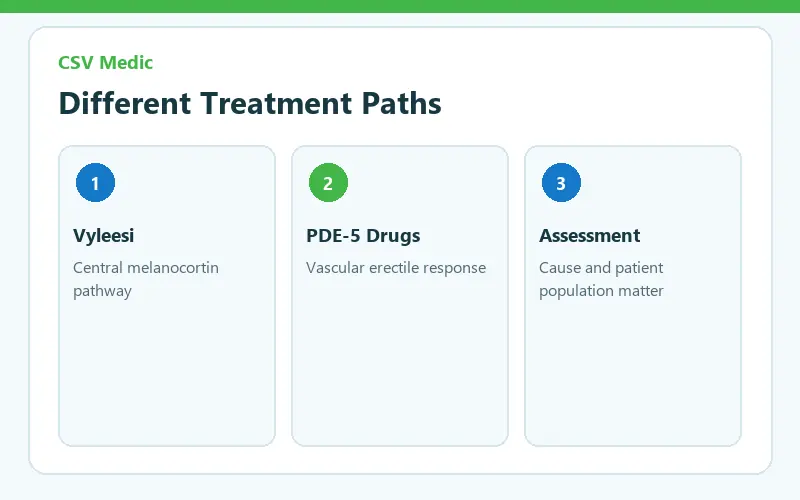
| Main pathway | Central melanocortin receptor agonism | PDE-5 inhibition and vascular response |
| Approved for men with ED | No | Yes for approved products |
| Key concerns | Nausea, blood-pressure changes, hyperpigmentation, interactions | Nitrate interaction, blood-pressure effects, visual/hearing warnings, priapism |
The treatments are not interchangeable. Diagnosis, cardiovascular health, medication interactions, and patient goals determine which options may be appropriate.
Product Quality and Compounding Questions
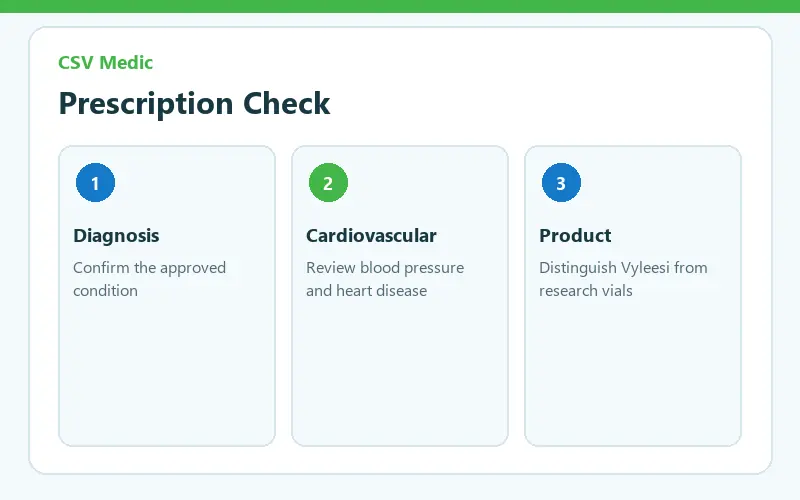
FDA has issued enforcement letters involving compounded bremelanotide and other peptides when products did not meet conditions for Section 503A exemptions. This does not erase the Vyleesi approval. It demonstrates why the approved formulation and unapproved compounded products must be discussed separately.
Patients should verify:
- the exact product name and active ingredient;
- whether it is the FDA-approved autoinjector;
- the prescriber’s license and indication assessment;
- the dispensing pharmacy and state authorization;
- storage and expiration instructions;
- management of blood pressure, nausea, and interactions;
- adverse-event and emergency support.
FDA’s consumer compounding information explains why quality and approval status matter.
Patient Forums: What They Add and What They Cannot Prove
A Reddit discussion about bremelanotide experiences in men contains highly variable reports of effects, headaches, nausea, and prolonged erections. It also includes unverified dosing advice.
The thread is useful for identifying questions, not for calculating effectiveness or establishing a safe regimen. Posters may use different products, omit medical history, combine drugs, or report unusually positive or negative experiences.
How Clinicians Evaluate Low Sexual Desire
Low desire is common and does not always represent a disorder. Evaluation focuses on whether the change is persistent, generalized, acquired, and personally distressing. A clinician may ask about relationships, pain, mood, sleep, trauma, pregnancy, menopause, contraception, substance use, and medical conditions.
Medication review is essential. Antidepressants, antihypertensives, hormonal treatments, sedatives, and other drugs can affect sexual function. Laboratory testing may be appropriate when symptoms suggest thyroid disease, anemia, diabetes, hyperprolactinemia, or another endocrine condition, but indiscriminate hormone panels can also mislead.
Treatment may involve education, couples or individual therapy, management of pain, medication adjustment, pelvic-floor care, treatment of depression or anxiety, and an approved medicine when the diagnosis and risk profile fit. A peptide should not be used to bypass this assessment.
Myths Versus Facts About PT-141
Myth: PT-141 is a female version of Viagra
Fact: Bremelanotide and PDE-5 inhibitors act through different pathways and have different approved populations, outcomes, contraindications, and side effects.
Myth: FDA approval covers PT-141 sold by any clinic
Fact: Approval covers Vyleesi under its approved application. Research or compounded products do not automatically match its quality, device, concentration, or evidence.
Myth: More frequent use produces better results
Fact: The approved label limits frequency because exposure and adverse effects matter. Using more than directed can increase risk and is not a valid way to overcome nonresponse.
Myth: A strong physical response proves HSDD treatment success
Fact: The approved condition concerns sexual desire and related distress in a defined population. A physical response alone does not establish that the diagnosis is correct or that overall wellbeing improved.
Alternatives and Supportive Care
Vyleesi is one option for a limited population, not the starting answer for every sexual concern. Depending on the cause, evidence-based care may include:
- reviewing medications that affect libido or arousal;
- treating vaginal dryness, pelvic pain, or genitourinary symptoms;
- addressing depression, anxiety, sleep, or relationship distress;
- sex therapy or cognitive-behavioral approaches;
- management of diabetes, cardiovascular disease, or endocrine disorders;
- other FDA-approved treatments when indicated.
Men with erectile dysfunction should receive cardiovascular risk assessment and evidence-based treatment rather than assume that PT 141 peptide for men is safer than approved ED care. Women with pain, bleeding, new neurologic symptoms, or sudden sexual-function changes may need targeted diagnostic evaluation.
Questions to Ask Before Filling a Prescription
Patients prescribed Vyleesi can ask how the diagnosis was established, how blood pressure will be evaluated, which reactions require stopping treatment, whether oral medications could be affected, how to store and use the autoinjector, and when effectiveness should be reassessed.
They should also ask what happens if treatment does not help. The approved label recommends discontinuation when symptoms do not improve after an appropriate trial. Continuing an ineffective drug only increases cost and exposure.
Privacy and communication matter in sexual-health care. A reputable service explains who can access records, how prescriptions are transmitted, how adverse events are handled, and when an in-person examination is necessary. It does not rush a patient from an online questionnaire to a peptide sale without exploring the source of distress.
Treatment goals should be defined before starting. The patient and clinician can agree on what improvement would feel meaningful, which side effects would be unacceptable, and when to reassess. This prevents a modest or absent benefit from being hidden behind vague promises about confidence or performance.
Frequently Asked Questions
Is PT-141 the same as bremelanotide?
PT-141 is a development name associated with bremelanotide. The FDA-approved product is Vyleesi. Unverified vials are not automatically equivalent.
Is PT-141 FDA approved?
Vyleesi is FDA approved for a specific form of HSDD in eligible premenopausal women. PT-141 is not broadly approved for every libido or performance use.
Is PT-141 approved for men?
No. Vyleesi is not indicated for men or for treatment of erectile dysfunction.
Does PT-141 increase blood pressure?
Bremelanotide can temporarily increase blood pressure and reduce heart rate. It is contraindicated in uncontrolled hypertension or known cardiovascular disease.
What is the most common side effect?
Nausea is one of the most common and clinically important adverse reactions. Flushing, headache, vomiting, fatigue, and injection-site reactions also occur.
Does PT-141 enhance sexual performance?
Vyleesi is not indicated to enhance sexual performance. Its approved use concerns acquired, generalized HSDD with distress in eligible premenopausal women.
Is compounded PT-141 FDA approved?
No. Compounded drugs are not FDA approved and do not undergo FDA premarket review for safety, effectiveness, or quality.
Can PT-141 interact with oral medications?
Yes. Delayed gastric emptying may affect oral drug absorption. A prescriber and pharmacist should review all medications.
Should low sexual desire be medically evaluated?
Yes. Medical, psychiatric, hormonal, medication-related, pain-related, and relationship factors can contribute and may require different care.
Selected Medical Sources
- FDA Vyleesi prescribing information
- DailyMed current Vyleesi drug label
- FDA multidisciplinary review of Vyleesi
- PubMed: two randomized phase 3 trials
- PubMed: neurobiology of bremelanotide
- PubMed: critical analysis of trial outcomes
- FDA compounding questions and answers
- FDA information for consumers and clinicians
These references apply to bremelanotide and the approved Vyleesi product. They do not establish that research vials or compounded products are equivalent. Readers comparing legal status can also review CSV Medic’s guide to whether peptides are legal.
Conclusion
PT 141 peptide is not merely a research trend: bremelanotide has an FDA-approved product supported by phase 3 trials. But the approval is precise. Vyleesi is intended for eligible premenopausal women with acquired, generalized HSDD, not men, performance enhancement, or every form of low desire.
Responsible content must preserve that distinction and disclose cardiovascular, nausea, hyperpigmentation, and interaction risks. Readers can explore CSV Medic’s health education library, How It Works, and medical disclaimer for additional context.
Editorial and Medical Review Status
This educational draft was prepared from the current FDA prescribing information, peer-reviewed clinical trials and public-health guidance available on September 1, 2026. It is saved for medical and editorial review by Dr Spencer before publication. The label, contraindications and drug-interaction information should be checked again on the publication date.
Medical disclaimer: This article is educational and does not provide medical advice, diagnosis, or prescribing instructions. Vyleesi is a prescription medicine with contraindications and risks. Consult a qualified healthcare professional for evaluation and current product information.
