
Weight Loss Education, Weight Loss Medication
GLOW Peptide: 11 Essential Safety and Evidence Facts

Aug
The GLOW peptide is a seller-created name commonly used for a blend of GHK-Cu, BPC-157, and TB-500. It is not a standardized FDA-approved medicine, and the exact three-ingredient combination has not been established as safe or effective in controlled human trials. Patients should evaluate the formula, route, source, and evidence for each ingredient rather than assuming the word “GLOW” describes a proven treatment.
Interest in this blend has grown because its ingredients are discussed online in connection with skin appearance, hair, inflammation, tissue repair, and exercise recovery. Those discussions combine laboratory findings, animal research, limited human evidence for certain formulations, and personal stories. They do not create clinical proof for an injectable blend.
This guide explains what is GLOW peptide, what researchers actually know about its components, why a GLOW peptide dosage chart cannot establish a safe personal dose, and what questions belong in a conversation with a licensed clinician.
Key Takeaways
- GLOW peptide is usually a marketing name for GHK-Cu, BPC-157, and TB-500 in one vial.
- There is no universally standardized GLOW blend peptide formula.
- Research on one ingredient or route does not prove the finished injectable blend works.
- FDA has identified important evidence and quality gaps for injectable GHK-Cu, BPC-157, and TB-500 used in compounding.
- No validated GLOW peptide protocol or FDA-approved GLOW peptide dosage exists.
- “Before and after” photographs cannot verify identity, sterility, causation, or long-term safety.
- A product sold as “research use only” is not a substitute for a prescription or medical supervision.
What Is GLOW Peptide?
GLOW peptide is not the name of one naturally occurring molecule. It is a commercial shorthand for a multi-peptide mixture. The most frequently advertised GLOW stack peptide contains:
| Ingredient | What it is | Where the evidence is strongest | Main limitation |
|---|---|---|---|
| GHK-Cu peptide | A copper-binding tripeptide | Laboratory work and some topical cosmetic research | Injectable safety and benefit data are limited |
| BPC-157 peptide | A synthetic 15-amino-acid peptide | Predominantly laboratory and animal research | Very limited reliable human clinical evidence |
| TB-500 peptide | A synthetic fragment associated with thymosin beta-4 | Preclinical fragment research; separate studies exist for full thymosin beta-4 | Full thymosin beta-4 findings cannot be assigned to TB-500 |
Vendors may use different quantities or even different ingredients while keeping the same name. That means two products labeled GLOW peptide may not be chemically equivalent. A blend name cannot replace an ingredient list, concentration, batch record, or lawful prescription label.
People also search for peptide GLOW, GLOW 70 peptide, GLOW peptide blend, and GLOW stack peptide. These phrases generally point to the same marketing concept, but they do not guarantee the same formulation.
Why Has the GLOW Peptide Become Popular?
The name is memorable and connects three highly discussed research peptides to visible goals such as skin or hair appearance. Social-media posts also package complex science into a simple “repair and glow” story. That story is more certain than the evidence.
A mixture can create new chemical, stability, and safety questions that are not present in a study of one ingredient. Peptides can aggregate or degrade, and a compounded injectable product must also be evaluated for identity, strength, sterility, endotoxins, storage, and beyond-use dating.
The FDA explains that compounded drugs are not FDA approved. The agency does not verify their safety, effectiveness, or quality before marketing. Compounding can meet a legitimate medical need in appropriate circumstances, but it should not be confused with routine approval of a peptide blend.
For broader context, CSV Medic’s What Are Peptides patient guide explains how approval status, route, and pharmacy oversight change the risk discussion. Patients can also search ClinicalTrials.gov for GHK-Cu studies rather than relying on seller summaries.
GHK-Cu: What Does the Evidence Show?
GHK-Cu is a naturally occurring copper-binding peptide that has been studied in cell signaling, wound biology, extracellular matrix processes, and cosmetic formulations. Reviews indexed in PubMed describe a broad laboratory literature, but laboratory activity does not automatically become a clinical benefit.
Route matters. Some cosmetic evidence involves topical products applied to skin. An injectable GHK-Cu product creates different exposure and quality questions. A recent review of topical GHK-Cu evidence also emphasized how limited rigorous clinical data remain despite widespread marketing.
FDA lists injectable GHK-Cu among bulk substances that may present significant safety risks in compounding. The agency notes potential immunogenicity, aggregation, peptide-related impurities, and limited human data. That is not the same as saying every exposure will cause harm. It means the evidence is inadequate to confidently characterize risk.
Readers can review CSV Medic’s broader guide to peptides for muscle growth and fat loss for a patient-focused discussion of route, evidence, and recovery claims.
BPC-157: Promising Laboratory Findings Are Not Clinical Proof
BPC-157 is often promoted for tendons, muscles, gastrointestinal concerns, or recovery. Most supportive claims trace to animal experiments and laboratory models. Human evidence remains limited, and the substance is not an FDA-approved medicine.
FDA has raised concerns about immunogenicity, peptide-related impurities, and active pharmaceutical ingredient characterization. The agency also states that it has identified no or only limited safety information for proposed administration routes.
This does not mean researchers should stop investigating BPC-157. It means the current evidence cannot support broad promises about GLOW peptide benefits in patients. A study of a rat tendon, intestinal cell, or isolated signaling pathway does not answer whether a three-peptide injection improves recovery in humans.
CSV Medic’s Are Peptides Legal guide separates research questions from approval and compounding claims. Readers can also inspect the PubMed literature for BPC-157 and the ClinicalTrials.gov BPC-157 search; neither database should be interpreted as proof that the finished GLOW blend works.
TB-500 Is Not the Same as Full Thymosin Beta-4
TB-500 is a short synthetic fragment corresponding to amino acids 17 through 23 of thymosin beta-4. Full thymosin beta-4 is a 43-amino-acid peptide found in the body and has been studied in several settings. The shorter fragment is not interchangeable with the full molecule.
This distinction matters because online explanations sometimes cite a human trial of full thymosin beta-4 as proof for TB-500. FDA’s TB-500 briefing document states that the agency did not identify human exposure data for drug products containing the TB-500 fragment. Evidence from full thymosin beta-4 may help frame research questions, but it cannot establish the safety or effectiveness of TB-500 or a GLOW blend.
The FDA also lists injectable GHK-Cu, BPC-157, and the TB-500 fragment among bulk substances with significant safety concerns or major information gaps. Its bulk-substance safety risk page is more authoritative than a vendor’s certificate or testimonial.
What Are the Claimed GLOW Peptide Benefits?
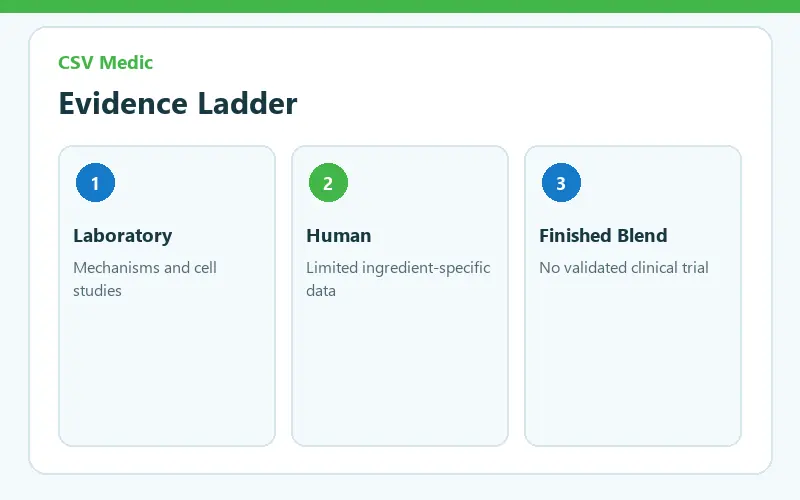
Common marketing claims include improved skin appearance, collagen support, hair growth, faster tissue recovery, reduced inflammation, and better healing. These ideas come from the proposed biology of individual ingredients. They have not been confirmed for the exact blend in robust human trials.
| Claim seen online | What supports the idea | What remains unknown |
|---|---|---|
| Skin or collagen support | GHK-Cu laboratory and topical research | Whether an injectable blend improves patient outcomes |
| Tendon or tissue repair | BPC-157 and thymosin-related preclinical studies | Effective human dose, clinical benefit, and long-term safety |
| Faster exercise recovery | Biological hypotheses and anecdotes | Controlled evidence against rehabilitation and standard care |
| Reduced inflammation | Laboratory pathways involving individual components | Whether the mixture produces a meaningful, safe clinical effect |
| Hair improvement | Cosmetic interest in copper peptides | Whether GLOW peptide injections improve hair growth |
The most accurate wording is that the ingredients have been investigated for processes related to these claims. It is not accurate to say the GLOW peptide has been proven to deliver them.
GLOW Peptide Side Effects and Safety Gaps
Because the exact blend lacks controlled clinical trials, a complete GLOW peptide side effects profile does not exist. Potential concerns include:
- injection-site pain, redness, swelling, bruising, or infection;
- allergic or immune reactions;
- contamination, endotoxins, or incorrect concentration;
- peptide aggregation and degradation;
- unknown interactions among the three ingredients;
- side effects that are not recognized because follow-up is absent;
- delayed care when an injury or skin condition needs a diagnosis.
Seek urgent medical care for trouble breathing, facial or throat swelling, fainting, severe widespread rash, chest pain, confusion, or signs of a serious infection. Persistent pain, fever, spreading redness, drainage, or worsening symptoms also require prompt assessment.
People who are pregnant or breastfeeding, children, patients with significant liver or kidney disease, people receiving cancer treatment, patients with immune disorders, and anyone taking medicines that may interact should not experiment with an unapproved blend. A clinician must assess individual circumstances.
Is There a Safe GLOW Peptide Dosage?
No validated GLOW peptide dosage has been established. There is no FDA-approved label, standardized clinical formulation, or controlled dose-ranging trial for the finished blend. A GLOW peptide dosage chart found online usually reflects a seller’s arithmetic or community practice, not an evidence-based treatment guideline.
The same applies to searches for GLOW peptide dose per day, GLOW peptide dosing chart, GLOW peptide injection instructions, or a GLOW blend peptide dosage. A syringe conversion can calculate volume from a known concentration. It cannot determine whether the substance is authentic, whether the mixture is stable, or whether the amount is safe for a particular person.
We do not provide a GLOW peptide protocol because doing so would turn uncertain research into individualized medical direction. Any legitimate medication plan should identify the exact ingredients, concentration, route, indication, prescriber, dispensing pharmacy, monitoring plan, and reasons to stop.
GLOW Peptide Before and After Photos: What Can They Prove?
GLOW peptide before and after images may feel persuasive, but they are weak evidence. Lighting, camera angle, hydration, skincare, makeup, weight change, training, rehabilitation, and time can all change appearance.
A photograph cannot confirm what was in a vial. It also cannot show sterility, laboratory values, adverse events, or whether another treatment caused the result. Even an authentic personal experience cannot predict what will happen to another patient.
Patient communities can help readers understand the questions people ask. For example, Reddit discussions describe mixed experiences with a GHK-Cu, BPC-157, and TB-500 blend. These posts are anecdotes, not controlled evidence, and should never replace medical evaluation.
GLOW vs KLOW Peptide
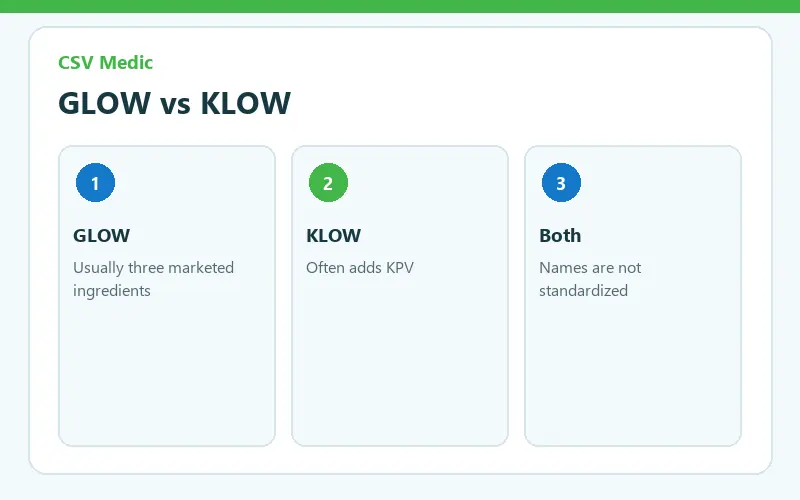
The usual difference in a GLOW vs KLOW peptide comparison is the addition of KPV.
| Feature | GLOW peptide | KLOW peptide |
|---|---|---|
| Commonly advertised components | GHK-Cu, BPC-157, TB-500 | GHK-Cu, BPC-157, TB-500, KPV |
| Standardized formula | No | No |
| Controlled human trial of exact blend | Not established | Not established |
| FDA-approved finished medicine | No | No |
| Main marketing theme | Skin, appearance, recovery | Similar themes plus inflammation-related claims |
Adding KPV does not automatically make the blend stronger, safer, or more effective. It introduces another active ingredient and another evidence gap. CSV Medic’s peptide collection can help readers identify the exact product name before discussing evidence or regulatory status with a clinician.
Myths vs Facts
| Myth | Fact |
|---|---|
| A natural peptide is automatically safe | Biological molecules can still produce potent effects, immune reactions, or interactions |
| Three researched ingredients create a researched blend | The exact mixture needs its own formulation, stability, dose, and clinical evidence |
| A blue vial proves GHK-Cu identity | Color cannot verify identity, purity, strength, or sterility |
| A pharmacy-made product is FDA approved | Compounded drugs are not FDA approved |
| Online GLOW peptide reviews prove effectiveness | Reviews can generate questions, but they cannot establish causation or safety |
How to Evaluate a Peptide Blend Claim
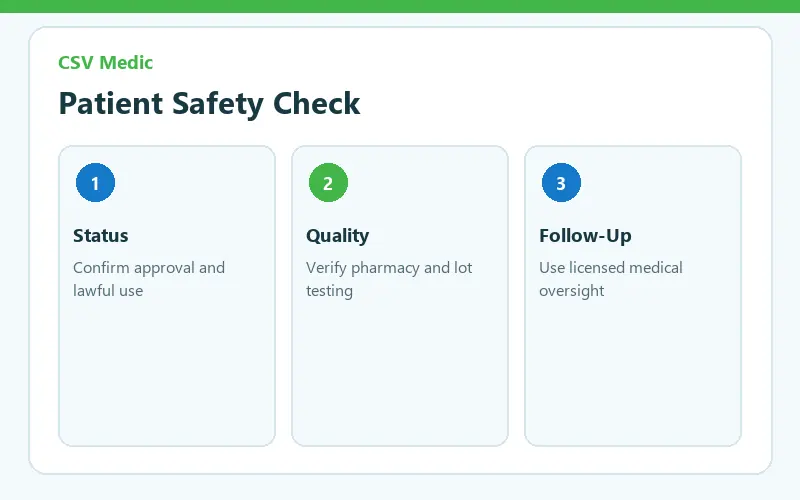
Before considering any peptide-related service, ask:
- Is the product FDA approved for the proposed use?
- What exact ingredients and concentrations are present?
- Is the route supported by human evidence?
- Is the prescription based on a documented patient-specific need?
- Which licensed pharmacy dispenses it?
- How are identity, potency, sterility, and endotoxins tested?
- What interactions and contraindications were reviewed?
- Who provides follow-up and adverse-event care?
- What evidence evaluates the exact combination rather than one ingredient?
- What approved or better-studied alternatives exist?
The FDA's compounding safety page explains why poor-quality compounded products can cause serious harm. The official July 2026 PCAC meeting page shows how advisory review differs from drug approval. CSV Medic’s medical disclaimer explains why patient education cannot replace individual medical advice.
Frequently Asked Questions About GLOW Peptide
What is GLOW peptide made of?
It commonly refers to GHK-Cu, BPC-157, and TB-500, but the name is not standardized. Confirm the actual formula rather than relying on the nickname.
Is GLOW peptide FDA approved?
No FDA-approved medicine is marketed under the name GLOW peptide. Individual ingredients and compounded products must be evaluated separately.
What does GLOW peptide do?
Marketing claims connect it with skin, hair, inflammation, healing, and recovery. Controlled human trials have not established that the exact blend produces these outcomes.
Does GLOW peptide help with weight loss?
GLOW is not an established obesity medication. It should not replace evidence-based obesity assessment, nutrition, activity, sleep care, or approved treatments when appropriate. CSV Medic’s weight-loss programs page explains a medically supervised approach.
Is a GLOW peptide dosage chart reliable?
An online chart may show mathematical conversions, but there is no validated clinical dosing standard for the blend. It cannot establish safe use.
Are topical copper peptides the same as injectable GLOW peptide?
No. Route, formulation, exposure, and evidence differ. Results from a topical cosmetic product cannot be assumed for an injection.
Is GLOW 70 peptide a standardized product?
No universal regulatory standard defines a product by that name. The number often refers to the total milligrams claimed for a particular blend, but labels and ratios vary.
What are the most important GLOW peptide side effects?
The full profile is unknown. Injection reactions, infection, allergy, immune reactions, impurities, incorrect concentration, and interactions are important concerns.
What is the difference between GLOW and KLOW peptide?
KLOW commonly adds KPV to the three ingredients associated with GLOW. Neither name represents a standardized FDA-approved combination.
Where can I verify a peptide product?
Start with the FDA, your state board of pharmacy, the dispensing pharmacy, and a licensed clinician. Do not rely only on a seller’s certificate or social-media post.
Final Perspective
The GLOW peptide is a useful example of why attractive blend names require careful scrutiny. Its ingredients have scientific stories, but those stories differ in strength, route, and relevance. The exact mixture has not been proven safe or effective in controlled human trials, and no validated GLOW peptide protocol exists.
Patients deserve a transparent discussion of regulatory status, formulation quality, evidence limits, alternatives, and follow-up. To ask CSV Medic about legally available products or pharmacy services, use the contact page. Contact does not guarantee that an unapproved peptide will be prescribed or supplied.
About the Author
This article was medically reviewed and published by the CSV Medic editorial team in collaboration with licensed healthcare providers specializing in weight management, metabolic health, and peptide education. CSV Medic develops medical content using current regulatory guidance and peer-reviewed sources, with clear separation between approved treatment, compounding, and investigational research.
Medical Disclaimer
This article is for educational purposes only and does not constitute medical advice, diagnosis, or a prescription. GLOW peptide is not an FDA-approved finished medicine, and evidence for the exact blend is limited. Always consult a licensed healthcare professional before starting, stopping, or changing any medication or injectable product. Seek urgent medical care for severe or rapidly worsening symptoms.
