
Weight Loss Education, Weight Loss Medication
Survodutide: 7 Promising Weight Loss and Safety Facts

Jul
Survodutide is an investigational medicine being studied for obesity and metabolic liver disease. It is a once-weekly dual glucagon and GLP-1 receptor agonist, also known by the research code BI 456906. As of July 2026, survodutide is not FDA approved and there is no approved retail product or patient dosing schedule.
Interest has grown because recent phase 3 results showed clinically meaningful average weight reduction. That does not make online research products equivalent to the medicine used in a controlled trial. This guide separates published survodutide trial evidence from claims patients may see in advertisements or social media.
What Is Survodutide?
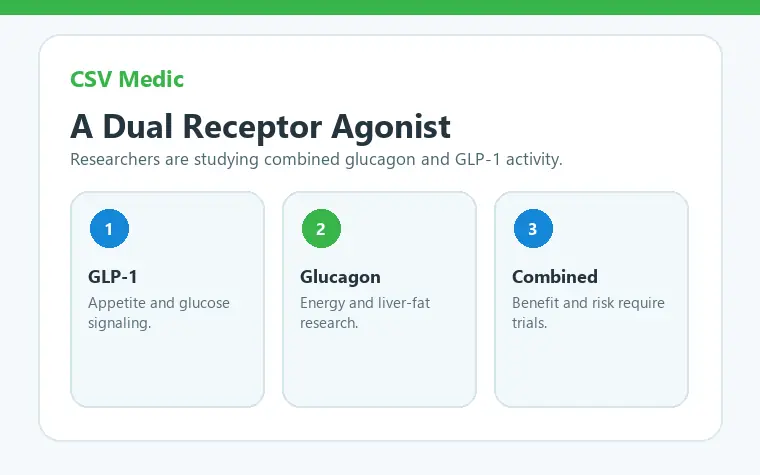
Survodutide is designed to activate two hormone receptors. GLP-1 signaling can affect appetite, food intake, and glucose regulation. Glucagon-receptor signaling is being studied for effects on energy use and liver fat. The balance between these actions is one reason researchers are studying survodutide weight loss and liver outcomes.
The FDA explains that an investigational drug is still being tested and has not completed the approval process. A clinical-trial identifier, scientific paper, or peptide label is not FDA approval. CSV Medic’s guide to whether peptides are legal provides additional context about approval, compounding, and research-only marketing.
7 Promising Facts From Survodutide Research
1. Phase 3 obesity results are now published
A 2026 phase 3 trial enrolled 725 adults with overweight or obesity without diabetes. At week 76, the treatment-regimen estimand showed average body-weight changes of approximately -12.2% with 3.6 mg, -13.0% with 6.0 mg, and -5.4% with placebo. The result supports continued regulatory evaluation; it is not an individual promise.
2. Many participants achieved at least 5% weight reduction
In the same survodutide phase 3 study, about 72.6% of participants in the 3.6 mg group and 71.9% in the 6.0 mg group achieved at least 5% weight reduction, compared with 46.3% with placebo under the treatment-regimen estimand. Trial populations, adherence, discontinuation, and analysis methods matter when interpreting percentages.
3. Gastrointestinal symptoms were common
Survodutide side effects in the phase 3 publication were predominantly gastrointestinal. Gastrointestinal symptoms were reported in 80.9% of the 3.6 mg group, 89.7% of the 6.0 mg group, and 47.9% of the placebo group. A headline about weight change should never omit the tolerability findings.

4. Liver outcomes are a major research area
A separate phase 3 study evaluated adults with metabolic dysfunction-associated steatotic liver disease, or MASLD, and fibrosis. At week 48, average body-weight change and liver-fat outcomes favored survodutide over placebo. Earlier phase 2 work also studied metabolic dysfunction-associated steatohepatitis, often called MASH.
5. There is no approved survodutide dosage
Searches for survodutide dosage or a survodutide peptide schedule can be misleading. Research protocols used defined titration and monitoring under investigator control. Because the medicine is investigational, there is no FDA-approved patient dose, pharmacy label, or self-treatment instruction.
6. Research material sold online is not the clinical-trial product
A vial marked survodutide peptide, BI 456906, or ‘research use only’ should not be treated as an approved medicine. Identity, concentration, sterility, storage, and manufacturing quality may be unknown. FDA guidance warns that unapproved drugs have not been reviewed for safety, effectiveness, or quality.
7. Approval still requires regulatory review
Positive the investigational medicine results do not establish a launch date. Sponsors must complete studies, analyze the full benefit-risk profile, submit an application, and satisfy regulators. Until an approval appears in an official FDA database and prescribing information is issued, the investigational medicine remains investigational.
Survodutide vs Retatrutide and Tirzepatide
| Medicine | Receptor targets | Status in July 2026 | Key distinction |
|---|---|---|---|
| the investigational medicine | Glucagon + GLP-1 | Investigational | Obesity and liver-disease research |
| Retatrutide | GIP + GLP-1 + glucagon | Investigational | Triple-agonist research program |
| Tirzepatide | GIP + GLP-1 | FDA-approved products | Approved labels and pharmacy products exist |
Survodutide vs retatrutide is not a direct consumer choice because both remain investigational. Tirzepatide is different because FDA-approved brands and prescribing information exist. Our retatrutide side-effects guide and peptide therapy safety guide explain how approval status changes the questions patients should ask.

How Patients Can Evaluate the investigational medicine Claims
- Look for a PubMed record or registered ClinicalTrials.gov study, not a seller’s summary.
- Check whether a result comes from phase 2, phase 3, an animal study, or laboratory research.
- Read the study population, duration, analysis method, adverse events, and discontinuations.
- Do not convert research doses into self-injection instructions.
- Avoid sources that promise guaranteed weight loss or claim FDA approval without an official record.
- Discuss approved treatment options with a licensed clinician instead of using an unapproved substitute.
Patients seeking current approved care can review CSV Medic’s weight-loss program overview, what are peptides guide, and medical disclaimer.
What Participation in an Investigational Trial Means
A registered study is not ordinary prescribing. Researchers use an approved protocol, informed consent, eligibility criteria, scheduled visits, safety reporting, and defined rules for changing or stopping treatment. Participants may be assigned to different groups and may not receive the investigational medicine.
Before joining, a potential participant should ask about travel, visit frequency, tests, contraception or pregnancy requirements, possible costs, compensation, privacy, injury information, and whom to contact for urgent symptoms. The consent document should explain known and uncertain risks in understandable language.
Clinical-trial participation is voluntary. A person can ask questions before signing and can leave, although the research team may recommend follow-up for safety. Joining a study should not be confused with buying a research-only vial, which lacks the same protocol, oversight, identity controls, and adverse-event monitoring.
Questions about survodutide FDA approval should be checked against official FDA databases. Until an approval and prescribing label exist, patients should view dosing charts, reconstitution videos, and online purchase offers as unsafe substitutes for regulated clinical development.
Patients who do not qualify for a study can still ask a licensed clinician about approved obesity treatments, nutrition support, sleep, activity, and medical conditions that affect weight. Choosing regulated care provides a known label, pharmacy standards, and a follow-up plan while research continues.
Research updates should also be dated. Conference summaries can appear before peer-reviewed papers, and early results may change when the complete dataset is analyzed. Patients should look for the publication date, trial identifier, sponsor, participant count, and final study status before treating a new claim as established evidence.
Frequently Asked Questions About the investigational medicine
Is the investigational medicine FDA approved?
No. As of July 2026, it remains an investigational medicine in clinical development.
What is BI 456906?
BI 456906 is the research code used for the investigational medicine in trial records and scientific publications.
How much weight did people lose in survodutide trials?
In one 2026 phase 3 obesity trial, average week-76 weight changes were about -12.2% and -13.0% in two treatment groups versus -5.4% with placebo under the treatment-regimen estimand. Individual results vary.
What are the common survodutide side effects?
Gastrointestinal symptoms were common in published trials. A complete safety profile requires the full study and future regulatory review, not a list copied from social media.
Can a doctor prescribe the investigational medicine?
There is no routine FDA-approved product to prescribe. Access to an investigational medicine generally occurs through a registered study or another lawful investigational pathway with strict oversight.
Where can patients find legitimate survodutide trials?
Use ClinicalTrials.gov and verify the study sponsor, locations, eligibility, recruitment status, and contact details. Participation is never guaranteed.
The Bottom Line
the investigational medicine has promising phase 3 obesity and liver-disease evidence, but it is still investigational. The published numbers should be considered with side effects, discontinuations, study design, and the absence of an approved dosage or retail product. Patients should avoid research-only products and discuss approved options with a licensed healthcare provider.
Sources and Further Reading
The medical and regulatory information in this guide was checked against the following prescribing information, government guidance, clinical-trial records, and peer-reviewed studies.
- Phase 3 the investigational medicine obesity trial
- Phase 3 the investigational medicine MASLD and fibrosis trial
- Phase 2 the investigational medicine MASH trial
- the investigational medicine in cirrhosis research
- ClinicalTrials.gov the investigational medicine obesity study NCT06066515
- ClinicalTrials.gov search for the investigational medicine
- FDA explanation of investigational drugs
- FDA drug-development and approval process
- FDA information about unapproved drugs
About the Author and Medical Review
This article was medically reviewed and published by Dr Spencer and the CSV Medic editorial team in collaboration with licensed healthcare providers specializing in medical weight management. CSV Medic content is checked against current prescribing information, regulatory guidance, and peer-reviewed clinical research.
Medical Disclaimer
This article is for informational purposes only and does not constitute medical advice, diagnosis, or a prescription. Medication choice, dose, eligibility, insurance coverage, and monitoring must be determined by a licensed healthcare provider. Do not start, stop, switch, combine, or change the dose of any prescription medication without medical guidance. Seek urgent care for severe or rapidly worsening symptoms.
