
Weight Loss Education, Weight Loss Medication
Retatrutide Dosage Chart: The Essential Dosing Guide You Need

Jun
Retatrutide Dosage Chart: Complete Dosing Guide
If you are researching a retatrutide dosage chart, the first thing to know is that retatrutide is still an investigational medication. It has been studied in clinical trials for obesity and metabolic health, but it has not received full FDA approval as of mid-2026. That means there is no official retail package insert, no standard pharmacy label for the public, and no one-size-fits-all dose that should be copied from the internet. The safest way to understand dosing is to separate clinical trial dose levels from vial-strength measurement math.
Published trial records and medical literature show why this topic needs careful wording. A ClinicalTrials.gov record for retatrutide describes a dose-ranging obesity study, while PubMed-indexed retatrutide research gives broader clinical context. You can also search the FDA Drugs@FDA database to confirm whether a drug has an approved label. These are the types of sources patients should rely on before comparing any peptide chart online.
This guide explains how clinicians think about retatrutide dosing, why titration matters, what trial dose levels looked like, and how concentration affects units and milliliters on a syringe. It is not a personal dosing plan. Instead, it is an educational map that helps you ask better questions before treatment, especially if you are comparing retatrutide with approved alternatives or trying to understand measurement language on a prescription label.
Retatrutide Starting Dose and Titration Schedule
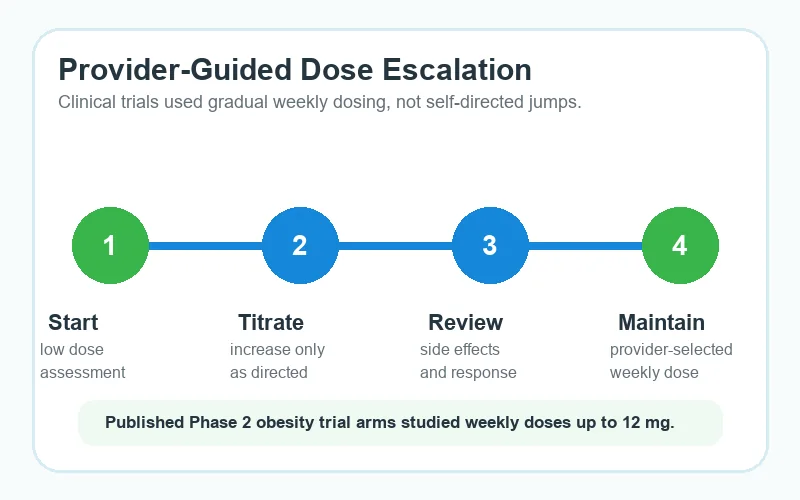
A retatrutide starting dose is the first dose level used at the beginning of treatment or in a clinical study. With incretin-based therapies, providers usually start low because nausea, appetite changes, constipation, reflux, and other gastrointestinal symptoms can be more noticeable when the body is introduced to a new medication too quickly. A gradual retatrutide dosing schedule gives the provider time to evaluate tolerance before deciding whether the dose should stay the same, increase, or stop.
In dose-ranging studies, retatrutide was administered once weekly and tested at multiple dose levels. The important idea is not that every person should move toward the highest number. The important idea is that titration was structured, monitored, and tied to a research protocol. In real care, a provider looks at medical history, current medications, weight-loss goals, side effects, lab history, and risk factors before deciding whether any incretin-based treatment is appropriate.
The phrase retatrutide titration schedule means the step-by-step movement from a starting dose to a later maintenance dose. A maintenance dose is not always the maximum dose. It is the dose a clinician believes offers a reasonable balance between benefit, safety, and tolerability. For many patients, the best dose is the one they can continue safely, not the most aggressive dose on a chart.
This is also why a careful dosing conversation should include more than body weight alone. A provider may ask about gallbladder history, pancreatitis history, kidney function, gastrointestinal disease, diabetes medications, pregnancy plans, alcohol use, and previous reactions to incretin-based medications. Those details can influence whether a person is a candidate for treatment, how slowly the plan should move, and what symptoms should be monitored early.
If someone is already using another weight management medication, the starting point becomes even more individualized. Switching from one therapy to another, combining products, or restarting after a long break can change tolerability. A responsible plan should document the current medication list, the last dose date, the reason for switching, and the follow-up schedule. That level of detail is exactly what a simple online chart cannot provide.
Retatrutide Dosage Per Week: What Clinical Trials Used
The most useful clinical number to understand is the weekly retatrutide dose studied in trials, not the total milligrams printed on a vial. In the Phase 2 obesity study, participants received once-weekly injections across several assigned dose arms, including lower and higher weekly targets. Published obesity data commonly discuss weekly dose levels up to 12 mg. Other dose-ranging research also explored low starting levels and escalation to study safety, tolerability, and metabolic response.
A clinical trial retatrutide dosage chart is different from a product listing or vial-strength table. Trial charts describe the amount of active drug a participant received each week under strict supervision. Vial charts describe how much powder may be in a vial before liquid is added. Mixing those two ideas is where many online dosage posts become confusing. A 30 mg vial is not the same thing as a 30 mg weekly dose.
For SEO and patient education, this distinction matters because people search terms like retatrutide dosage, retatrutide dosing, and retatrutide dosage for weight loss expecting a simple answer. The responsible answer is that clinical dosing belongs to a licensed professional, especially while retatrutide remains investigational. Patients should use online guides to understand terminology, not to replace a prescription plan.
Some readers call this a retatrutide dosage schedule, while others search for a retatrutide peptide dosage chart. In both cases, the safer interpretation is the same: the chart explains measurement language and trial context, not a personal injection plan. A retatrutide peptide dosage should come from a licensed provider who can confirm whether the treatment is appropriate and how it should be monitored.
Retatrutide Dosage Chart by Dose Level
The table below is a measurement example for common vial-strength searches such as retatrutide 10mg, retatrutide 20mg, and retatrutide 30mg. It is not an instruction to use these strengths, and it is not a prescribed weekly dose. The purpose is to show how concentration changes after liquid is added. Always follow the instructions on the pharmacy label or the plan provided by a licensed clinician.
For the specific retatrutide 10mg dosage chart question, remember that the vial-strength number only tells you how much powder is in the vial before mixing. The measured amount on a syringe changes when the same vial is mixed with different volumes of sterile diluent, which is why concentration must always be checked before interpreting units or milliliters.
| Vial strength search | Example mixing volume | Resulting concentration | 1 mg equals on U-100 syringe |
|---|---|---|---|
| 10 mg vial | 1 mL | 10 mg/mL | 0.10 mL or 10 units |
| 10 mg vial | 2 mL | 5 mg/mL | 0.20 mL or 20 units |
| 20 mg vial | 2 mL | 10 mg/mL | 0.10 mL or 10 units |
| 30 mg vial | 3 mL | 10 mg/mL | 0.10 mL or 10 units |
| 40 mg vial | 4 mL example only | 10 mg/mL | 0.10 mL or 10 units |
| 60 mg vial | 3 mL example only | 20 mg/mL | 0.05 mL or 5 units |
| 100 mg vial | 5 mL example only | 20 mg/mL | 0.05 mL or 5 units |
| 120 mg vial | 6 mL example only | 20 mg/mL | 0.05 mL or 5 units |
This retatrutide dosage chart also shows why a vial-strength number can be misleading. Higher vial strengths may be discussed online, but they do not automatically mean a higher weekly dose is appropriate. The concentration depends on how much sterile diluent is used, and the correct volume depends on the prescribed dose. Some vials may not physically hold the example volume shown in a simple chart, so the label and provider instructions matter more than any generic internet table.
How to Read Your Retatrutide Dosage Chart in Units and ML
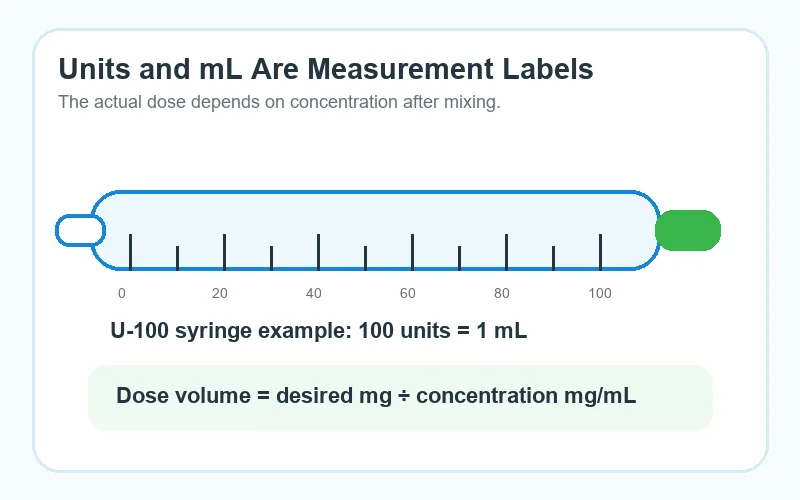
Many people search for retatrutide dosage in ml because syringes are marked by volume, not by milligrams. Milligrams measure the amount of medication. Milliliters measure the amount of liquid. Units on a U-100 insulin-style syringe are another way to mark liquid volume. On a U-100 syringe, 100 units equals 1 mL, 50 units equals 0.5 mL, and 10 units equals 0.1 mL.
The key formula is simple: dose volume equals desired milligrams divided by concentration in milligrams per milliliter. If a vial is mixed to 10 mg/mL, then 1 mg equals 0.1 mL, which equals 10 units on a U-100 syringe. If the same vial is mixed to 5 mg/mL, then 1 mg equals 0.2 mL, which equals 20 units. This is why retatrutide dosing in units cannot be understood without knowing the exact concentration.
A retatrutide dosage chart should always show the mixing volume and the resulting concentration. A chart that only says “take 20 units” is incomplete because 20 units could represent different milligram amounts depending on how the vial was reconstituted. If the label is unclear, pause and ask the prescribing professional or pharmacy before measuring anything.
How to Reconstitute Retatrutide: Bacteriostatic Water Guide
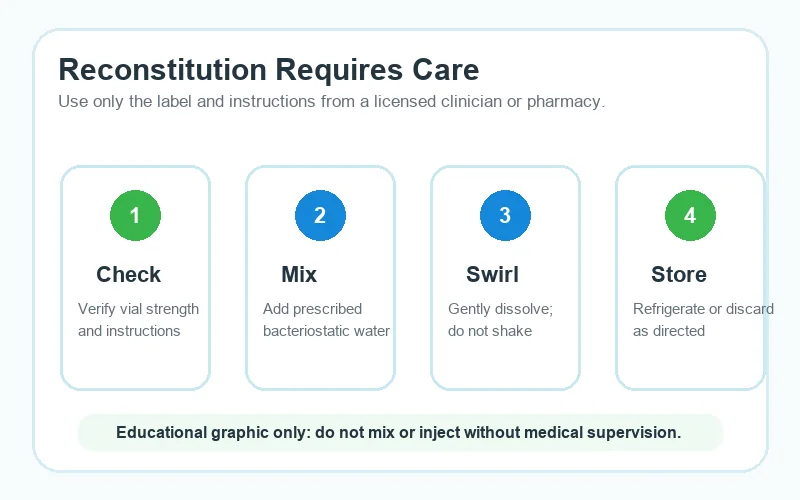
Reconstitution means adding a sterile liquid to a vial of powder so the medication can be measured as a liquid. This section is educational only. It is not a replacement for sterile training, pharmacy instructions, or a prescription label. If a product requires mixing, the label should tell you the vial strength, the diluent, the volume to add, storage instructions, expiration guidance, and the correct measured amount.
People often ask how much bac water for 10mg retatrutide. The answer depends on the concentration your clinician or pharmacy wants. As a math example, adding 1 mL to a 10 mg vial creates 10 mg/mL, while adding 2 mL creates 5 mg/mL. CSV Medic lists bacteriostatic water for injection as a supply item, but the decision to use any diluent and volume should come from a licensed professional.
For a retatrutide 30mg vial, an example concentration would be 30 mg in 3 mL, which equals 10 mg/mL. At that concentration, 1 mg would measure 0.1 mL or 10 units on a U-100 syringe. Again, that is concentration math, not a treatment plan. The bigger message is that “mg in the vial” and “mg in the weekly dose” are two separate numbers.
General reconstitution safety principles include checking the label, using the correct sterile diluent, adding liquid slowly against the side of the vial, swirling gently rather than shaking, inspecting the solution, and following storage instructions exactly. If the vial is cloudy, discolored, contaminated, expired, or unlabeled, do not use it.
Retatrutide Dosage Calculator: How to Measure Your Dose
A retatrutide dosage calculator can be helpful only if the inputs are correct. The calculator needs the vial strength in milligrams, the amount of diluent added in milliliters, and the dose your clinician prescribed in milligrams. Without all three numbers, a calculator can give a confident-looking but unsafe answer.
A retatrutide dosage calculator for weight loss should be treated as a math helper, not as medical decision-making software. It can translate milligrams into milliliters or syringe units after a provider has chosen the dose, but it cannot decide the right treatment, starting point, or maintenance plan for a patient.
Here is the calculation logic in plain language. First, divide vial strength by total liquid volume to get concentration. Second, divide the desired milligram dose by that concentration to get milliliters. Third, if using a U-100 syringe, multiply milliliters by 100 to estimate units. This retatrutide dosage chart uses that same math throughout the article, but the math must match the actual label in your hand.
- Vial strength: total milligrams in the vial before mixing.
- Diluent volume: total milliliters of bacteriostatic water or other approved diluent added.
- Concentration: milligrams per milliliter after reconstitution.
- Measured volume: the milliliters or units needed for the prescribed milligram dose.
If any part of the label does not match your calculation, do not guess. Medication errors often happen when people copy a chart without checking concentration. This is especially important with investigational peptides, compounded products, and products that may be sold in multiple vial sizes.
A good measurement workflow should be slow and boring. Read the label twice, confirm the vial strength, confirm the total liquid volume, calculate the concentration, then compare your result with the written instructions. If the instruction says milligrams but the syringe shows units, convert only after you know the concentration. If the instruction already gives units, make sure those units match the exact mixture you have, not a different vial size or a chart from another website.
It is also smart to keep a simple log for provider review. A log might include the date, the prescribed milligram amount, the measured volume, side effects, appetite changes, hydration, bowel changes, and any missed doses. That record helps the clinician decide whether the plan is tolerable, whether symptoms are improving, and whether the next step should be holding steady instead of escalating.
Retatrutide Microdosing: Is It Safe and Effective?
Retatrutide microdosing is a popular search term, but it is not the same thing as an evidence-based clinical protocol. Some people use the word microdosing to mean a very low starting amount, while others use it to mean a customized dose below a typical escalation schedule. Those meanings are not interchangeable.
In medical weight management, the safer concept is individualized titration. A provider may decide that a slower increase is appropriate for someone with sensitivity to gastrointestinal side effects, medication interactions, or other risk factors. That does not mean every patient should invent a smaller dose at home. It means dosing should be matched to a supervised plan.
There is also a practical issue: very tiny volumes can be hard to measure accurately. A small measuring error can become meaningful when a solution is highly concentrated. For that reason, retatrutide microdosing should never be treated as a casual workaround for side effects or cost. It should be discussed with a qualified clinician who understands the medication, the patient, and the concentration.
Retatrutide vs Tirzepatide Dosage Chart Comparison
Retatrutide and tirzepatide are often compared because both are incretin-based therapies studied for weight management. The dosing conversation is different, though. Tirzepatide has FDA-approved products with official labeling for specific indications. Retatrutide is still investigational, so a retatrutide dosage chart is based on trial information and measurement education rather than an approved consumer label.
When patients compare options, it may help to review medically supervised alternatives such as liraglutide peptide or other physician-guided approaches. Some patients also research combination concepts such as cagrilintide peptide, but combination therapy is not something to self-design. These comparisons should focus on safety, eligibility, monitoring, and evidence, not just the highest expected weight-loss number.
A simple comparison looks like this: tirzepatide dosing is guided by approved labeling for its indicated use, while retatrutide dosing is guided by clinical trial protocols and ongoing research. Both require attention to side effects, contraindications, and patient-specific factors. A chart can organize information, but it cannot replace clinical judgment.
Retatrutide Dosing for Weight Loss: What You Need to Know
Retatrutide dosing for weight loss is being studied because the medication targets multiple hormone pathways involved in appetite, energy balance, and metabolic signaling. Early research has created strong interest, but interest is not the same as approval. Until full regulatory review is complete, patients should be careful with anyone promising a universal retatrutide dose or a guaranteed result.
If you are comparing weight loss peptide options, CSV Medic has a broader weight loss peptides category that can help you understand the types of products people commonly research. For supplies and related items, you can also review the CSV Medic shop. Product pages should be used as education and shopping context, while medical decisions should stay with a licensed provider.
Because retatrutide is investigational, a responsible consultation should discuss approved options, clinical trial availability, medical history, and risk factors. If you want a provider-led conversation about weight management rather than guessing from a chart, you can start with the CSV Medic consultation page.
The best use of this retatrutide dosage chart is to understand language: starting dose, weekly dose, titration, maintenance dose, milligrams, milliliters, units, vial strength, and concentration. Once those terms are clear, it becomes easier to spot incomplete advice and ask better questions before treatment.
Patients should also know what questions to bring into a consultation. Useful questions include: What evidence supports this treatment for my situation? Is retatrutide appropriate while it is still investigational? Would an approved medication be safer or more predictable? What side effects should I report immediately? How often should labs or follow-up visits happen? What should I do if I miss a dose, vomit, cannot eat enough, or develop severe abdominal pain?
The answer to those questions may be different for a patient with diabetes, a patient taking blood pressure medication, a patient with prior bariatric surgery, or a patient who has never used an injectable weight-loss therapy before. This is why medically supervised weight management should feel like a review of your whole health picture, not just a quick selection from a dose menu.
From a practical SEO standpoint, this page is designed to answer informational, commercial, and safety-focused search intent without turning the article into a sales pitch. Someone researching retatrutide dosage for weight loss may still be early in the education stage. The content should help that person understand trial dosing, concentration math, and provider questions before making a treatment decision.
Frequently Asked Questions About Retatrutide Dosage
Is there an official retatrutide dosage chart? Not for routine public prescribing. Retatrutide has been studied in clinical trials, but it has not received full FDA approval as of mid-2026. Any chart online should be treated as educational, not as an official label.
What are the clinical trial dose levels? Published obesity research studied once-weekly retatrutide across multiple assigned dose arms, including higher weekly targets up to 12 mg. Trial dosing happened under research supervision with eligibility criteria, monitoring, and side-effect tracking.
What is the retatrutide starting dose? A starting dose is the initial dose level selected by a study protocol or clinician. It is usually lower than later dose levels because the body may need time to adjust. The correct starting point depends on the protocol, the patient, and the provider’s judgment.
How much bacteriostatic water should be used? The answer depends on vial strength and desired concentration. For example, 10 mg mixed with 1 mL creates 10 mg/mL, while 10 mg mixed with 2 mL creates 5 mg/mL. Only use the volume instructed by a licensed clinician or pharmacy.
Is retatrutide dosage in ml the same as milligrams? No. Milligrams measure drug amount. Milliliters measure liquid volume. Units on a U-100 syringe also measure volume. You need concentration before converting between them.
Can a calculator replace a provider? No. A retatrutide dosage calculator can help explain math, but it cannot decide whether the medication is appropriate, safe, or correctly sourced. It also cannot evaluate side effects, contraindications, or whether approved alternatives would be better.
About the Author
This article was medically reviewed and published by the CSVMedic editorial team in collaboration with licensed healthcare providers specializing in weight management and peptide therapy. CSVMedic's content is developed under the guidance of board-certified medical professionals to ensure accuracy and alignment with the latest clinical research. All medical claims in this article are supported by published clinical trial data and peer-reviewed sources linked throughout the text.
Medical Disclaimer
This article is for informational purposes only and does not constitute medical advice. Always consult with a licensed healthcare provider before starting, stopping, or changing any medication. Individual results may vary. Retatrutide is still in clinical trials and has not received full FDA approval. If you are considering retatrutide treatment, CSVMedic offers medically supervised weight loss programs. Visit CSVMedic.com to schedule a free consultation with our licensed medical team.
CSV Medic Medical Review
This article was published by Dr Spencer and the CSV Medic editorial team in collaboration with healthcare-focused reviewers experienced in medical weight loss education, prescription medication safety, and patient support. Our content is written for education, reviewed for clarity, and updated when clinical guidance or product information changes.
CSV Medic content is informational only and does not replace care from a licensed medical provider. Always speak with a qualified clinician before starting, stopping, or changing any medication or weight loss program.
