
Weight Loss Education, Weight Loss Medication
KPV Peptide: 9 Essential Benefits and Safety Facts

Jul
KPV peptide has moved from laboratory papers into online wellness conversations, where it is often promoted for inflammation, gut health, skin support, and recovery. The attention is understandable, but the evidence is easy to overstate. KPV is a three-amino-acid fragment associated with alpha-melanocyte-stimulating hormone, and most published research is preclinical rather than proof that it treats disease in people.
For patients, the most important fact is simple: KPV peptide is not an FDA-approved medication, and the FDA says it has not identified human exposure data for drug products containing KPV. That does not mean every laboratory finding is meaningless. It means the possible KPV peptide benefits, dose, interactions, and long-term safety have not been established through the type of human trials used for an approved treatment.
What Is KPV Peptide?
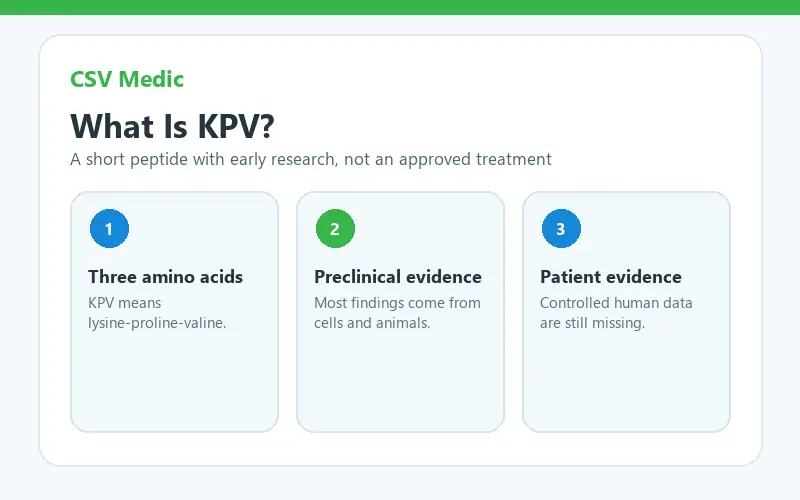
KPV stands for lysine-proline-valine. It is a short tripeptide derived from the carboxyl end of alpha-MSH, a naturally occurring signaling peptide. When patients ask what is KPV peptide, they are usually asking whether this small fragment can reproduce anti-inflammatory effects discussed in experimental research without the pigment-related activity associated with the larger molecule. That possibility remains a research question, not a confirmed clinical benefit.
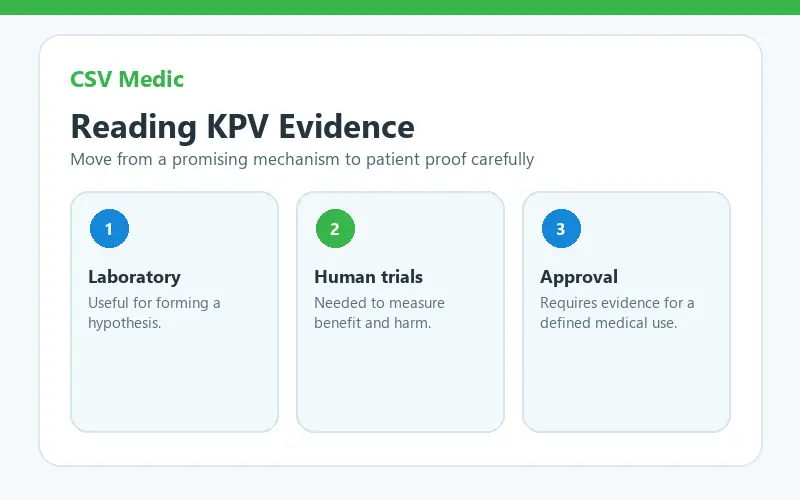
A useful way to understand KPV peptide is to separate mechanism from outcome. Cell and animal studies can show that a compound changes inflammatory signaling or improves a laboratory model. They cannot tell us with confidence whether a patient will feel better, what strength is appropriate, or whether repeated exposure is safe. Our broader guide to what peptides are explains why a peptide’s biological activity does not automatically make it a proven therapy.
What Does KPV Peptide Do in Research?
When people ask what does KPV peptide do, the most responsible answer is that researchers have studied its possible effects on inflammatory pathways. A PubMed-indexed study found that KPV uptake through the PepT1 transporter reduced inflammatory responses in cell experiments and mouse models of intestinal inflammation. Another animal study examined a colon-targeted delivery system in a mouse colitis model. These studies help scientists form hypotheses, but neither establishes a treatment for human inflammatory bowel disease.
The proposed KPV peptide mechanism is often described in marketing as if it were a guaranteed result. In reality, laboratory models simplify a complex disease. Absorption, metabolism, formulation, immune response, other medicines, and the cause of a patient’s symptoms can all change the outcome. A claim such as ‘supports inflammation’ should never replace a diagnosis when abdominal pain, bleeding, fever, a spreading rash, or persistent diarrhea is present.
Nine Essential KPV Peptide Benefits and Safety Facts
1. Anti-inflammatory findings are mainly preclinical
The most discussed KPV peptide benefits come from cell and animal models. Researchers have reported changes in inflammatory signaling and experimental colitis, which makes KPV scientifically interesting. However, there are no large, well-controlled human trials showing that KPV peptide improves Crohn’s disease, ulcerative colitis, eczema, psoriasis, or another inflammatory condition. Patients should treat benefit lists as hypotheses until human research catches up.
2. Gut-health claims are not a diagnosis
KPV peptide for gut health is frequently discussed alongside bloating, irritable bowel symptoms, and inflammatory bowel disease. Those conditions are not interchangeable. Similar symptoms can come from infection, medication effects, celiac disease, gallbladder problems, food intolerance, or a condition that needs urgent assessment. A licensed clinician can decide whether stool testing, blood work, imaging, or gastroenterology review is more appropriate than an experimental product.
3. Skin claims need human trials
KPV peptide for skin is promoted in topical and injectable forms, but formulation changes exposure. A topical cosmetic, a compounded cream, and an injection cannot be assumed to have the same effect or risk. Irritated skin may also reflect infection, allergy, medication reactions, or autoimmune disease. Patients should not delay dermatology care while experimenting with an unapproved product.
4. FDA status matters
KPV peptide is not FDA approved. The FDA has specifically listed KPV among bulk substances that may present significant safety risks for compounding and noted that it lacks human exposure data. This is a stronger warning than simply saying research is limited. The agency cannot verify the safety, effectiveness, quality, or labeling of an unapproved KPV product sold online. Read our guide on whether peptides are legal for the difference between a peptide discussed in research and a lawfully marketed medicine.
5. There is no validated KPV peptide dosage
Searches for KPV peptide dosage are common, but no FDA-approved label or widely accepted clinical guideline establishes a dose for inflammatory, skin, or gut conditions. Online charts often convert animal research, supplier directions, or anecdotal protocols into human instructions. Those conversions can be misleading because route, concentration, purity, body size, and formulation all matter. CSV Medic does not recommend self-dosing an investigational compound.
6. Side effects are not well characterized
A short list of KPV peptide side effects cannot be considered complete because robust human exposure data are missing. Possible concerns include allergic reactions, injection-site problems, contamination, incorrect strength, interactions, and effects that have not yet been recognized. Lack of reported events is not the same as proof of safety when few controlled human studies exist.
7. Product quality changes risk
An online vial labeled KPV peptide may not contain the stated amount, may include impurities, or may not have been manufactured under standards expected for an approved drug. A certificate displayed by a seller is not the same as FDA approval or patient-specific pharmacy dispensing. Research-use-only language is also a warning that the product was not supplied for self-injection.
8. Approved care may address the real problem
A patient’s goal may be less inflammation, better digestion, healthier skin, or improved weight. Each goal has established diagnostic pathways and, in many cases, approved treatments. For weight concerns, a structured medical weight loss program can review health history, medications, nutrition, sleep, and evidence-based options rather than assuming one experimental peptide fits everyone.
9. Monitoring matters more than hype
Responsible peptide therapy starts with the condition being treated, the quality of evidence, known contraindications, and a plan for follow-up. If a clinic cannot explain KPV peptide approval status, evidence limits, product source, expected monitoring, and what would make treatment stop, that is a reason to pause. The same standard applies to every wellness injection.
KPV Peptide vs Approved Peptide Medicines
| Question | KPV | FDA-approved peptide medicine |
|---|---|---|
| Human evidence | Limited; mainly preclinical | Reviewed clinical-trial evidence for a specific indication |
| Standard dose | No FDA-approved KPV dosage | Dose and titration described in prescribing information |
| Manufacturing | Varies by source | Regulated manufacturing and labeling |
| Monitoring | No universal standard | Condition-specific warnings and follow-up |
This comparison does not mean all approved peptide medicines are safe for every person. Approved medicines still have contraindications and side effects. It means their benefits, risks, strength, and instructions have been evaluated for a defined use. Patients considering peptide injections can review our peptide therapy safety guide before discussing options with a clinician.
How to Evaluate a KPV Clinic or Product
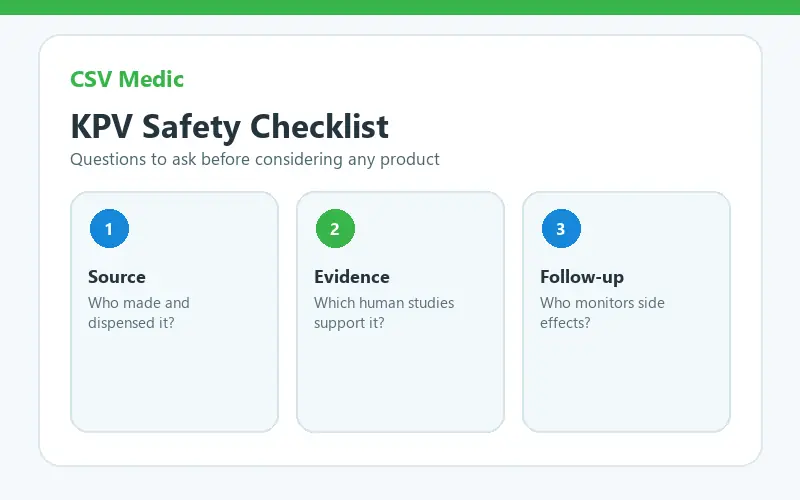
- Ask whether the product is FDA approved for the condition being discussed.
- Ask what human clinical trials support the promised benefit.
- Confirm who prescribes, dispenses, and monitors the product.
- Do not accept research-use-only material as a patient medication.
- Ask what side effects require stopping and when emergency care is needed.
- Avoid clinics that promise a cure, guaranteed weight loss, or universal dosing.
A medical consultation should be a genuine assessment, not a formality before checkout. Your provider should review diagnoses, allergies, pregnancy status, current prescriptions, supplements, and the reason you are seeking KPV. A safer decision may be to investigate the symptom first or use an approved alternative.
Frequently Asked Questions About KPV
Is KPV FDA approved?
No. KPV is not an FDA-approved medication. The FDA has stated that it has not identified human exposure data for drug products containing KPV and lacks important safety information.
What are the main KPV benefits?
Possible anti-inflammatory, intestinal, and skin-related effects have been discussed based largely on preclinical studies. These findings have not established that KPV safely treats a disease in people.
What is the correct KPV dosage?
There is no FDA-approved KPV dosage for gut, skin, inflammation, or weight-related use. Patients should not convert animal-study amounts or supplier charts into a self-injection plan.
What are KPV side effects?
A reliable complete side-effect profile is not available. Potential concerns include allergic reactions, contamination, dosing errors, injection complications, interactions, and presently unknown effects.
Can KPV help with weight loss?
KPV is not an approved weight-loss medication, and strong human evidence for weight reduction is lacking. Patients can learn about evidence-based options in CSV Medic’s weight loss education library.
Can KPV be compounded?
Compounding rules are specific and evolving. A compounded product is not FDA approved, and FDA has raised safety concerns about KPV. Patients should ask a licensed prescriber and pharmacist about the exact legal and clinical basis for any proposed product.
Should I buy KPV online?
Patients should not self-inject products sold as research chemicals or rely on seller claims as medical evidence. Discuss the symptom and safer alternatives with a licensed clinician.
The Bottom Line
KPV is scientifically interesting, but interest is not the same as established patient care. The strongest available message is caution: possible KPV benefits come mainly from preclinical research, an approved dosage does not exist, and the FDA has highlighted missing human exposure and safety information. A licensed provider can help investigate the problem you want to solve and compare regulated options without turning uncertainty into a promise.
Medical Sources and Further Reading
The following independent medical and regulatory sources support the clinical and safety information in this article:
- FDA: Bulk substances that may present significant safety risks
- PubMed: PepT1-mediated KPV uptake and intestinal inflammation
- PubMed: Colon-targeted KPV delivery in a mouse colitis model
- FDA: Human drug compounding information
About the Author and Medical Review
This article was medically reviewed and published by the CSV Medic editorial team in collaboration with licensed healthcare providers specializing in weight management. CSV Medic content is developed under the guidance of medical professionals and checked against current regulatory information, prescribing information, and peer-reviewed research.
Medical Disclaimer
This article is for informational purposes only and does not constitute medical advice, diagnosis, or a prescription. Always consult a licensed healthcare provider before starting, stopping, or changing a medication or peptide product. Approval status, availability, insurance coverage, and individual suitability can change. Seek urgent medical care for severe or rapidly worsening symptoms.
